Economics

Bernanke on the Federal Reserve’s exit strategy

Federal Reserve Chairman Ben S. Bernanke has given testimony before the Committee on Financial Services of the U.S. House of Representatives.

If you thought things were moving our way, look at the remarks at the end of note nine.

The Federal Reserve believes it is possible that, ultimately, its operating framework will allow the elimination of minimum reserve requirements, which impose costs and distortions on the banking system.

Economics

Laurence Kotlikoff’s “Jimmy Stewart is Dead”

Jimmy Stewart plays George Bailey who is cast as the “honest” and trustworthy banker in the classic Hollywood film, “It’s a Wonderful Life.” Kotlikoff’s book laments that in the real world of modern banking, such characters no longer exist.

Kotlikoff himself is a Professor of Economics at Boston. Several Nobel Prize winners have endorsed the book: George Akerlof, Robert Lucas, Robert Fogel, Edward Prescott, and Edmund Phelps. I count 36 endorsements from the great and the good of the academic world on the back cover and front pages. I do not recall ever seeing this in a book.

The book is written for the layman. It is very light on economic theory, but does reference some otherworldly models. It is very good at explaining what on the face of it appear to be complex financial phenomena, but are in fact con tricks that in any other industry would earn you a prison sentence. Kotlikoff shows his readers how the financial system has failed in its fiduciary duty, and presents a very simple and elegant solution for its salvation called Limited Purpose Banking (LPB). He also proposes a reduction of the financial service sector regulators in the USA from its current 115 down to one: the Federal Financial Authority (FFA).

In his opening remarks he discusses the Modigliani-Miller Theorem, written in 1958, showing in elegant maths how in the absence of bankruptcy costs, leverage does not matter. If a company takes on more risk by borrowing more, its owners will offset that risk by borrowing less, leaving total debt in the economy unchanged.  Kotlikoff makes no mention of the fact that leverage in itself is not a bad thing if it is made up of people forgoing their consumption today, i.e. saving and committing it to projects that will deliver up goods in the future.   This glaring omission does not impede him from telling the story of our financial meltdown and making a solid policy recommendation for this crisis. It does, however, prevent him from seeing the elephant in the room: that the credit creation process itself is the source of the boom and the bust.

The nature of fractional reserve banking is such that if you deposit your cash in a bank, it will lend it out many times over. This means that multiple claims come to exist on the original real money that was deposited. If you deposit £100 in bank A, which lends it to an entrepreneur who deposits it in Bank B, both you and the entrepreneur now have £100! Like magic, we have £200 in the system, with £100 of it created ex novo by the banking system itself! In the UK, with no legal reserve requirement, we have a only £3 on average kept in deposit for every £100 of IOU’s promised by the banking system.

Kotlikoff provides a mainstream justification for fractional reserve banking, citing the Diamond-Dybvig Model, which holds that we value immediate liquidity for emergencies. We do not need that money all the time, so banks can use this and get us a higher return in the meantime. Therefore, governments must do everything to prevent a bank run if more people want their money back than actually exists in the bank vaults.

This is the theoretical understanding we have today and the model is used to justify all sorts of bank bailouts, as we have seen.

Kotlikoff points out that whilst the bailouts have prevented a collapse of the system of fractional reserve banking, the bailouts do not preserve the purchasing power of money. They just guarantee that the money unit will still exist. This is a very good point. All the bailouts are being funded by more claims on the future taxpayer.  In the UK, we have a system of money debasement called Quantitative Easing, which will just debase and reduce our purchasing power.

In effect, the bailouts do not do what they say they do on the tin, and daily our purchasing power is getting weaker. It is hard enough to get politicians in the UK to acknowledge the scale of our official national debt, but we owe at least as much again “off balance sheet”, in unfunded pension liabilities and Private Finance Initiative obligations.  Debasement will be the most popular way forward for all future governments as they will not want to overtly extract more wealth from us. Dishonesty will be the preferred policy.

Limited purpose banking would be a simple solution to all of this. Banks would be limited to their main purpose of matching savers to borrowers.  All financial companies would act as pass though mutual fund companies. They would be middle men, never would they own the financial assets. They could thus never fail in the “run on the bank” sense — i.e. depositors wishing to withdraw money — but only if they were very bad at business.  This is thus as near as you will get to risk-free banking. Never again would the economy be held liable to bail out the bankers.

Kotlikoff foresees at least two mutual funds being offered, with custodians holding the assets: one that holds cash and one that holds insurance funds. He does stress that innovation could still happen, with a multiplicity of funds being offered.  The Federal Financial Authority (FFA) would regulate the custody element of the safe keeping of the various mutual fund assets. He assumes that regulators will be able to opine, like the current rating agencies, on the soundness of the assets that have been bought by the fund. He would trust the government over the rating agencies. I personally would trust neither! In my industry, selling meat and fish, we have a number of free market created quality assurance bodies such as the British Soil Association for organic certification, the Marine Stewardship Council for fish sustainability that require no government sanction.  These have the confidence of both the consumer and producer. I would suggest that this and not a super regulator is the way forward.

Cash funds are nice and easy; they hold cash and are 100% reserved. They can never go up or down in value. These cash mutual funds represent the demand deposits of the new spec banking system.  All services such as cheque writing and paying bills is done via this vehicle.

I have written about 100% reserve banking here and Steve Baker has specifically examined the 100% reserve banking proposal of Irving Fisher, to which Kotlikoff refers.  He notes that the current economic profession considers these ideas to be “crackpot”; the Diamond-Dybvig model remains dominant.  He goes go on to say, “I want to be clear that I am not an advocate of narrow banking in of itself. Narrow banking is a small feature of limited purpose banking and would hardly suffice to deal with today’s multifaceted financial problems.”

He notes that with the many cash mutual funds in place, the money measure in the USA, MI, would correspond exactly with what the government had printed. So to cover all obligations, a massive print up in US dollars would need to take place — many trillions of dollars to truly purge the system. What Kotlikoff misses is De Soto’s insight, based on the work of Fisher, that there will be a unique moment in history when instead of causing debasement, the printed money would cover all unfunded demand deposits, swapping them out for cash. Wipe out or retire these demand deposits and the banking system has no current creditors, only assets. Take out the equivalent amount of assets from the banking system, so the banking system has the same net worth as before, then put these assets into the mutuals and pay off the national debt. This is not inflationary, requires no debasement, and will help deliver up safe banking.  This is summarised in our Day of Reckoning article.

Insurance mutuals would have all the other banking instruments such as CDO’s in them and could market these funds to whomever they wished. These are essentially what we would term a hedge fund today, though Kotlikoff proposes that these be closed end. This means you have to sell your shares in the fund to redeem your money. Consequently, long term lending can take place in these funds without the fear of a maturity mismatch. The only money this type of fund can lose is what is invested in it. It could never in itself pull down the banking system.

I sense that the author does not feel comfortable with the 100% reserve label, with its “crackpot” associations. In discussing the transfer of Citigroup he says,

“Here we’d need to swap all of CitiGroup’s debt for equity and prevent it from ever borrowing again to fund risky investments. We can now think of CitiGroup as a huge mutual fund with lots of different assets, one big commercial bank with 100 percent capital requirement, or one LPB with a large number of different mutual funds corresponding to the different Citigroup asset classes.”

He also points out that LPB could not actually be that far away if you take into account all the reserves that have been created already. This is something George Reisman has also pointed out.

Kotlikoff defensively shows how LPB would not reduce liquidity. It would not reduce real credit, i.e. savers forwarding money to borrowers. It would stop credit created out of thin air via the banking system, the prime cause of the crisis, but this is not mentioned in his book. It would lead to an optimal size financial sector. Our cash assets would be safe as you can get. Government could still monetise debt as it could still create cash from nothing. The currency and thus the purchasing power of money could not collapse by the actions of the banking system, but only by the actions of the government.

Kotlikoff concludes,

Limited purpose banking is the answer. This simple and easily-implemented pass-though mutual fund system, with its built in firewalls, would preclude financial crises of the type we’re now experiencing. The system will rely on independent rating by the government, but private rating as well. It would require full disclosure and provide maximum transparency. Most important, it would make clear that risk is ultimately born by people, not companies, and that most people need, and have a right, to know what risks, including fiscal risk, they are facing. Finally, it would make clear what risks are, and are not, diversifiable. It would not pretend to insure the uninsurable or guarantee returns that can’t be guaranteed. In short, the system would be honest, and because of that, it would be safe-safe for ourselves and safe for our children.

Although I think he has failed to identify the state sponsored banking system, with its fractional reserve credit creation point as the cause of booms and busts, his solution has many merits and many similarities with the solution proposed by Fisher, De Soto, and others. He missed what I call the golden opportunity, or unique moment in history, to actually enact a reform that delivers up 100% reserve of LPB and pays off the national debt and other unfunded obligations at the same time. My own solution is the De Soto 100% reserve free banking solution with banks working within the existing commercial law to which all non-bank companies must adhere. However, both systems have the same effects and would do the job needed: to sort out the banking system, provide stability, and let capitalism flourish. Yet another workable solution has been proposed by our very own Paul Birch. Kotlikoff’s contribution to the debate, with all the Nobel endorsements, is timely, and I hope policy makers give due attention to innovative solutions like these.

Economics

De Soto and the Relevance of his Banking Reform Proposal Today

This has been copied from Money, Bank Credit, and Economic Cycles which can be downloaded here or bought here.

PREFACE TO THE SECOND ENGLISH EDITION

I am happy to present the second English edition of Money, Bank Credit, and Economic Cycles. Its appearance is particularly timely, given that the severe financial crisis and resulting worldwide economic recession I have been forecasting, since the first edition of this book came out ten years ago, are now unleashing their fury.

The policy of artificial credit expansion central banks have permitted and orchestrated over the last fifteen years could not have ended in any other way. The expansionary cycle which has now come to a close began gathering momentum when the American economy emerged from its last recession (fleeting and repressed though it was) in 2001 and the Federal Reserve reembarked on the major artificial expansion of credit and investment initiated in 1992. This credit expansion was not backed by a parallel increase in voluntary household saving. For many years, the money supply in the form of bank notes and deposits has grown at an average rate of over 10 percent per year (which means that every seven years the total volume of money circulating in the world has doubled). The media of exchange originating from this severe fiduciary inflation have been placed on the market by the banking system as newly created loans granted at very low (and even negative in real terms) interest rates. The above fueled a speculative bubble in the shape of a substantial rise in the prices of capital goods, real-estate assets and the securities which represent them, and are exchanged on the stock market, where indexes soared.

Curiously, like in the “roaring” years prior to the Great Depression of 1929, the shock of monetary growth has not significantly influenced the prices of the subset of consumer goods and services (approximately only one third of all goods). The last decade, like the 1920s, has seen a remarkable increase in productivity as a result of the introduction on a massive scale of new technologies and significant entrepreneurial innovations which, were it not for the injection of money and credit, would have given rise to a healthy and sustained reduction in the unit price of consumer goods and services. Moreover, the full incorporation of the economies of China and India into the globalized market has boosted the real productivity of consumer goods and services even further. The absence of a healthy “deflation” in the prices of consumer goods in a stage of such considerable growth in productivity as that of recent years provides the main evidence that the monetary shock has seriously disturbed the economic process. I analyze this phenomenon in detail in chapter 6, section 9.

As I explain in the book, artificial credit expansion and the (fiduciary) inflation of media of exchange offer no short cut to stable and sustained economic development, no way of avoiding the necessary sacrifice and discipline behind all high rates of voluntary saving. (In fact, particularly in the United States, voluntary saving has not only failed to increase in recent years, but at times has even fallen to a negative rate.) Indeed, the artificial expansion of credit and money is never more than a short-term solution, and that at best. In fact, today there is no doubt about the recessionary quality the monetary shock always has in the long run: newly-created loans (of money citizens have not first saved) immediately provide entrepreneurs with purchasing power they use in overly ambitious investment projects (in recent years, especially in the building sector and real estate development). In other words, entrepreneurs act as if citizens had increased their saving, when they have not actually done so. Widespread discoordination in the economic system exerts a harmful effect on the real economy, and sooner or later the process reverses in the form of an economic recession, which marks the beginning of the painful and necessary readjustment. This readjustment invariably requires the reconversion of every real productive structure inflation has distorted. The specific triggers of the end of the euphoric monetary “binge” and the beginning of the recessionary “hangover” are many, and they can vary from one cycle to another. In the current circumstances, the most obvious triggers have been the rise in the price of raw materials, particularly oil, the subprime mortgage crisis in the United States, and finally, the failure of important banking institutions when it became clear in the market that the value of their liabilities exceeded that of their assets (mortgage loans granted).

At present, numerous self-interested voices are demanding further reductions in interest rates and new injections of money which permit those who desire it to complete their investment projects without suffering losses. Nevertheless, this escape forward would only temporarily postpone problems at the cost of making them far more serious later. The crisis has hit because the profits of capital-goods companies (especially in the building sector and in real-estate development) have disappeared due to the entrepreneurial errors provoked by cheap credit, and because the prices of consumer goods have begun to perform relatively less poorly than those of capital goods. At this point, a painful, inevitable readjustment begins, and in addition to a decrease in production and an increase in unemployment, we are now still seeing a harmful rise in the prices of consumer goods (stagflation).

The most rigorous economic analysis and the coolest, most balanced interpretation of recent economic and financial events support the conclusion that central banks (which are true financial central-planning agencies) cannot possibly succeed in finding the most advantageous monetary policy at every moment. This is exactly what became clear in the case of the failed attempts to plan the former Soviet economy from above. To put it another way, the theorem of the economic impossibility of socialism, which the Austrian economists Ludwig von Mises and Friedrich A. Hayek discovered, is fully applicable to central banks in general, and to the Federal Reserve—(at one time) Alan Greenspan and (currently) Ben Bernanke—in particular. According to this theorem, it is impossible to organize society, in terms of economics, based on coercive commands issued by a planning agency, since such a body can never obtain the information it needs to infuse its commands with a coordinating nature. Indeed, nothing is more dangerous than to indulge in the “fatal conceit”—to use Hayek’s useful expression—of believing oneself omniscient or at least wise and powerful enough to be able to keep the most suitable monetary policy fine tuned at all times. Hence, rather than soften the most violent ups and downs of the economic cycle, the Federal Reserve and, to some lesser extent, the European Central Bank, have most likely been their main architects and the culprits in their worsening. Therefore, the dilemma facing Ben Bernanke and his Federal Reserve Board, as well as the other central banks (beginning with the European Central Bank), is not at all comfortable. For years they have shirked their monetary responsibility, and now they find themselves in a blind alley. They can either allow the recessionary process to begin now, and with it the healthy and painful readjustment, or they can escape forward toward a “hair of the dog” cure. With the latter, the chances of even more severe stagflation in the not-too-distant future increase exponentially. (This was precisely the error committed following the stock market crash of 1987, an error which led to the inflation at the end of the 1980s and concluded with the sharp recession of 1990–1992.) Furthermore, the reintroduction of a cheap-credit policy at this stage could only hinder the necessary liquidation of unprofitable investments and company reconversion. It could even wind up prolonging the recession indefinitely, as has occurred in Japan in recent years: though all possible interventions have been tried, the Japanese economy has ceased to respond to any monetarist stimulus involving credit expansion or Keynesian methods. It is in this context of “financial schizophrenia” that we must interpret the latest “shots in the dark” fired by the monetary authorities (who have two totally contradictory responsibilities: both to control inflation and to inject all the liquidity necessary into the financial system to prevent its collapse). Thus, one day the Federal Reserve rescues Bear Stearns, AIG, Fannie Mae, and Freddie Mac or Citigroup, and the next it allows Lehman Brothers to fail, under the amply justified pretext of “teaching a lesson” and refusing to fuel moral hazard. Then, in light of the way events were unfolding, a 700-billion-dollar plan to purchase the euphemistically named “toxic” or “illiquid” (i.e., worthless) assets from the banking system was approved. If the plan is financed by taxes (and not more inflation), it will mean a heavy tax burden on households, precisely when they are least able to bear it. Finally, in view of doubts about whether such a plan could have any effect, the choice was made to inject public money directly into banks, and even to “guarantee” the total amount of their deposits, decreasing interest rates to almost zero percent.

In comparison, the economies of the European Union are in a somewhat less poor state (if we do not consider the expansionary effect of the policy of deliberately depreciating the dollar, and the relatively greater European rigidities, particularly in the labor market, which tend to make recessions in Europe longer and more painful). The expansionary policy of the European Central Bank, though not free of grave errors, has been somewhat less irresponsible than that of the Federal Reserve. Furthermore, fulfillment of the convergence criteria involved at the time a healthy and significant rehabilitation of the chief European economies. Only the countries on the periphery, like Ireland and particularly Spain, were immersed in considerable credit expansion from the time they initiated their processes of convergence. The case of Spain is paradigmatic. The Spanish economy underwent an economic boom which, in part, was due to real causes (liberalizing structural reforms which originated with José María Aznar’s administration in 1996). Nevertheless, the boom was also largely fueled by an artificial expansion of money and credit, which grew at a rate nearly three times that of the corresponding rates in France and Germany. Spanish economic agents essentially interpreted the decrease in interest rates which resulted from the convergence process in the easy-money terms traditional in Spain: a greater availability of easy money and mass requests for loans from Spanish banks (mainly to finance real estate speculation), loans which these banks have granted by creating the money ex nihilo while European central bankers looked on unperturbed. When faced with the rise in prices, the European Central Bank has remained faithful to its mandate and has tried to maintain interest rates as long as possible, despite the difficulties of those members of the Monetary Union which, like Spain, are now discovering that much of their investment in real estate was in error and are heading for a lengthy and painful reorganization of their real economy.

Under these circumstances, the most appropriate policy would be to liberalize the economy at all levels (especially in the labor market) to permit the rapid reallocation of productive factors (particularly labor) to profitable sectors. Likewise, it is essential to reduce public spending and taxes, in order to increase the available income of heavily-indebted economic agents who need to repay their loans as soon as possible. Economic agents in general and companies in particular can only rehabilitate their finances by cutting costs (especially labor costs) and paying off loans. Essential to this aim are a very flexible labor market and a much more austere public sector. These factors are fundamental if the market is to reveal as quickly as possible the real value of the investment goods produced in error and thus lay the foundation for a healthy, sustained economic recovery in a future which, for the good of all, I hope is not long in coming.

We must not forget that a central feature of the recent period of artificial expansion was a gradual corruption, on the American continent as well as in Europe, of the traditional principles of accounting as practiced globally for centuries. To be specific, acceptance of the International Accounting Standards (IAS) and their incorporation into law in different countries (in Spain via the new General Accounting Plan, in effect as of January 1, 2008) have meant the abandonment of the traditional principle of prudence and its replacement by the principle of fair value in the assessment of the value of balance sheet assets, particularly financial assets. In this abandonment of the traditional principle of prudence, a highly influential role has been played by brokerages, investment banks (which are now on their way to extinction), and in general, all parties interested in “inflating” book values in order to bring them closer to supposedly more “objective” stockmarket values, which in the past rose continually in an economic process of financial euphoria. In fact, during the years of the “speculative bubble,” this process was characterized by a feedback loop: rising stock-market values were immediately entered into the books, and then such accounting entries were sought as justification for further artificial increases in the prices of financial assets listed on the stock market.

In this wild race to abandon traditional accounting principles and replace them with others more “in line with the times,” it became common to evaluate companies based on unorthodox suppositions and purely subjective criteria which in the new standards replace the only truly objective criterion (that of historical cost). Now, the collapse of financial markets and economic agents’ widespread loss of faith in banks and their accounting practices have revealed the serious error involved in yielding to the IAS and their abandonment of traditional accounting principles based on prudence, the error of indulging in the vices of creative, fair-value accounting.

It is in this context that we must view the recent measures taken in the United States and the European Union to “soften” (i.e., to partially reverse) the impact of fair-value accounting for financial institutions. This is a step in the right direction, but it falls short and is taken for the wrong reasons. Indeed, those in charge at financial institutions are attempting to “shut the barn door when the horse is bolting”; that is, when the dramatic fall in the value of “toxic” or “illiquid” assets has endangered the solvency of their institutions. However, these people were delighted with the new IAS during the preceding years of “irrational exuberance,” in which increasing and excessive values in the stock and financial markets graced their balance sheets with staggering figures corresponding to their own profits and net worth, figures which in turn encouraged them to run risks (or better, uncertainties) with practically no thought of danger. Hence, we see that the IAS act in a pro-cyclic manner by heightening volatility and erroneously biasing business management: in times of prosperity, they create a false “wealth effect” which prompts people to take disproportionate risks; when, from one day to the next, the errors committed come to light, the loss in the value of assets immediately decapitalizes companies, which are obliged to sell assets and attempt to recapitalize at the worst moment, i.e., when assets are worth the least and financial markets dry up. Clearly, accounting principles which, like those of the IAS, have proven so disturbing must be abandoned as soon as possible, and all of the accounting reforms recently enacted, specifically the Spanish one, which came into effect January 1, 2008, must be reversed. This is so not only because these reforms mean a dead end in a period of financial crisis and recession, but especially because it is vital that in periods of prosperity we stick to the principle of prudence in valuation, a principle which has shaped all accounting systems from the time of Luca Pacioli at the beginning of the fifteenth century to the adoption of the false idol of the IAS.

In short, the greatest error of the accounting reform recently introduced worldwide is that it scraps centuries of accounting experience and business management when it replaces the prudence principle, as the highest ranking among all traditional accounting principles, with the “fair value” principle, which is simply the introduction of the volatile market value for an entire set of assets, particularly financial assets. This Copernican turn is extremely harmful and threatens the very foundations of the market economy for several reasons. First, to violate the traditional principle of prudence and require that accounting entries reflect market values is to provoke, depending upon the conditions of the economic cycle, an inflation of book values with surpluses which have not materialized and which, in many cases, may never materialize. The artificial “wealth effect” this can produce, especially during the boom phase of each economic cycle, leads to the allocation of paper (or merely temporary) profits, the acceptance of disproportionate risks, and in short, the commission of systematic entrepreneurial errors and the consumption of the nation’s capital, to the detriment of its healthy productive structure and its capacity for long-term growth. Second, I must emphasize that the purpose of accounting is not to reflect supposed “real” values (which in any case are subjective and which are determined and vary daily in the corresponding markets) under the pretext of attaining a (poorly understood) “accounting transparency.” Instead, the purpose of accounting is to permit the prudent management of each company and to prevent capital consumption [1], by applying strict standards of accounting conservatism (based on the prudence principle and the recording of either historical cost or market value, whichever is less), standards which ensure at all times that distributable profits come from a safe surplus which can be distributed without in any way endangering the future viability and capitalization of the company. Third, we must bear in mind that in the market there are no equilibrium prices a third party can objectively determine. Quite the opposite is true; market values arise from subjective assessments and fluctuate sharply, and hence their use in accounting eliminates much of the clarity, certainty, and information balance sheets contained in the past. Today, balance sheets have become largely unintelligible and useless to economic agents. Furthermore, the volatility inherent in market values, particularly over the economic cycle, robs accounting based on the “new principles” of much of its potential as a guide for action for company managers and leads them to systematically commit major errors in management, errors which have been on the verge of provoking the severest financial crisis to ravage the world since 1929.

In chapter 9 of this book (pages 789–803), I design a process of transition toward the only world financial order which, being fully compatible with the free-enterprise system, can eliminate the financial crises and economic recessions which cyclically affect the world’s economies. The proposal the book contains for international financial reform has acquired extreme relevance at the present time (November 2008), in which the disconcerted governments of Europe and America have organized a world conference to reform the international monetary system in order to avoid in the future such severe financial and banking crises as the one that currently grips the entire western world. As is explained in detail over the nine chapters of this book, any future reform will fail as miserably as past reforms unless it strikes at the very root of the present problems and rests on the following principles:

  1. the reestablishment of a 100-percent reserve requirement on all bank demand deposits and equivalents;
  2. the elimination of central banks as lenders of last resort (which will be unnecessary if the preceding principle is applied, and harmful if they continue to act as financial central-planning agencies); and
  3. the privatization of the current, monopolistic, and fiduciary state-issued money and its replacement with a classic pure gold standard.

This radical, definitive reform would essentially mark the culmination of the 1989 fall of the Berlin Wall and real socialism, since the reform would mean the application of the same principles of liberalization and private property to the only sphere, that of finance and banking, which has until now remained mired in central planning (by “central” banks), extreme interventionism (the fixing of interest rates, the tangled web of government regulations), and state monopoly (legal tender laws which require the acceptance of the current, state-issued fiduciary money), circumstances with very negative and dramatic consequences, as we have seen.

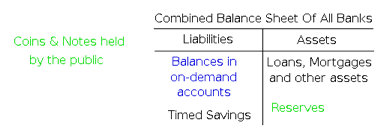
I should point out that the transition process designed in the last chapter of this book could also permit from the outset the bailing out of the current banking system, thus preventing its rapid collapse, and with it the sudden monetary squeeze which would be inevitable if, in an environment of widespread broken trust among depositors, a significant volume of bank deposits were to disappear. This short-term goal, which at present, western governments are desperately striving for with the most varied plans (the massive purchases of “toxic” bank assets, the ad hominem guarantee of all deposits, or simply the partial or total nationalization of the private banking system), could be reached much faster and more effectively, and in a manner much less harmful to the market economy, if the first step in the proposed reform (pages 791–98) were immediately taken: to back the total amount of current bank deposits (demand deposits and equivalents) with cash, bills to be turned over to banks, which from then on would maintain a 100-percent reserve with respect to deposits. As illustrated in chart IX-2 of chapter 9, which shows the consolidated balance sheet for the banking system following this step, the issuance of these banknotes would in no way be inflationary (since the new money would be “sterilized,” so to speak, by its purpose as backing to satisfy any sudden deposit withdrawals). Furthermore, this step would free up all banking assets (“toxic” or not) which currently appear as backing for demand deposits (and equivalents) on the balance sheets of private banks. On the assumption that the transition to the new financial system would take place under “normal” circumstances, and not in the midst of a financial crisis as acute as the current one, I proposed in chapter 9 that the “freed” assets be transferred to a set of mutual funds created ad hoc and managed by the banking system, and that the shares in these funds be exchanged for outstanding treasury bonds and for the implicit liabilities connected with the public social-security system (pp. 796–97). Nevertheless, in the current climate of severe financial and economic crisis, we have another alternative: apart from canceling “toxic” assets with these funds, we could devote a portion of the rest, if desired, to enabling savers (not depositors, since their deposits would already be backed 100 percent) to recover a large part of the value lost in their investments (particularly in loans to commercial banks, investment banks, and holding companies). These measures would immediately restore confidence and would leave a significant remainder to be exchanged, once and for all and at no cost, for a sizeable portion of the national debt, our initial aim. In any case, an important warning must be given: naturally, and I must never tire of repeating it, the solution proposed is only valid in the context of an irrevocable decision to reestablish a free-banking system subject to a 100-percent reserve requirement on demand deposits. Any of the reforms noted above, if adopted in the absence of a prior, firm conviction and decision to change the international financial and banking system as indicated, would be simply disastrous: a private banking system which continued to operate with a fractional reserve (orchestrated by the corresponding central banks), would generate, in a cascading effect, and based on the cash created to back deposits, an inflationary expansion like none other in history, one which would eventually finish off our entire economic system.

The above considerations are crucially important and reveal how very relevant this treatise has now become in light of the critical state of the international financial system (though I would definitely have preferred to write the preface to this new edition under very different economic circumstances). Nevertheless, while it is tragic that we have arrived at the current situation, it is even more tragic, if possible, that there exists a widespread lack of understanding regarding the causes of the phenomena that plague us, and especially an atmosphere of confusion and uncertainty prevalent among experts, analysts, and most economic theorists. In this area at least, I can hope the successive editions of this book which are being published all over the world [2] may contribute to the theoretical training of readers, to the intellectual rearmament of new generations, and eventually, to the sorely needed institutional redesign of the entire monetary and financial system of current market economies. If this hope is fulfilled, I will not only view the effort made as worthwhile, but will also deem it a great honor to have contributed, even in a very small way, to movement in the right direction.

Jesús Huerta de Soto
Madrid
November 13, 2008

_________________________________________________________

[1] See especially F. A. Hayek, “The Maintenance of Capital,” Economica 2 (August 1934), reprinted in Profits, Interest and Investment and Other Essays on the Theory of Industrial Fluctuations(Clifton, N.J.: Augustus M. Kelley, 1979; first edition London: George Routledge & Sons, 1939). See especially section 9, “Capital Accounting and Monetary Policy,” pp. 130–32.

[2] Since the appearance of the first English-language edition, the third and
fourth Spanish editions have been published in 2006 and 2009. Moreover,
Tatjana Danilova and Grigory Sapov have completed a Russian translation, which has been published as Dengi, Bankovskiy Kredit i Ekonomicheskie Tsikly (Moscow: Sotsium Publishing House, 2008). Three thousand copies have been printed initially, and I had the satisfaction of presenting the book Octo- ber 30, 2008 at the Higher School of Economics at Moscow State University. In addition, Professor Rosine Létinier has produced the French translation, which is now pending publication. Grzegorz Luczkiewicz has completed the Polish translation, and translation into the following languages is at an advanced stage: German, Czech, Italian, Romanian, Dutch, Chinese, Japan- ese, and Arabic. God willing, may they soon be published.

Economics

A Pro-Free-Market Program for Economic Recovery, by George Reisman

George Reisman is one of the most educated and intelligent men on the planet. He was one of only four people the great master economist , Ludwig von Mises, put though and supervised his PhD program with. He also worked for many years very closely with the novelist and noted philosopher and the founder of Objectivism, Ayn  Rand .

I have had a number of very useful and inspiring conversations with George Reisman over the years and would like to introduce him to our readers as he is advocating something very similar to us as a method of sorting out the financial mess we are in. I have included the full talk, but you could join it at this section “The 100-Percent Reserve” if you are comfortable with the way the credit is created and causes boom and bust.

This has been copied from the Mises Institute web site.

Mises Daily: Friday, November 20, 2009 by George Reisman

[This talk was given at Economic Downturn: Cause and Cure (Mises Circle, Sponsored by Louis E. Carabini) Newport Beach, California, November 14, 2009.]

George Reisman

Good afternoon, ladies and gentlemen:

As you all know, we are in a severe economic downturn. The official unemployment rate now exceeds 10 percent and according to many observers is actually substantially higher. Within the last year or so, our financial system has been rocked to its foundations. The collapse of the housing bubble and the numerous defaults and bankruptcies connected with it brought down major financial institutions, such as Bear-Stearns, Lehman Brothers, and Merrill Lynch. It also brought down numerous small and medium-sized banks and threatened to bring down even such banking giants as Citigroup and Bank of America. The Dow Jones stock average fell from a high of 14,000 to about 6,500. Important retailers such as CompUSA, Circuit City, Mervyns, and Linens ‘N Things went under, as did countless small businesses throughout the country. Practically every shopping mall gives testimony to the severity of the downturn in the form of vacant stores.

The collapse of the housing bubble and the massive losses and mounting unemployment that have resulted from it have unleashed a veritable firestorm of hostility against capitalism, in the conviction that it is capitalism and its economic freedom that are responsible. It is now generally taken for granted that any solution for the downturn requires massive new government intervention, to curb, control, or abolish this or that aspect of capitalism and its alleged evil.

Reflecting this view, in an effort to avoid financial collapse, the government’s response was the enactment of an $800 billion “stimulus package” designed to boost spending throughout the economic system, and the pouring of more than $1.1 trillion of new and additional reserves into the banking system, along with the direct investment of capital in the country’s most important banks and in major automobile firms, in order to prevent them from failing.

As a result of its so-called “investments,” the government now owns a majority interest in the common stock of General Motors, once the flagship company of capitalism. There have been important extensions of government control over the economic system in other areas as well. For example, the stimulus package contains substantial funding for new bureaucracies to control healthcare and energy production.

The new and additional bank reserves, moreover, are not only massive, but almost all of them are excess reserves. Excess reserves are the reserves available to the banks for the making of new and additional loans, i.e., for new and additional credit expansion. They are the difference between the reserves the banks actually hold and the reserves they are required to hold by law or government regulation.

To gauge the significance of today’s excess reserves, one should consider that total bank reserves as recently as July of 2008 were on the order of just $45 billion, and excess reserves were less than $2 billion. Those $45 billion of reserves supported a total of checking deposits in one form or another on the order of $6 trillion (a sum that included traditional checking deposits, so-called “sweep accounts,” money-market mutual-fund accounts, and money-market deposit accounts insofar as checks could be written against them). That was a ratio of checking deposits to reserves in excess of 100 to 1, or equivalently, a fractional reserve of less than 1 percent.

Today, of the $1.1 trillion-plus of total reserves, all but approximately $62 billion of required reserves, are excess reserves. As of the week of November 4, excess reserves were $1.06 trillion.

Fortunately, for the time being at least, the banks are afraid to lend very much of this sum, but the potential is clearly there for a massive new credit expansion and corresponding increase in the quantity of money. Recognition of this potential is reflected in the current surge in the price of precious metals. Indeed, since $1.06 trillion of new and additional excess reserves are more than 22 times as large as the $45 billion of reserves that were sufficient not so long ago to support $6 trillion of checking deposits, they might potentially support checking deposits in excess of $132 trillion. In effect, what has happened is that our recent brush with massive deflation has turned out to be an occasion for a massive inflationary fueling period in the effort to avoid that deflation.

Inflation and Deflation: Credit Expansion and Malinvestment

The title of my talk, of course, is “A Pro-Free-Market Program for Economic Recovery.” What this entails changes as the government adds new and additional measures that create new and additional problems. If I were giving this talk a year ago, my discussion would have been weighted somewhat more heavily toward deflation and somewhat less heavily toward inflation than is the case today.

A fundamental fact is that our present monetary system is characterized both by irredeemable paper money, i.e., fiat money, and by credit expansion. There is no limit to the quantity of fiat money that can be created. This is the foundation for potentially limitless inflation and the ultimate destruction of the paper money, when the point is reached that it loses value so fast that no one will accept it any longer.

The fact that our monetary system is also characterized by credit expansion is what creates the potential for massive deflation — for deflation to the point of wiping out the far greater part of the money supply, which in the conditions of the last centuries has been brought into existence through the mechanism of credit expansion.

Credit expansion is what underlay the housing bubble, and before that, the stock market bubble, and before that a long series of other booms and busts, running through the Great Depression of 1929 that followed the stock market boom of the 1920s, through the 19th and 18th Centuries all the way back to the Mississippi Bubble of 1719, and perhaps even further back.

Credit expansion is the lending out of money created virtually out of thin air. It is money manufactured by the banking system, always with at least the implicit sanction of the government, which chooses not to outlaw the practice. Since 1913, credit expansion in this country has proceeded not only with the sanction but also with the approval, and active encouragement of the Federal Reserve System, which, as I’ve shown, is now desperately trying to reignite the process as the means of recovering from the current downturn.

The new and additional money is created by the banking system through the lending out of funds placed on deposit with it by its customers and still held by those customers in the form of checking accounts of one kind or another. The customers can continue to spend those checking deposits themselves, simply by writing checks or using other, similar methods of transferring their balances to others.

But now, at the same time, those to whom the banks have lent in this way also have money. To illustrate the process, imagine that Mr. X deposits $1,000 of currency in his checking account. He retains the ability to spend his $1,000 by means of writing checks. From his point of view, he has not reduced the money he owns any more than if he had exchanged $1,000 in hundred-dollar bills for $1,000 in fifty-dollar bills, or vice versa. He has merely changed the form in which he continues to hold the exact same quantity of money.

But now imagine that Mr. X’s bank takes, say, $900 of the currency that he has deposited and lends it to Mr. Y. Mr. Y now possess $900 of spendable money in addition to the $1,000 that Mr. X continues to possess. In other words, the quantity of money in the economic system has been increased by $900. Mr. Y’s loan has been financed by the creation of new and additional money virtually out of thin air. This is the nature and meaning of credit expansion.

Now, nothing of substance is changed, if instead of lending currency to Mr. Y, Mr. X’s bank creates a new and additional checking deposit for Mr. Y in the amount of $900. (This, in fact, is the way credit expansion usually occurs in present-day conditions.) There will once again be $900 of new and additional money. There will be altogether $1,900 of money resting on a foundation merely of the $1,000 of currency deposited by Mr. X.

The $1,000 of currency that Mr. X’s bank holds is its reserve. If Mr. Y deposits his currency or check in another bank, it is the banking system that now has $1,000 of reserves and $1,900 of checking deposits. On the foundation of these reserves, it can create still more money and use it in the further expansion of credit. Indeed, as we have seen, the process of credit expansion is capable of creating checking deposits more than 100 times as large as the reserves that support them.

Credit expansion makes it possible to understand what caused the housing bubble and its collapse. From January of 2001 to December of 2007, credit expansion took place in excess of $2 trillion. This new and additional money made available in the loan market drove down interest rates, including, very prominently, interest rates on home mortgages. Since the interest rate on a mortgage is a major factor determining the cost of homeownership, lower mortgage interest rates greatly encouraged buying houses.

This artificially increased demand for houses, made possible by credit expansion, soon began to raise the prices of houses, and as the new and additional money kept pouring into the housing market, home prices continued to rise. This went on long enough to convince many people that the mere buying and selling of houses was a way to make a good living. On this basis, the demand for houses increased yet further, and finally a point was reached where the median-priced home was no longer affordable by anyone whose income was not far in excess of the median income, i.e., only by a relatively few percent of families.

In the middle of 2004, the Federal Reserve became alarmed about the situation and its implications for rising prices in general, and over the next two years progressively increased its Federal Funds interest rate from 1 percent to 5.25 percent. This rise in the Federal Funds rate signified a reduction in the flow of new and additional excess reserves into the banking system and thus its ability to make new and additional loans. This served to prick the housing bubble.

But before its end, perhaps as much as a trillion and a half dollars or more of credit expansion and its newly created money had been channeled into the housing market. Once the basis of high and rising home prices had been removed, home prices began to fall, leaving large numbers of borrowers with homes worth less than they had paid for them and with mortgages they could not meet.

The investments in housing represented a classic case of what Mises calls “malinvestment,” i.e., the wasteful investment of capital in inherently uneconomic ventures. The malinvestment in housing was on a scale comparable to the credit expansion that had created it, i.e., about $2 trillion or more. That’s about how much was lost in the housing market. When the money capital created by credit expansion was wiped out, the lending, investment spending, employment, and consumer spending that depended on that capital were also wiped out.

And, particularly important, as vast numbers of home buyers defaulted on their mortgages, the mounting losses on mortgage loans increasingly wiped out the capital of banks and other financial institutions, setting the stage for their failure.

The current plight of the economic system is the result of credit expansion and the malinvestment it engenders. Capital in physical terms is the physical assets of business firms. It is their plant and equipment and inventories and work in progress. As Mises never tired of pointing out, capital goods cannot be created by credit expansion. All that credit expansion can do is change their employment and shift them into lines where their employment results in losses. The empty stores and idle factories around the country are very much the result of the loss of the capital squandered in malinvestment in housing.

Other Consequences of Credit Expansion

The plight of the economic system is also the result of other consequences of credit expansion, namely, the encouragement it gives to high debt and dangerous leverage. This is the result of the fact that while credit expansion drives down market interest rates, the spending of the new and additional funds it represents serves to drive up business sales revenues and what the old classical economists called the rate of profit. This combination makes borrowing appear highly profitable and greatly encourages it. Individuals and business firms take on more and more debt relative to their equity. They expect borrowing to multiply their gains.

In addition, credit expansion is responsible for many business firms operating with lower cash holdings relative to the scale of their economic activity, in many cases, dangerously low cash holdings. Many businessmen develop the attitude, why hold cash when credit expansion makes it possible to borrow easily and profitably? Instead, invest the money.

“Why hold cash when credit expansion makes it possible to borrow easily and profitably? Instead, invest the money.”

Thus, when credit expansion finally gives way to the recognition of vast malinvestments and the accompanying loss of huge sums of capital, the economic system is also mired in debt and deficient in cash. Thus, it is poised to fall like a house of cards, in a vast cascade of failures and bankruptcies, first and foremost, bank failures.

The Road to Recovery

The road to recovery from our economic downturn can be understood only in the light of knowledge of credit expansion and its consequences. The nature of credit expansion and its consequences imply the nature of the cure.

The prevailing — Keynesian — view on how to recover from our downturn totally ignores credit expansion and its effects. It believes that all that counts is “spending,” practically any kind of spending. Just get the spending going and economic activity will follow, the Keynesians believe.

This conception of things, which underlies the support for “stimulus packages” and anything else that will increase consumer spending, is mistaken. It rests on a fundamental misconception. It ignores the fact that the fundamental problem is not insufficient spending, but insufficient capital due to the losses caused by malinvestment. It ignores the further facts that credit expansion has brought about excessive debt and, however counterintuitive this may seem, insufficient cash. Too little capital, too much debt, and not enough cash are the problems that countless business firms are facing today as a result of the credit expansion that generated the housing bubble.

Just as a reminder: the way that credit expansion brings about a situation of too little cash while itself constituting a flood of cash is that it makes it appear profitable to invest every last dollar of cash in the expectation of being able easily and profitably to borrow whatever cash may be needed.

What this discussion implies is that an essential requirement of economic recovery is that the widespread problems in the balance sheets of business firms must be fixed. Business firms need more capital, less debt, and more cash. When they achieve that, business confidence will be restored.

Ironically what could achieve at least less debt and more cash in the hands of business, and thus actually do some significant good is if when people received government “stimulus” money, they did not spend very much of it, or, better still, any of it at all. To the extent that all people did with money coming from the government was pay down debt and hold more cash, they would be engaged in a process of undoing some of the major damage done by credit expansion. They would be reducing their burden of debt and increasing their liquidity, thereby increasing their security against the threat of insolvency. Such behavior, of course, would be regarded by Keynesians as constituting a failure of their policies, because in their eyes, all that counts is consumer spending.

The 100-Percent Reserve

The most important single step on the road to economic recovery is the establishment of a 100-percent reserve system against checking deposits. Ideally, the 100-percent reserve would be in gold. And that’s ultimately what we should aim at, for all of the reasons Rothbard explained. But even a 100-percent reserve in paper would do the job of totally preventing all future credit expansion and, equally important, all declines in the money supply.

(Because the 100-percent gold reserve standard is the long-run ideal of advocates of sound money, I cannot help but feel a sense of great satisfaction in the fact that a major step toward its achievement is what turns out to be urgently needed as a matter of sound current economic policy.)

In the simplest terms, to establish a 100-percent-reserve system in terms of paper, the government would simply print up enough additional paper currency so that when added to the paper currency the banks already have, every last dollar of their checking deposits would be covered by such currency. (Strictly speaking, a significant part, and for some months now the far greater part, of the reserves of the banks are not in actual currency but in checking deposits with the Federal Reserve. For the sake of simplicity, however, we can think of the checking deposits held by the banks with the Federal Reserve as a denomination of currency, since, for the banks, they are fully as interchangeable with currency as $50 bills are with $100 bills and vice versa.)

To illustrate the process of achieving a 100-percent reserve, imagine that total checking deposits are $3 trillion. In that case, the Fed would give the banks new and additional reserves that when added to their existing reserves would bring them up to $3 trillion. Through various programs, such as purchasing bad assets, the Fed has in fact already brought the total reserves of the banks up to over a trillion dollars, but almost all of those reserves, as we’ve seen, are excess reserves, a ready foundation for a massive new credit expansion, since excess reserves can be lent out.

What my example implies is adding to the $1.1 trillion of reserves the banking system now has, a further $1.9 trillion and making all $3 trillion of reserves required reserves. This would mean that the banks could not engage in any lending of these reserves and thus would be unable to finance credit expansion or any increase in the supply of checking deposits on the strength of them. The money supply in the hands of the public and spendable in the economic system would thus not be increased. That would happen only if and to the extent that the 100-percent reserve principle were breached.

Under a 100-percent reserve, checking depositors could simultaneously all demand their full balances in cash and the banks would be able to pay them all. Depositors’ demand for cash would not create a problem and no amount of losses by the banks on their loans and investments would prevent them from honoring their checking deposits immediately and in full. Thus the checking deposit component of the money supply could not fall and nor, of course could its other component, which is the paper money in the hands of the public, usually described as the currency component. Thus, there could simply be no deflation of the money supply. And, as I’ve said, because all reserves would be required reserves, there would simply be no reserves whatever available for lending out, and thus no credit expansion whatever. The expression “killing two birds with one stone” could not have a better application.

“The most important single step on the road to economic recovery is the establishment of a 100-percent reserve system against checking deposits.”

In a addition, a significant byproduct of a 100-percent reserve system would be that the FDIC would no longer serve any purpose and thus could be abolished.

Now an essential prerequisite of the 100-percent reserve is knowing the size of checking deposits, so that it will be known how much the 100-percent reserve needs to cover. At present, when one allows for such things as “sweep accounts,” money-market mutual funds, and money-market deposit accounts, the magnitude to which the 100-percent reserve would apply can plausibly be argued to range from about $1.5 trillion to $8 trillion. It is very solidly $1.5 trillion, but does in fact range up to $8 trillion in that checks can be written on the additional sums involved, at least from time to time and for some large minimum amount.

To clearly establish the magnitude of checking deposits, bank depositors should be asked if their intention is to hold money in the bank, ready for their immediate use and transfer to others, or to lend money to the bank. In the first case, their funds would be in a checking account, against which the bank would have to hold a 100-percent reserve. In the second case, their funds would be in a savings account, against which the bank could hold whatever lesser reserve it considered necessary. In this case, the bank’s customers could not spend the funds they had deposited until they withdrew them from the bank.

As I’ve said, the long-run goal in connection with the 100-percent reserve would be ultimately to convert it to a 100-percent gold reserve system. At that time, following the ideas of Rothbard further, the gold reserve of the Fed would be priced high enough to equal the currency and checking deposits of the country and be physically turned over to the individual citizens and the banks in exchange for all outstanding Federal Reserve money. The Fed would then be abolished. But this is a distinct and much later step in pro-free-market reform.

The 100-Percent Reserve and New Bank Capital

It should be realized that a major consequence of the establishment of a 100-percent-reserve system could be a corresponding enlargement of the capital of the banking system and thus an ability to cover even very great losses and thereby avoid such things as government bank bailouts and takeovers.

Consider the balance sheet of an imaginary bank. It’s got checking deposit liabilities of $100. Initially, it has assets of $105, which implies that on the liabilities side of its balance sheet it has capital of $5 in addition to its checking deposit liabilities of $100.

Now unfortunately, malinvestment has resulted in a loss of $20 in the banks’ assets, in the part of its assets consisting of loans and investments. As a result, its total assets are reduced from $105 to $85 and its capital is completely wiped out and becomes negative in the amount of $15.

However, on its asset side the bank still has some cash reserve, say, $10. If $90 of new and additional reserves were added to these $10, to bring the bank’s reserves up to 100-percent equality with its checking deposits, the bank’s asset total would also be increased by $90. This $90 increase on the bank’s asset side would have to be matched by a $90 increase on its liabilities side, specifically by a $90 increase in its capital. Its capital would go from minus $15 to plus $75.

Applying this to the banking system as a whole in transitioning to a 100-percent reserve, we can see that the creation of such a vast amount of new bank capital would be entailed as easily to overcome whatever losses the banks might have suffered in their loans and investments.

As explained, if checking deposits were $3 trillion, the Fed would give the banks new and additional reserves that when added to their existing reserves would bring them up to $3 trillion. If this had been done in September of 2008, bringing reserves up to $3 trillion would have required adding $2.955 trillion of new and additional reserves to the $45 billion or so of reserves the banks already had. This vast addition on the asset side of the banks’ balance sheets would have implied an equivalent addition to the banks’ capital on the liabilities side. No matter how bad the banks’ assets were, I think it’s virtually certain that an additional sum of this size would have been far more than sufficient to cover all the losses that the banks had incurred in their bad loans and investments. Their capital would have ended up being increased to the extent that the additional reserves exceeded the losses in assets under the head of loans and investments.

The government’s bailout program of stock purchases in the banks would have been avoided, along with all of its subsequent interference in matters of bank management.

Now, as we’ve seen, in fact the Fed has already supplied a vast amount of reserves, about $1.1 trillion, to the banks through various programs, such as purchasing bad assets. If the 100-percent reserve principle were adopted now, many or most of those assets could be taken back, and the programs that created them cancelled.

Thus, what I’ve shown here is how transitioning to a 100-percent reserve would guarantee the prevention both of new credit expansion and of deflation of the money supply. It could also provide additional capital to the banking system on a scale almost certainly far more than sufficient to place it on a financially sound footing. To avoid what would otherwise likely be an excessive windfall to the banks, it would be possible to match a more or less considerable part of the increase in their assets provided by the creation of additional reserves, with the creation of a liability of the banks to their depositors, perhaps in the form of some kind of mutual-fund accounts. Thus, the newly created reserves might provide a financial benefit to the banks’ depositors as well as to the banks.

Toward Gold

Of course, a 100-percent reserve system in which the reserves are fiat money does not address the problem of preventing inflation of the fiat money. It would still be possible for the government to inflate the fiat money without restraint. That is why it is necessary to have gold in the monetary system, serving as a restraint on the amount of currency and reserves.

Thus, an important ancillary measure in connection with the transition to a 100-percent paper-reserve system would be for the government to demonstrate a serious intent to move to a gold standard. Obliging the Federal Reserve to carry out a program of regular and substantial gold bullion purchases might accomplish this. In any event, it would be an essential prerequisite for someday achieving gold reserves sufficient to make possible the establishment of a 100-percent-reserve gold system. Along the way, this measure should lead to the day when purchases of gold bullion were the only source of increases in the supply of currency and reserves.

Establishing the Freedom of Wage Rates to Fall

Along with stabilizing the financial system through the adoption of a 100-pecent reserve, it’s absolutely essential to establish the freedom of wage rates and prices to fall. This is what is required to eliminate mass unemployment. Whatever the level of spending in the economic system may be, it is sufficient to buy as much additional labor and products as is required for everyone to be employed and producing as much as he can.

Nothing could be more obvious if one thinks about it. Assume, as is the case today, that there is 10 percent unemployment, with only 9 workers working for every 10 who are able and willing to work. The same total expenditure of money that today employs only 9 workers would be able to employ 10 workers, if the average wage per worker were 10 percent less. At nine-tenths the wage, the same total amount of wages is sufficient to employ ten-ninths the number of workers. It’s a question of simple arithmetic: 1 divided by 9/10 equals 10/9.

(Obviously, this is an overall, average result. In reality, some wage rates would need to fall by less than 10 percent and others by more than 10 percent.)

Of course, total wage payments are not fixed in stone. They can change. And in response to a fall in wage rates to their equilibrium level, to eliminate mass unemployment, they would increase. This is because prior to their fall, investment expenditures have been postponed, awaiting their fall. Once that fall occurs, those investment expenditures take place.

Finally, with debt levels sufficiently reduced and cash holdings sufficiently high, and thus business confidence restored, there is no reason to believe that a fall in wage rates could abort the process of recovery as the result of already employed workers earning less and thus spending less before new and additional workers were hired. The cash reserves and financial strength of business firms would enable them easily to ride out any such situation. And thus mass unemployment would simply be eliminated.

What stops wage rates from falling, what makes it actually illegal for them to fall, and which thus perpetuates mass unemployment, is the underlying pervasive influence of the Marxian exploitation theory. That doctrine is responsible for the existence of such things as minimum-wage laws and coercive labor unions and their above-market wage scales.

The most important fundamental requirement for achieving a free market in labor is the total refutation of the exploitation theory and its complete discrediting in public opinion. Such a refutation will show that it is not government and labor unions that raise real wages but businessmen and capitalists, and that essentially, all that unions do is cause unemployment and a lower productivity of labor and thus prices that are higher relative to wage rates. This knowledge is what is required to make possible the repeal of minimum-wage and pro-union legislation and thus achieve the fall in wage rates that will eliminate mass unemployment

Summary

In summation, my pro-free-market program for economic recovery is a provisional 100-percent-paper-money-reserve system applied to checking deposits, accompanied by a demonstrable commitment to ultimately achieving a 100-percent-gold reserve system. The 100-percent reserve in paper would put an end to all further credit expansion and at the same time make the money supply incapable of being deflated. Its establishment would also greatly increase the capital of the banking system. It would do so by more than enough to cover all the losses on loans and investments incurred in the aftermath of the collapse of the housing bubble and thus make possible the elimination of government ownership of common stock in banks and its interference in bank management. What it would not do is control the increase in paper currency and paper-currency reserves. That will require a 100-percent gold reserve system.

$95 $80

Finally, the freedom of wage rates and prices to fall must be established through the repeal of pro-union and minimum-wage legislation, and more fundamentally, the education of the public concerning the errors of the Marxian exploitation theory and their replacement with actual knowledge of what determines wages and the general standard of living. To say the least, this will certainly not be an easy agenda to follow, inasmuch as it must begin in the midst of a Marxist occupation of our nation’s capital.

Thank you.

George Reisman, Ph.D., is Pepperdine University Professor Emeritus of Economics and the author of Capitalism: A Treatise on Economics (Ottawa, Illinois: Jameson Books, 1996). His web site is www.capitalism.net. His blog is at www.georgereisman.com/blog/. Send him mail. (A PDF replica of the complete book Capitalism: A Treatise on EconomicsDownload PDF can be downloaded to the reader’s hard drive simply by clicking on the book’s title, immediately preceding, and then saving the file when it appears on the screen. ) See George Reisman’s article archives.

This talk was given at Economic Downturn: Cause and Cure (Mises Circle, Sponsored by Louis E. Carabini) Newport Beach, California, November 14, 2009.

Economics

Greg Mankiw Ponders Greenspan’s Paper the Crisis and Considers 100% Reserves

We are grateful to Robert Arbon for pointing out this article on Greg Mankiw’s Blog:

I just returned from the spring meeting of the Brookings Papers on Economic Activity, where I was a discussant for Alan Greenspan’s new paper on “The Crisis,” which has gotten a bit of media attention. I thought blog readers might enjoy reading my comments on the paper. Here they are:

This is a great paper. It presents one of the best comprehensive narratives about what went wrong over the past several years that I have read. If you want to assign your students only one paper to read about the recent financial crisis, this would be a good choice.

There are, however, particular pieces of the analysis about which I am skeptical. But before I get to that, let me begin by emphasizing several important points of agreement.

To begin with, Alan refers to recent events in the housing market as a “classic euphoric bubble.” He is certainly right that asset markets can depart from apparent fundamentals in ways that are often hard to understand. This has happened before, and it will happen again. When the bubble bursts, the aftershocks are never pleasant.

Read more.

Economics

Presbyterian Mutual Society and a Solution to Pay out all its Creditors and its Place in the Honest Money Movement

A bank , building society that uses factional reserves, lends long and pays out short is only going to exist should confidence be kept in it. The “Run on the Rock” in the summer of 2007 saw people queuing to get their cash out of the Northern Rock which resulted in the first systematic run on a bank since the 1866 run on the Overend, Gurney & Company bank in the UK.

Readers of this site will know that a bank can only exist with the legal and accounting privilege that allows them to use current creditors – i.e. the depositors of the Presbyterian Mutual Society (PMS) – to lend out a multiple number of times to property loans and other entrepreneurial loans. Readers will also know that when they deposit money they in effect lend it to the bank and become a creditor to the bank. A deposit of cash into a bank/Mutual means you as the depositee lend money to the bank/Mutual  That is, to be very clear, when you deposit, you cease to own the money – the bank does. This was established by law in 1811 in Carr V Carr and reaffirmed in Foley V Hill 1846.

The History

 The Society’s audited accounts for the year ended 31st March 2008 showed £305m of loans and £5m of liquid assets to pay up to £310m on demand deposits. So one can deduce that there was only £5m of cash supporting £310m IOUs to its creditors, the depositors. This means that the PMS multiplied its credit creation to the tune of 62 times! This is nearly twice the average of all the banks licensed by the Bank of England. In fairness to the Society, they did pay out £21m before they were left with only £5m of cash, so £26m of cash was in their vaults when the run happened. Thus a more conservative 12 x credit was created out of thin air or a leverage ratio of  1 part cash to 12 parts credit existed in this Society.

A quick refresher on how the banking system allows this creation of credit out of thin air can be found here http://www.cobdencentre.org/2010/02/a-day-of-reckoning/  where I say, “ It is often forgotten but when you place £1m in a savings account (in cash) in say the Royal Bank of Scotland, which has no legal reserve requirement, they then lend £970k (in credit) , keeping on average 3% of cash back in reserves, to an entrepreneur in say HSBC, who then deposits that money in HSBC. We now have one claim to the original £1m and one claim to the £970k. The money supply has moved from £1m to £1.97m – just like magic! This is credit expansion.

The reality is that across all the banks in the United Kingdom licensed by the Bank of England, we have for every £1 of money (in cash), £34 in claims to money (credit)!”

The Administrators’ report tells the sorry story of events in summary which I list underneath, but one glaring fact is omitted. This is that the very Government of the UK actually triggered the loss of confidence in this Bank. When our Prime Minister in his own words was “saving the world” he ordered a full guarantee , government backed, on all deposits. The PMS, which had 10,000 members, went into administration following a rush by savers to withdraw their money at the height of the banking crisis in October 2008. People withdrew their money as they learned the Society was not covered by the government’s bank deposit guarantee scheme. Previously they were content to leave their money in the Society. For the purposes of this article, it is not needed to debate the point: was it or was it not a bank that should have been supported by this guarantee? The salient point being that not being guaranteed scared people into making withdrawals where little existed before.

From the Administrators’ report of the12th January 2009 that can be down loaded here http://www.presbyterianmutualsociety.co.uk/files/Administrator’s%20Proposals%2012.1.09.pdf the  Society was placed into Administration by the Directors on 17th November 2008. The following are selected quotes from this report which speak for themselves:

 “the demand for withdrawals by members of their investments exceeded its cash reserves;”

 “the members’ investments were historically withdrawable on demand but the cash was invested by the Society in longer term investments such as property and loans.”

 “For the Society to allow members to withdraw their investments on demand and invest members’ money in longer term investments, the Society required a high degree of confidence among its members that their investments were secure. However this confidence has been severely tested by the current economic climate and eventually the demand by members for withdrawals exceeded the Society’s cash reserves. …I believe it will be difficult for the Society in its current form to continue as a going concern.”

 “loan capital will be treated as creditors and will therefore be paid in preference to members’ shares.”

 “Government Guarantee

 As you will be aware the Society does not benefit from the deposit guarantee scheme.

 During the month of October 2008 the Society experienced an unprecedented increase in the number of requests for repayment of members’ investments. It was common practice for the Society to repay investments on receipt of a request, and payments of £21 million were made up to Friday 24th October 2008, leaving £4 million in the Society’s bank account.

 An emergency meeting of the Society’s Board of Directors was convened on 25th October 2008 and it was resolved that:

…the 21 day notice period for the repayment of members’ investments be invoked in respect of requests received from members as at that date and any new requests received from members.

On 6th November 2008 the Society’s Board of Directors met again and it was reported that the demand among the Society’s members to withdraw their investments had increased which further exacerbated the Society’s liquidity. It was also reported at this meeting that legal proceedings had been commenced by three members seeking repayment of their investments. It was resolved by the Society’s Board of Directors on 6th November 2008 that the Society should be placed into Administration so that its assets could be protected, subject to enabling legislation being passed to permit the Society to go into administration.

During the period 27th October 2008 to 17th November 2008, the Society had received requests for withdrawals in excess of £50 million but the Society had cash reserves of only £4 million to meet such requests.”

 Now this would have been the story of every bank in the UK if the government had not acted as it did as we were ‘panicking’ as a nation. We should also note that all banks are in the same precarious situation as the PMS was with regard to lending long and paying out short still, to this day. Do we need to live like this?

The Future Safe Way to Run Banks and Provide Interest for Savers and Lending to the needs of Trade.

 If banks were mandated to hold 100% reserves of cash in their vaults, they could issue their bank statements saying what they owe you each month and you would know that you actually had cash in the vault to support your deposit that is represented by your bank statement. The bank statement after all is only a thing that would more accurately be called a “bank IOU statement.” Should you want interest you could ask for the cash you have deposited to be placed in a highly liquid government bond that could be converted into cash when you need it, paying you a rate of interest. Should you want a higher rate of interest, you can lend your money i.e. cease ownership and place in a bond that has in turn been lent to an entrepreneur for 6 months, 1 year, 2 years, 3 years, 5 years etc with the highest rate of interest being given for the longer term locked away and lent to somebody.

 The Solution for Paying Out 100% of the PMS Depositors’ Lost Money-  £310m – Now, Today

Following the work of 5 Nobel Prize winners and the founder of the American Chicago School, I would suggest the following written about in the Day of Reckoning article;

The Bank of England immediately issues notes to cover all the deposits i.e. redeem all the depositors for 100% cash notes and coins to be placed in their accounts. Please note, this costs the Bank of England the price of paper and the ink and nothing else and IS NOT INFLATIONARY and generates no liability to the UK taxpayer – see next point.

At the same time, get the administrator of the PMS to delete all current creditors (the depositors) as these have now been redeemed from the bank’s books by the Bank of England. The deleting of these bank obligations means that the money the depositors did lend on deposit to the PSM no longer exists, so for the sake of argument, if there was £310m of deposits, these have been redeemed in cash by the Bank of England and the equivalent amount of deposits have been removed from the money supply. Cost to the Bank of England = zero and cost to the UK tax payer = zero. Money supply stays the same.

The PMS in administration now has only assets i.e. loans from entrepreneurs /people who are repaying the loans or mortgages. These can now continue to get repaid, but instead of paying the creditors of the PMS, there are now none, so these loans can go into paying off the National Debt.

This way all parties win.

 A courageous politician in Northern Ireland or in mainland GB could well put forward a Private Members’ bill which could be the first legislative move to establishing Honest Money.

The Day of Reckoning article linked to above provides the start of the legislative solution to the whole UK wide banking system whose model is sadly no different to that of the little PMS.

Economics

Buchanan: The Constitutionalization of Money

James M. Buchanan (Nobel Laureate, economics, 1986) on reform of the monetary regime through constitutional 100% reserves:

The market will not work effectively with monetary anarchy. Politicization is not an effective alternative. We must commence meaningful dialogue with acceptance of these elementary verities. Far too much has been said and written in elaboration of the first statement, which too often is taken to be equivalent to the assertion that “capitalism” or “the market” has failed. Admittedly claims for market efficacy without qualifiers can be found. But economists should know that anarchy can only generate disorder rather than its opposite.

Later:

It follows that there is no economic reason why any money system, in an idealized setting, would allow for leverage at any level. No holder of a unit of money, as an entry in a balance sheet, should be authorized to lend more than the face value of this unit, quite independent of probabilistically determined expectations concerning potential redemptions.

Why not? Because to allow separate banks to create short-term liabilities to a multiple of the base money on the asset side of the account removes from the issuing authority some of the control of the aggregate amount of that value treated as money in the economy without offsetting benefits, thereby making the financial structure vulnerable to unpredictable shifts among instruments, which, in turn, generate changes in real values.

The modern dilemma is that we are left with a massive resource-using, financial- banking structure that has a functional purpose quite different from that which is widely accepted. The system in existence emerged from a historical process, the characteristics of which were partially appropriate for a monetary standard defined in terms of some commodity base, but which, ultimately, make no sense under a fiat system.

Finally:

Let us not waste this set of crises by exclusive recourse to jerry-built efforts to patch up the failed monetary anarchy we have witnessed.

Read more: http://www.mps2009.org/files/Buchanan.pdf

Economics

Darius Guppy is spot on about the bank credit creation process

Via Darius Guppy: our world balances on a sea of debt

What is needed is a root and branch re-evaluation of that most curious of cultural inventions – money, argues Darius Guppy.

See the enclosed article above, it could be written for this site.

I am delighted by the comments that show more and more people are questioning the madness of fractional reserve banking.

Soddy was our first Nobel price winner to suggest 100% reserves as a solution and I am delighted that Guppy is aware of this academic and his work.

Economics

How much is your pound or dollar actually worth since government has been in control of money?

The answer is that the US dollar has lost 98.17% of its purchasing power and the pound sterling 99.42% of its purchasing power. Well done then, I suppose, for surpassing even the great tyrants of old who plagued the citizenry of both nations!

Some History

Gold was money for a large part of mankind’s history.

It was discovered by early man to be the most marketable of commodities. As such, the free interaction of people led to this commodity being adopted as the final thing for which all goods and services were traded. This discovery allowed man to lift himself from direct exchange, or barter, of his goods and services to indirect exchange. This indirect exchange allowed the universal application of the division and specialization of labour that has, in turn, given us all the material prosperity we have today. The discovery of money, then, must rank along with language as arguably the most important invention or discovery in the whole course of human history.

Note that, like language, money was not created by the State but by the private and spontaneous interaction of free individuals.

There are many stories in history of wicked monarchs who, to fund their various despotic regimes or lifestyles, would call in the coinage of the realm, extract a small percentage of gold — a “clip” — and then add an impurity before giving them back to the public; this is debasing of the monetary unit. This embezzlement was unlawful for the minter in the private sector and many people over the ages have been executed for stealing from money owners in this way but the monarch usually got away with it. One of the most notable examples in history was when Emperor Nero reduced the value of the denarius from being pure silver weighing 4 grams to 3.8 grams. His financial gain was enormous.

Another great example of history is our very own tyrant per excellence, Henry the VIII. He reduced the weight of sliver in the silver penny to 1/3rd of its purity from 0.925 to 0.250. By the reign of Elizabeth I, the Tudor financier Sir Thomas Gresham had to negotiate a loan from the Antwerp traders to provide more money for her nation. Sir Thomas came back and said

It may please your majesty to understand, that the first occasion of the fall of exchange did grow by the King majesty, your late father, in abasing his coin … which was the occasion that all your fine gold was conveyed out of this your realm.

What became know as Gresham’s law is that “Bad money drives out good under legal tender laws”. In Europe this is know as the Copernicus Law, as he was saying the same thing on the continent. The great medieval philosopher and theologian Nicole d’Oresme was the inspiration of Copernicus on this matter.

Economics of the Matter

A debasement always meant an inflation. Why? As there was more coinage in circulation chasing a similar amount of goods and services for sale, prices rose.

No less a figure than John Maynard Keynes in Economic Consequences of the Peace (1920), said:

By a continuous process of inflation, governments can confiscate, secretly and unobserved, an important part of the wealth of their citizens. By this method, they not only confiscate, but they confiscate arbitrarily; and while the process impoverishes many, it actually enriches some.

This is from a man whose current disciples are inflating the western world’s money supply to a point that can only lead to rampant inflation.

We should remember the names which we have used to label money historically.  In the UK “sterling” and in the USA “dollar” each described a fixed weight of gold . Gold was the money unit, not sterling or dollar in itself.

Before World War I the pound sterling was worth $4.86856 and a dollar was worth 1/20th of an ounce of gold. For the sake of simplicity I will say that the pound sterling was defined as ¼ of an ounce of gold and the USA dollar 1/20th of an ounce.

So How Much is my Pound Sterling Worth Today?

The Maths

One ounce of gold today is worth $1,093.40 and 1/20 oz therefore $54.67 but the dollar pre World War I was just a name in the USA for 1/20 of an ounce of gold: what would have cost $1 before World War I would cost $54.67 today. The dollar has lost its purchasing power. In fact it has lost 98.17% of its purchasing power in 100 years. One dollar today should buy something like a single person’s weekly food shop, not a single daily newspaper.

The fate of the pound sterling has been even worse than that of the dollar. One ounce of gold today is £692.26. So if a pound sterling pre World War I was just a name in the UK for 1/4 of an ounce of gold, it would imply that the pre World War I purchasing price was 1/4 of £692.26 or £173.06. In fact the pound sterling has lost 99.42% of its purchasing power in 100 years. One pound should buy something like a good week’s food shop for a familiy of four and not just one daily newspaper like it would today.

Conclusion

Our modern day Neros and Henry VIIIs are those we call our Prime Ministers and our Presidents. We are told they are all well meaning men and women. That may well be the case. They have however, since World War I, sat on the single greatest debasement of our wealth in human history.

They do this via the monetization of their nations’ debt. A politician in power might have promised to give X, Y or Z group of people £X, £Y and £Z in exchange for voting for them. If the tax revenue is not enough, then they simply, out of thin air, either create more money — old style monetizing the debt to pay off the debt obligation — or, with a computer key, they open up a new bank deposit for themselves to pay or buy back some of their debt. This is called “QE” or Quantitive easing and we discuss the errors associated with it here.

Last year the UK raised over £200 billion by one part of the government issuing debt and the other part buying it. So £200 billion of new money is now in circulation. Nero and Henry VIII would blush at the brashness of this debasement. This is done wholly at the expense of yours and my very own purchasing power.

The Cobden Centre exists to promote honest money and social progress. Honest money is money that cannot be debased by governments to pay off liabilities they have incurred over and above their tax revenue. I outlined a banking reform proposal which advocated 100% reserve money here.  Staying within the existing paper money regime, one would need a bill to prevent the new issuance of either paper money or computer generated new bank deposits by the government. Ultimately, we must look at fully re rooting our paper money back into solid commodities that the government cannot destroy or create at will.

Further Reading