The world financial system is skating on thin ice, and that ice can crack at any moment.
The instabilities of the global paper money economy are evident everywhere. In Europe, the debt crisis is picking off one euro-member after another like the protagonists of a teenage horror movie, leaving us in no doubt what the final destination for the core is going to be. Yet – bizarrely and inexplicably – German Bundesanleihen still play the role of safe haven. In the U.S. of A., years of near-zero interest rates and two rounds of unprecedented “quantitative easing” have engineered a suspicious-looking rebound in equity markets and other financial assets, yet the victory of the interventionists over market forces looks hollow. Three years into the recovery, the economy is still sick. Manipulating financial markets seems one thing, generating prosperity quite another – only on Wall Street are the two the same. But according to the central bank’s chairman, if a policy fails it means you simply have to do more of it.
Only the intellectual and institutional inertia of the bloated financial industry, overfed on a rich forty-year diet of cheap money and ever-rising asset prices, is – for now at least – preventing a widespread rush for the exit. The industry is sitting on such a massive pile of inflated paper assets that there seem to be few alternatives to further feeding gluttonous governments and their clueless politicians. Additionally, things have gone from pretty bad to mind-blowingly worse too fast for most portfolio managers to comprehend – leading many to cling to the straws of time-worn investment routines and established asset allocation patterns. Did they not all learn back in money-manger school that government bonds were “safe assets”?
Smart ‘private money’ – nimbler, less consensus-oriented and, importantly, eager to sustain real spending power for the long run rather than beat some nominal index over the short run– is already running for the exit. Just look at the gold price and the prices of certain other real assets.
The tunnel vision of macroeconomics
My prediction is that things will get much worse very rapidly, and one of the reasons why I think this is inevitable is the inability of large sections of the political and financial establishment to even grasp what is going on. Of course, the reason for this is not any lack of intelligence. These are smart people. The reason is the oppressive dominance of an economic belief system that only provides a very narrow perspective on the full effects of an expanding supply of money.
And you want to know what really scares me? That the money-printer-in-chief, the man in charge of the printing press for the world’s dominant paper currency, the chairman of the U.S. Fed, not only shares this limited view of the effects of easy money, he is so completely beholden to the mainstream macro consensus that he is entirely incapable of even comprehending that his policy could do more harm than good.
Just look at this video of last week’s congressional hearings. The exchange between Congressman Ron Paul from Texas – the libertarian, Austrian-schooled Republican who is the only politician who ‘gets it’ – and the Fed chairman has been making the rounds on the web, and provoked already a lot of commentary. But what strikes me is not so much Bernanke’s struggle with explaining the monetary function of gold but something else. Something that indeed scares the living bejeesus out of me whenever I hear a Bernanke testimony.
Before I tell you what it is, let me stress that I don’t much like the widespread demonization of the Fed chairman. I have never met him but I cannot say that he comes across as an unpleasant individual. To the contrary, he seems to be a smart and decent person. Call me naïve, but I do not think that he is part of some conspiracy or any backroom dealing, or that he is in the pockets of the big Wall Street banks. I think he was sincere when he said that he never particularly cared about the management or the shareholders of the Wall Street firms he invariably bailed out and is still generously subsidizing with super-low funding rates and periodic debt monetization. He really believes that what he is doing is helping the U.S. economy and the U.S. people.
The problem is not that he is evil or dumb – I think he is neither – the problem is much bigger. Evil and dumb people can be dealt with. The deeply-convinced do-gooders in positions of almost unchecked power, those are the ones we should worry about, those who are full of good intentions but suffer from tunnel-vision, incurably in awe of their own theories and incapable of even beginning to grasp how what they are doing could make things worse. For keeping rates artificially low and bank reserves generously expanding is a form of constant market manipulation, and it is creating momentous dislocations and vast problems with as yet incalculable consequences – even if it does not presently generate instant hyperinflation or an intolerable expansion of the wider monetary aggregates, and thus looks deceptively harmless through Mr. Bernanke’s narrow prism of national account statistics.
Mr. Bernanke suffers from a blind side – there is an area of monetary phenomena, real and powerful phenomena, that are simply outside of his vision. It is the monetary blind side that all modern macroeconomists suffer from. For them two effects of an expanding money supply are visible, and only two:
1) The growth effect. Injecting more money lowers interest rates (temporarily) thus stimulates lending and borrowing, and leads to a (temporary) growth spurt. This effect is deemed unquestionably positive.
2) The inflation effect. More money means – all else being equal – that the purchasing power of the monetary unit drops. Prices tend to rise. Is this good or bad? Well, according to Bernanke and the mainstream consensus that he belongs to, the answer is, it depends. If there is a risk of that dreadful and debilitating deflation taking hold in the U.S. economy that seems to keep the chairman awake at night, then rising inflation is a good thing. But too much of it can be a bad thing.
So the two effects of the Fed’s money printing are higher growth and higher inflation. But here is the problem. This view is too narrow. It leaves out a very important, maybe the most important and potentially most damaging effect of money printing: the distortion of relative prices and the disruption of resource allocation and capital formation.
The Fed makes things worse
As I explain in detail in my upcoming book Paper Money Collapse – The Folly of Elastic Money and the Coming Monetary Breakdown, ‘elastic’ money is always destabilizing. Any expansion of the money supply (including bank reserves) must distort relative prices. Always and everywhere. Even if some fortuitous rise in money demand helps cushion the inflationary impact of expanding money and if inflation measures therefore remain contained. Even if the economy is weak and money printing is supposed to be a ‘stimulus’.
Specifically, every money injection must disrupt the market’s setting of interest rates and thus disorient the process of coordination between true savings and investment and capital formation.
Interest rates are market prices, and you interfere with them at your peril!
The following testimony was delivered before the House of Representatives Subcommittee on Domestic Monetary Policy and Technology, chaired by Congressman Ron Paul (R-Texas), on “Monetary Policy and the Debt Ceiling: Examining the Relationship between the Federal Reserve and Government Debt,” in Washington, D.C. on May 11, 2011. It was previously published on Northwood University’s blog In Defense of Capitalism & Human Progress
“I place economy among the first and most important virtues, and public debt as the greatest of dangers to be feared . . . To preserve our independence, we must not let our rulers load us with public debt . . . we must make our choice between economy and liberty or confusion and servitude . . . If we run into such debts, we must be taxed in our meat and drink, in our necessities and comforts, in our labor and in our amusements . . . If we can prevent the government from wasting the labor of the people, under the pretense of caring for them, they will be happy.”
Thomas Jefferson
Government Debt and Deficits
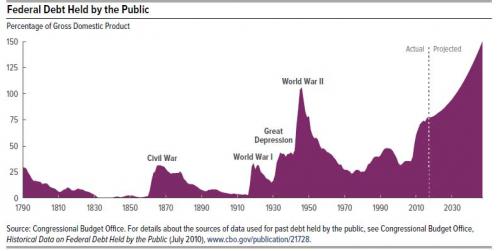
The current economic crisis through which the United States is passing has given a heightened awareness to the country’s national debt. After a declining trend in the 1990s, the national debt has dramatically increased from $5.7 trillion in January 2001 to $10.7 trillion at the end of 2008, to over $14.3 trillion through April of 2011. The debt has reached 98 percent of 2010 U.S. Gross Domestic Product.
The approximately $3.6 trillion that has been added to the national debt since the end of 2008 is more than double the market value of all private sector manufacturing in 2009 ($1.56 trillion), more than three times the market value of spending on professional, scientific, and technical services in 2009 ($1.07 trillion), and nearly five times the amount spent on non-durable goods in 2009 ($722 billion). Just the interest paid on the government’s debt over the first six months of the current fiscal (October 2010-April 2011), nearly $245 billion, is equal to more than 40 percent of the total market value of all private sector construction spending in 2009 ($578 billion)[1]
This highlights the social cost of deficit spending, and the resulting addition to the national debt. Every dollar borrowed by the United States government, and the real resources that dollar represents in the market place, is a dollar of real resources not available for use in private sector investment, capital formation, consumer spending, and therefore increases and improvements in the quality and standard of living of the American people.
In this sense, the government’s deficit spending that cumulatively has been increasing the national debt has made the United States that much poorer than it otherwise could have and would have been, if the dollar value of these real resources had not been siphoned off and out of use in the productive private sectors of the American economy.
What has made this less visible and less obvious to the American citizenry is precisely because it has been financed through government borrowing rather than government taxation. Deficit spending easily creates the illusion that something can be had for nothing. The government borrows “today” and can provide “benefits” to various groups in the society in the present with the appearance of no immediate “cost” or “burden” upon the citizenry.
Yet, whether acquired by taxing or borrowing, the resulting total government expenditures represent the real resources and the private sector consumption or investment spending those resources could have financed that must be foregone. There are no “free lunches,” as it has often been pointed out, and that applies to both what government borrows as much as what it more directly taxes to cover its outlays.
What makes deficit spending an attractive “path of least resistance” in the political process is precisely the fact that it enables deferring the decision of telling voter constituents by how much taxes would otherwise have to be increased, and upon whom they would fall, in the “here and now” to generate the additional revenue to pay for the spending that is financed through borrowing.[2]
But as the recent fiscal problems in a number of member nations of the European Union have highlighted, eventually there are limits to how far a government can try to hide or defer the real costs of all that it is providing or promising through its total expenditures to various voter constituent groups. Standard & Poor’s recent decision to downgrade the U.S. government’s prospective credit rating to “negative” shows clearly that what is happening in parts of Europe can happen here.
And given current projections by the Congressional Budget Office, the deficits are projected to continue indefinitely into future years and decade, with the cumulative national debt nearly doubling from its present level.[3] In addition, whether covered by taxes or deficit financing, these debt estimates do not include the federal government’s unfunded liabilities for Social Security and Medicare through most of the 21st century. In 2009, the Social Security and Medicare trust funds were estimated to have legal commitments under existing law for expenditures equal to at least $43 trillion over the next seventy-five years.[4] Others have projected this unfunded liability of the United States government to be much higher – possibly over $100 trillion.[5]
The Federal Reserve and the Economic Crisis
The responsibility for a good part of the current economic crisis must be put at the doorstep of America’s central bank, the Federal Reserve. By some measures of the money supply, the monetary aggregates (MZM or M-2) grew by fifty percent or more between 2003 and 2007. This massive flooding of the financial markets with huge amounts of liquidity provided the funds that fed the mortgage, investment, and consumer debt bubbles in the first decade of this century. Interest rates were pushed far below any historical levels.
For a good part of those five years, according to the St. Louis Federal Reserve Bank, the federal funds rate (the rate of interest at which banks lend to each other), when adjusted for inflation – the “real rate” – was either negative or well below two percent. In other words, the Federal Reserve supplied so much money to the banking sector that banks were lending money to each other for free for a good part of this time. It is no wonder that related market interest rates were also pushed way down during this period.[6]
Market interest rates are supposed to tell the truth. Like any other price on the market, interest rates are suppose to balance the decision of income earners to save a portion of their income with the desire of others to borrow that savings for various investment and other purposes. In addition, the rates of interest, through the present value factor, are meant to limit investment time horizons undertaken within the available savings to successfully bring the investments to completion and sustainability in the longer-term.
Due to the Fed’s policy, interest rates were not allowed to do their “job” in the market place. Indeed, Fed policy made interest rates tell “lies.” The Federal Reserve’s “easy money” policy made it appear, in terms of the cost of borrowing, that there was more than enough real resources in the economy for spending and borrowing to meet everyone’s consumer, investment and government deficit needs far in excess of the economy’s actual productive capacity.[7]
The housing bubble was indicative of this. To attract people to take out loans, banks not only lowered interest rates (and therefore the cost of borrowing), they also lowered their standards for credit worthiness. To get the money, somehow, out the door, financial institutions found “creative” ways to bundle together mortgage loans into tradable packages that they could then pass on to other investors. It seemed to minimize the risk from issuing all those sub-prime home loans, which we now see were really the housing market’s version of high-risk junk bonds. The fears were soothed by the fact that housing prices kept climbing as home buyers pushed them higher and higher with all of that newly created Federal Reserve money.
At the same time, government-created home-insurance agencies like Fannie Mae and Freddie Mac were guaranteeing a growing number of these wobbly mortgages, with the assurance that the “full faith and credit” of Uncle Same stood behind them. By the time the Federal government formally had to take over complete control of Fannie and Freddie in 2008, they were holding the guarantees for half of the $10 trillion American housing market.[8]
Low interest rates and reduced credit standards were also feeding a huge consumer-spending boom that resulted in a 25 percent increase in consumer debt between 2003 and 2008, from $2 trillion to over $2.5 trillion. With interest rates so low, there was little incentive to save for tomorrow and big incentives to borrow and consume today. But, according to the U.S. Census Bureau, during this five-year period average real income only increased by at the most 2 percent. Peoples’ debt burdens, therefore, rose dramatically.[9]
The easy money and government-guaranteed house of cards all started to come tumbling down in the second half of 2008. The Federal Reserve’s response was to open wide the monetary spigots even more than before the bubbles burst.
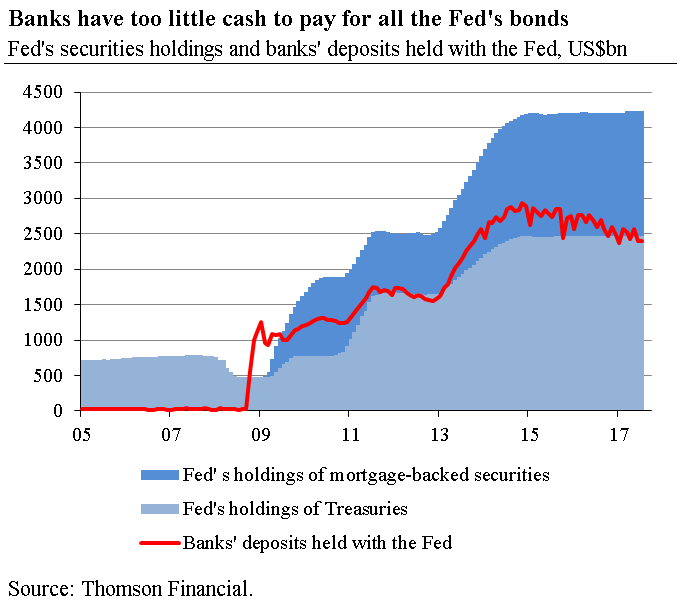
The Federal Reserve has dramatically increased its balance sheet by expanding its holding of U.S. government securities and private-sector mortgage-back securities to the tune of around $2.3 trillion. Traditional Open Market Operations plus its aggressive “quantitative easing” policy have increased bank reserves from $94.1 billion in 2007 to $1.3 trillion by April 2011, for a near fourteen-fold increase, and the monetary basis in general has expanded from $850.5 billion in 2007 to $2,242.9 billion in April of 2011, a 260 percent increase. The monetary aggregates, MZM and M-2, respectively, have grown by 28 percent and 21.6 percent over this same period.[10]
In the name of supposedly preventing a possible price deflation in the aftermath of the economic boom, Fed policy has delayed and retarded the economy from effectively readjusting and re-coordinating the sectoral imbalances and distortions that had been generated during the bubble years.[11] Once again interest rates have been kept artificially low. In real terms, the federal funds rate and the 1-year Treasury yield have been in the negative range since the last quarter of 2009, and at the current time is estimated to be below minus two percent.
This has prevented interest rates from informing market transactors what the real savings conditions are in the economy. So, once again, the availability of savings and the real cost of borrowing is difficult to discern so as to make reasonable and rational investment decisions, and not to foster a new wave of misdirected and unsustainable private sector investment and financial decisions.
The housing market has not been allowed to fully adjust, either. With so much of the mortgage-backed securities being held off the market in the portfolio of the Federal Reserve, there is little way to determine any real market-based pricing to determine their worth or their total availability so the housing market can finally bottom out with clearer information of supply and demand conditions for a sustainable recovery.
This misguided Fed policy has been, in my view, a primary factor behind the slow and sluggish recovery of the United States economy out of the current recession.
Federal Reserve Policy and Monetizing the Debt
Many times in history, governments have used their power over the monetary printing press to create the funds needed to cover their expenses in excess of taxes collected. Sometimes this has lead to social and economic catastrophes.[12]
Monetizing the debt refers to the creation of new money to finance all or a portion of the government’s borrowing. Since the early 2008 to the present, Federal Reserve holdings of U.S. Treasuries have increased by about 240 percent, from $591 billion in March 2008 to $1.4 trillion in early May 2011, or a nearly $1 trillion increase. In the face of an additional $3.6 trillion in accumulated debt during the last three fiscal years, it might seem that Fed policy has “monetized” less than one-third of government borrowing during this period.
However, the Fed’s purchase of mortgage-backed securities, no less than its purchase of U.S. Treasuries, potentially increases the amount of reserves in the banking system available for lending. And since 2008, the Federal Reserve had bought an amount of mortgaged-backed securities that it prices on its balance sheet as being equal about $928 billion.
The $1.4 trillion increase in the monetary base since the end of 2007, from $850.5 billion to $2.2 trillion, has increased MZM measurement of the money supply by $2,161.1, or an additional $769 billion dollars in the economy above the increase in the monetary base. This is an amount that is 83 percent of the dollar value of the $927 billions in mortgage-backed securities.
Due to the “money multiplier” effect – that under fractional reserves, total new bank loans are potentially a multiple of the additional reserves injected into the banking system – it is not necessary for the Fed to purchase, dollar-for-dollar, every additional dollar of government borrowing to generate a total increase in the money supply that may be equal to the government’s deficit.
Thus, it can be argued that Fed monetary policy has succeeded, in fact, in generating an increase in the amount of money in the banking system that is equal to two-thirds of the government’s $3.6 trillion of new accumulated debt.
That the money multiplier effect has not been as great as it might have been, so far, is because the Federal Reserve has been paying interest to member banks to not lend their excess reserves. This sluggishness in potential lending has also been affected by the general “regime uncertainty” that continues to pervade the economy. This uncertainty concerns the future direction of government monetary and fiscal policy. In an economic climate in which it difficult to anticipate the future tax structure, the likely magnitude of future government borrowing, and the impact of new government programs, hesitancy exists on the part of both borrowers and lenders to take on new commitments.
But the monetary expansion has most certainly been the factor behind the worsening problem of rising prices in the U.S. economy and the significant fall in the value of the dollar on the foreign exchange markets.
The National Debt and Monetary Policy
It is hard for Americans to think of their own country experiencing the same type of fiscal crisis that has periodically occurred in “third world” countries. That type of government financial mismanagement is supposed to only happen in what used to be called “banana republics.”
But the fact is, the U.S. is following a course of fiscal irresponsibility that may lead to highly undesirable consequences. The bottom line truth is that over the decades the government – under both Republican and Democratic leadership – has promised the American people, through a wide range of redistributive and transfer programs and other on-going budgetary commitments, more than the U.S. economy can successfully deliver without seriously damaging the country’s capacity to produce and grow through the rest of this century.
To try to continue to borrow our way out of this dilemma would be just more of the same on the road to ruin. The real resources to pay for all the governmental largess that has been promised would have to come out of either significantly higher taxes or crowding out more and more private sector access to investment funds to cover continuing budget deficits. Whether from domestic or foreign lenders, the cost of borrowing will eventually and inescapably rise. There is only so much savings in the world to fund private investment and government borrowing, particularly in a world in which developing countries are intensely trying to catch up with the industrialized nations.
Interest rates on government borrowing will rise, both because of the scarcity of the savings to go around and lenders’ concerns about America’s ability to tax enough in the future to pay back what has been borrowed. Default risk premiums need not only apply to countries like Greece.
Reliance on the Federal Reserve to “print our way” out of the dilemma through more monetary expansion is not and cannot be an answer, either. Printing paper money or creating it on computer screens at the Federal Reserve does not produce real resources. It does not increase the supply of labor or capital – the machines, tools, and equipment – out of which desired goods and services can be manufactured and provided. That only comes from work, savings and investment. Not from more green pieces of paper with presidents’ faces on them.
However, what inflation can do is:
Accelerate the devaluation of the dollar on the foreign exchange markets, and thereby disrupting trading patterns and investment flows between the U.S. and the rest of the world;
Reduce the value, or purchasing power, of every dollar in people’s pockets throughout the economy as prices start to rise higher and higher;
Undermine the effectiveness of the price system to assist people as consumers and producers in making rational market decisions, due to the uneven manner in which inflation impacts of some prices first and affects others only later;
Potentially slow down capital formation or even generate capital consumption, as inflation’s uneven effects on prices makes it difficult to calculate profit from loss;
Distort interest rates in financial markets, creating an imbalance between savings and investment that sets in motion the boom and bust of the business cycle;
Create incentives for people to waste their time and resources trying to find ways to hedge against inflation, rather than devote their efforts in more productive ways that improve standards of living over time;
Bring about social tensions as people look for scapegoats to blame for the disruptive and damaging effects of inflation, rather than see its source in Federal Reserve monetary policy;
Run the risk of political pressures to introduce distorting price and wage controls or foreign exchange regulations to fight the symptom of rising prices, rather than the source of the problem – monetary expansion.
What is To Be Done?
The bottom line is, government is too big. It spends too much, taxes too heavily, and borrows too much. For a long time, the country has been trending more and more in the direction of increasing political paternalism. Some people argue, when it is proposed to reduce the size and scope of government in our society, that this is breaking some supposed “social contract” between government and “the people.”
The only workable “social contract” for a free society is the one outlined by the American Founding Fathers in the Declaration of Independence and formalized in the Constitution of the United States. This is a social contract that recognizes that all men are created equal, with governmental privileges and favors for none, and which expects government to respect and secure each individual’s right to his life, liberty, and honestly acquired property.
The reform agenda for deficit and debt reduction, therefore, must start from that premise and have as its target a radical “downsizing” of government. That policy should plan to reduce government spending across the board in every line item of the federal budget by 10 to 15 percent each year until government has been reduced in size and scope to a level and a degree that resembles, once again, the Founding Father’s conception of a free and limited government.[13]
A first step in this fiscal reform is to not increase the national debt limit. The government should begin, now, living within its means – that is, the taxes currently collected by the Treasury. In spite of some of the rhetoric in the media, the U.S. need not run the risk of defaulting or losing its international financial credit rating. Any and all interest payments or maturing debt can be paid for out of tax receipts. What will have to be reduced are other expenditures of the government.
But the required reductions and cuts in various existing programs should be considered as the necessary “wake-up call” for everyone in America that we have been living far beyond our means. And as we begin living within those means, priorities will have to be made and trade-offs will have to be accepted as part of the transition to a smaller and more constitutionally limited government.
In addition, the power of monetary discretion must be taken out of the hands of the Federal Reserve. The fact is, central banking is a form of monetary central planning under which it is left in the hands of the members of the Board of Governors of the Federal Reserve to “plan” the quantity of money in the economy, influence the value or purchasing power of the monetary unit, and manipulate interest rates in the loan markets.
The monetary central planners who run the Federal Reserve have no more or greater knowledge, wisdom or ability that those central planners in the old Soviet Union. The periodic recurrence of the boom and bust of the business cycle demonstrates that there is no way for them to get it right – in spite of them saying, again and again, that “next time” they will get it right.
It is what the Nobel Prize-winning, Austrian economist, Friedrich A. Hayek, once called a highly misplaced “pretense of knowledge.” That is why in a wide agenda for reform, the goal should be to move towards a market-based monetary system, the first step in such an institutional change being a commodity-backed monetary order such as a gold standard.[14]
And in the longer-run serious consideration must be given the possibilities of a monetary system completely privatized and competitive, without government control, management, or supervision.[15]
The budgetary and fiscal crisis right now has made many political issues far clearer in people’s minds. The debt dilemma is a challenge and an opportunity to set America on a freer and potentially more prosperous track, if the reality of the situation is looked at foursquare in the eye.
Otherwise, dangerous, destabilizing, and damaging monetary and fiscal times may be ahead.
[1] The 2011 Statistical Abstract: The National Data Book (Washington, D.C., U.S. Census Bureau, 2011), Table 669.
[2] Richard M. Ebeling, Why Government Grow: The Modern Democratic Dilemma,” AIER Research Reports, Vol. LXXV, No. 14 (Great Barrington, MA: American Institute for Economic Research, August 4-18, 2008); James M. Buchanan and Richard E. Wagner, Democracy in Deficit: The Political Legacy of Lord Keynes (New York: Academic Press, 1977); and earlier, Henry Fawcett and Millicent Garrett Fawcett, Essays and Lectures on Social and Political Subjects (Honolulu, Hawaii: University Press of the Pacific, [1872] 2004), Ch. 6: “National Debts and National Prosperity,” pp. 125-153.
[3]The Budget and Economic Outlook: Fiscal Years 2011 to 2021 (Washington, D.C.: Congressional Budget Office, January 27, 2011)
[4] Richard M. Ebeling, “Brother, Can You Spare $43 Trillion? America’s Unfunded Liabilities,” AIER Research Reports, Vol. LXXVI, No. 3 (Great Barrington, MA: American Institute for Economic Research, March 2, 2009), pp. 1-3.
[12] See, Richard M. Ebeling, “The Lasting Legacies of World War I: Big Government, Paper Money, and Inflation,” Economic Education Bulletin, Vol. XLVIII, No. 11 (Great Barrington, MA: American Institute for Economic Research, November 2008), for a detailed example of the German and Austrian instances of monetary-financed inflationary destruction following the First World War.
Want to know what is the biggest threat to your prosperity? Look no further than the policy statement released last night by the U.S. Federal Open Market Committee (FOMC)– America’s monetary politburo, the nation’s committee for financial central planning staffed with a select group of highly educated bureaucrats and guided by a former economics professor, and continuously engaged in administratively setting interest rates, manipulating asset prices and determining the extent of lending in what is really the pseudo-capitalist economy of the U.S. of A.
I don’t mean the specific wording of the statement that gets the economists on Wall Street so excited – what phrase did they change? Is this more hawkish or more dovish than last month’s statement? – Who cares? What matters is the sheer and utter economic idiocy underlying the Federal Reserve’s ‘mandate’ and at the core of practically every fiat money central bank. What you see in this statement – black on white – is the conceptual lunacy at the heart of our global paper money system, the reason we are in a massive crisis and about to get deeper into it.
The core belief enshrined in this document, and indeed in every Fed policy statement, is this: the central bank can and should, via discretionary changes in the supply of state paper money, affect interest rates in such a way that the economy reaches full employment and enjoys stable prices. What frivolous hubris! In a proper market economy, interest rates would, of course, be set by the market and result from the free interplay of voluntary saving and voluntary investment decisions by independent agents. Alas, not so in our semi-socialist system of state-controlled fiat money with a central planning bank. The committee knows better what interest rates and asset prices the economy needs to reach its full potential. After all, the committee is staffed with really clever people. Such things cannot be left to the public – or the market.
Think about the puerile assumption behind this: good, lasting and competitive jobs, one assumes, not as a result of saving, capital formation and entrepreneurial risk taking but as a result of clever monetary manipulation by the FOMC. And as the committee has ascertained that, presently, the US public is not reaching its full economic potential, Americans need to be cajoled into doing better with continuing super low interest rates that encourage them to go further into debt, and with bond prices delicately manipulated via the Fed’s debt monetisation program. This is such unspeakable rubbish, and such a shameless declaration of administrative arrogance, I can’t believe that many people outside the common-sense-free ivory tower of the MIT economics department and the privileged paper money aristocracy take this seriously. My sense is that fewer and fewer people in the real world do.
This idiotic assumption is the reason the entire world has, over the past forty years, converted from commodity money, or, paper money at least tentatively linked to commodities, to complete fiat money systems in which the supply of money is not only fully elastic and unrestricted by any ‘barbaric’ raw materials – shudder! – but under the full control of the enlightened and well-meaning state bureaucracy. By injecting new money into the economy, full employment can be generated. Fantastic! No really, it is fantastic. I mean fantastic as in imaginary, fanciful, implausible, incredible, insane, ludicrous, mad, irrational, nonsensical, outlandish and preposterous. That type of fantastic.
Make no mistake. This system is not only suboptimal, it is unsustainable. And we have already reached the endgame.
Imagine a country where the average household routinely spends half its $100 income on buying in 4,000 calories a day of flour and half on all the other necessities, as well as the little luxuries, of life.
Next, picture the response if the subjectively perceived degree of scarcity of flour suddenly rises, pushing its price up 20% as it does. To keep matters as simple as possible, let us not delve too deeply into the whys and wherefores of this impetus, but simply let us insist it is not because of any actual shortage of physical supply on the cash market.
Assuming that demand for this staple of its members’ diet is close to an irreducible minimum, and that, in its anxiety to maintain its basic nutritional needs, the family will henceforth have to spend $60 on flour instead of $50 and so will be left with a mere $40 to devote to its purchases of everything else in place of the previous $50.
Supposing, too, that money in this benighted land is no longer an emergent construct of mutual intercourse and free exchange – and therefore, in some sense, ‘hard’ – but is rather issued without restraint, at the whim of a central collective of Platonic Guardians.
Let us further insist that Hoi Phylakes see it as their calling to ensure that the averaged prices of all things other than flour can never decline and, subject to some very woolly and ill-defined limits on how much politically insupportable harm they cause in the attempt, that no-one shall lack employment for reasons which a loose-thinker might attribute to a simple lack of money, no matter how sub-marginal or even blatantly unremunerative his labours might be.
Now, given that the jump in the price of flour has – at least as a first-round effect – led to only $4 being offered for a basket of goods which used to attract an offer of $5, the combined effect (differentiated among them as it will be in practice) is that they will fall in price by something of the order of 20%. Barring some miracle of instantaneous cost cutting, the total wage bill at the firms in that line of business will need to be reduced proportionately, meaning steep wage cuts or heavy job losses – each of them anathema to the Keynesian creed of orthodox economics.
Enter the central bank, stage right. If the lack of a post-flour disposable $10 (per household) has seen ‘deflation’ of such a hideous magnitude set in among the arbitrarily flour-excluding array of goods which it monitors, the instant addition of another $10 pro rata to the money supply should, it feels, set matters straight at once.
Alas for the conceit of the planner, for, as our original premise made clear, consumer preferences have decisively shifted in favour of buying flour not other goods, to settle at a new ratio of 60/40. Thus, the new exchangeable total of $110 (assuming the extra money to have been placed into the hands of the same family and not diverted off into some other passing fad or siphoned craftily into the pockets of the politically well-connected) is likely to have $66 of it used for flour and only $44 laid out on the rest, so ‘core deflation’ (in reality nothing of the sort, of course) will only have been ameliorated to -12% and not banished entirely, as was the naïve intention.
Chasing on through this battle of wills between the state and the individual – and still ignoring second order effects – an equilibrium might only be looked for when the supply of money has been artificially swollen by no less than a quarter – to $125 per household – whereat each family can spend three-fifths ($75) of this, as they desire to do, on flour and two-fifths – or the original $50 – on everything else and so finally eliminate ‘core consumer price deflation’ if only at the cost of magnifying the original, steep 20% rise in the price of flour to a vertiginous, final 50%.
Of course, that would not be an end of it, for none of this has masked a major alteration in the terms of trade between people in their (often simultaneous) roles as flour producers and consumers, nor between them in their non-flour equivalents. Ultimately, one set has benefited from the shift and one has lost out.
Granted, to the extent that flour producers and flour consumers are not entirely one and the same body of people and, hence, may express a varying menu of preferences, the former may seek to enjoy their relatively higher incomes by buying things other than flour for themselves and so partially mitigate the real effects on others.
Moreover, the change in relative pricing (something which would have taken its natural course even if there had there been no Ivory Tower full of academic meddlers and shallow special-pleaders) will have sent signals to people everywhere that they need to further adjust to a change of circumstances largely of their own creation. Thus, they might more closely review their use of the newly-expensive flour, making sure they maximise its utility and minimise any inefficiencies or identifiable excesses in its use.
They might devote care and attention to improving grain yields, bringing more land into cultivation, automating the milling process, easing the logistics of delivery to the point of sale, and even to developing alternative sources of sustenance.
Meanwhile, the producers of non-flour goods – who nonetheless also require their daily bread if they are to have the energy to man their own offices and factories – will seek to change the ratio between the necessary flour input (and, indeed, of any other inputs) and both the physical output – and, more importantly, the value entrained therein – of what they sell in order to earn that same bread, whether for personal consumption or productive uptake.
All in all, the initial shift in relative prices – however painful to those caught unawares by it and however threatening to those improvident enough to be conducting their business without an adequate reserve against this or any similarly unforeseen vicissitude – will incentivise savers to direct funds to those entrepreneurs whose own success will depend upon serving the currently expressed preferences of their customers better than their competitors and who, along the way, will slowly but surely lessen any constraints imposed by the original re-ordering of wants.
It cannot be too strongly emphasised that this would have happened whether or not the central bank had embarked upon its Canute-like programme of futile – or, rather, actively counter-productive – monetary infusions. These will only have multiplied the confusions over both the nature and the degree of the shift which was taking place and so delayed the implementation of the necessary schedule of adaptations, something which could have been most swiftly and least wastefully realised on an entirely unhampered market.
However, given the all-but inevitable fact of the Bank’s visitations, let us pause a moment to reckon the true achievements of our pecuniary Politburo in its vainglorious attempt to frustrate the workings of economic law.
Above all, it has thrown obstacles in the paths of both the consumers and the entrepreneurs who seek to direct the productive methods by which those same consumers’ efforts aim to satisfy their own needs – whether through offering their current labour or the savings which represent the unharvested fruits of their earlier labour.
It has effected an inequitable transfer of real wealth from creditors to debtors as a result of the sharp reduction in the value of the money in which the contracts between the two are written. It has probably done something similar to relations between counterparts at home and abroad through the effect on the currency exchange rate – something in which it will take a truly perverse degree of pride. In each case it will have made people more distrustful of acting according to that very division of labour, both across space and through time, which is what so enriches us all.
It has protracted and exacerbated the first, spontaneous rise in the price of flour with no better aim than to give everyone else the illusion that their stabilized nominal receipts have in some way compensated for their sharply fallen real ones – a cruel enough illusion if it succeeds: a fertile seed of social discontent if it does not.
It is also likely to have involved the heavy-handed intervention of the other organs of state power. These will probably stir up animosity towards the flour producers (especially if they live abroad) even to the point of penalising them retrospectively (an affront to natural justice) and so stripping them of both the motivation and the means to increase supply.
In their inept, après moi le déluge populism, they may well stoop to subsidising the consumption of that very flour which the public interest insists should be the subject of a much closer economy of use. They will probably invoke an aggressive policy of autarky, banning exports and paying tax- or inflation-dollars to homegrown Ersatz boondogglers while spreading the discord across the nations’ borders to the detriment of all concerned.
Never wasting a ‘good crisis’, all this will inevitably enhance the office-holders’ power of patronage and increase the rents paid to their cronies at the expense of the well-being of all other members of the commonwealth at large.
Finally, the central bank will have helped fuel an increasingly feverish round of financial market speculation – not just in flour but, as the all-too fungible money pours into the system and the itch to play with it becomes undeniable, in all manner of other things as well. ‘Speculators’ – the most active of them ironically housed within or financed by the central authority’s very own, cherished recipients of corporatist largesse and protection – will then provide a convenient scapegoat upon whom to deflect all criticism about the economic pain being suffered as the result of its own criminally misguided actions.
I hardly need to say that to substitute ‘oil’ for ‘flour’ or to specify one central bank in particular is to turn our little Gedanken economy into a passably close representative of the situation in which we all find ourselves today, one from which there seem to be all too few pathways not strewn with thorns, their paving of good intentions long-since broken up into a wearisome thoroughfare of jagged rocks and ankle-twisting potholes.
In fact, in command of the Federal Reserve is a coterie which is at once seeking to rationalise away its implication in rising commodity prices—the infamous argument about the cheaper, hedonised iPad2 being enough to mitigate the strain on household budgets imposed by the soaring price of necessities—and simultaneously relying upon a future deceleration in their rise to make subsequent year-on-year changes less contentious, simply by dint of the arithmetical ’basis effect.’
As well as being a decidedly obvious attempt at having things both ways, what we really have here is a hidden policy of rehashed, New Deal, price leveltargeting—i.e., price rises are not only not to be fought, but actively encouraged, so long as these erode both real debt levels and real wages, although it is also to be hoped that they do not increase for too long at the current rapid rate, lest that conditions an economic response which is only likely to see them spiral upward in a disastrously quickening fashion as echoes of Mises’ famous ‘crack-up boom’ begin to be heard.
Against this, the market has become somewhat fixated on what happens at the end of June when the current monetization of the misconduct of a derelict fiscal authority is due to end—an obsession which has some justification given that it has arguably been the single most important factor in a 32-week run which has led to the fastest, like-period gains in commodity prices since the first oil shock and to a rise in the S&P which, before being dampened by events in the Middle East and the Miyagi prefecture, had touched a rapidity only lately exceeded during the initial rebound from the GFC, the Tech Bubble, and the run-up to the Crash of ‘87.
Even if the winds are blowing against any immediate extension of this insanity, there seems little doubt that the Bernanke Fed is concreted into a position of chronic over-laxity and that if both asset prices and the macroeconomic aggregates subsequently start to suffer a bout of cold turkey, it will not be too long before the political calculus once again begins to coincide with the prejudicial leaning of the Chairman and his acolytes on the FOMC and some other, equally ill-advised measures are taken in response.
Two further market reactions may well prove conducive to such an early resumption of the game.
Firstly, much hinges on the fate of Treasury yields which will only have the support from any emergent ‘Risk Off’ move to help them and not the rather more tangible backstop of a near-100% central bank bid for net new debt. By seemingly ‘overtightening’ asset markets—and by dint of its possible repercussions for stock prices — this would see a widespread chorus of complaints—emanating from Wall St. as well as the Beltway—in favour of a prompt resumption of the policy of the printing press.
Secondly, any liquidation-led drop in key commodity prices—most notably oil – will strengthen the Fed’s hand in arguing, however speciously, that it was right all along not to compound the economically disruptive effects of a rapid rise in the stuff with a succession of higher interest rates, as was typically its response in the past.
Beyond the influence exerted by the Fed (and the policy paralysis evident at the BOE), we have seen the ECB make good on its threat to act just a little more responsibly when it raised its rates by 25bps and then backing this up with some reasonably forthright rhetoric which implies that the market is right to fear that there might be more in store where that came from.
In truth, we should not be as harsh about the bankers in Frankfurt as we are about their transatlantic peers, since the ECB has been reasonably successful in ring-fencing its emergency, quasi-fiscal role as financier of bust PIGS from its more typical function of providing liquidity to the system at large. So much so, in fact, that real Eurozone M1 is barely growing at all, having undergone its sharpest deceleration in at least thirty years—a grand aggregate phenomenon which presumably masks sharply divergent behaviour in a Germany where industrial production is rising at a trend 10% a year pace to within a whisker of its pre-Crash highs and the blighted, over-built periphery where the weeds are metaphorically springing up in the half-completed streets.
As for China, despite a swathe of surprisingly forthright local commentary underlining the inflationary horror which was unleashed by last year’s vast stimulus efforts, its central bank’s latest incremental tightening has been greeted with a yawn by a market both increasingly conditioned to such measures and wilfully optimistic that each such move simply hastens the great day when the series will end and we are off to the races again, trading everything frantically up on the wings of a newly invigorated Dragon.
That leaves as perhaps the most salient question to confront us as that relating to the side-effects of the BOJ’s programme of emergency liquidity injections, loan-support programmes, forex intervention, and—potentially—fiscal backstopping for another creakingly over-burdened state.
Already the Bank’s balance sheet has climbed to post-Lehman heights and the count of current account (reserve) balances has soared beyond all previous comparison, breaking the yen out against nearly every currency pairing of significance and taking risk reversals and basis swaps and other such positioning indicators with them.
The burning issue here, then, is this: in its misplaced anxiety to assist its people by showering them with money amid the rubble of their lives and homes, will the BOJ do enough to re-instate the yen as carry currency of choice and so negate any contractionary effects (however ephemeral) of the coming end of QE-II in the US?
The idea of a neutral interest rate emanates from the writings of the Swedish economist Knut Wicksell. According to Wicksell,
There is a certain rate of interest on loans which is neutral in respect to commodity prices, and tend neither to raise nor to lower them. This is necessarily the same as the rate of interest which would be determined by supply and demand if no use were made of money and all lending were effected in the form of real capital goods.
In other words, the neutral rate of interest is defined as the rate at which the demand for physical loan capital coincides with the supply of savings expressed in physical magnitudes. (Note that once the neutral rate is reached, the state of equilibrium is attained — implying that the economy is now well balanced and the price level is stable).
The main source of economic instability, it is held, is the variance between the money market interest rate and the neutral rate. If the market rate falls below the neutral rate, investment will exceed saving, implying that aggregate demand will be greater than aggregate supply. Assuming that excess demand is financed by an expansion in bank loans, this leads to the creation of new money, which in turn pushes the general level of prices up.
Conversely, if the market interest rate increases above the neutral rate, savings will exceed investment, aggregate supply will exceed aggregate demand, bank loans and the stock of money will contract, and prices will fall. Hence, whenever the market rate is in line with the neutral rate, the economy is in a state of equilibrium and there are neither upward nor downward pressures on the price level.
Again, this theory posits that deviations in the money market interest rate from the neutral rate is what sets in motion changes in the money supply which in turn disturb the general price level. Consequently, it is the role of the central authority to bring money market interest rates in line with the level of the neutral rate of interest.
According to this view, in order to establish whether monetary policy is tight or loose it is not enough to pay attention to the level of money market interest rates; rather one needs to contrast money market interest rates with the neutral rate. If the market interest rate is above the neutral rate then the policy stance is tight. Conversely, if the market rate is below the neutral rate then the policy stance is loose.
However, how is one to implement this framework? The main problem here is that the neutral interest rate can’t be observed. How can one tell whether the market interest rate is above or below the neutral rate?
Wicksell suggested that policy makers pay close attention to changes in the price level. A rising price level would call for an upward adjustment in the money market interest rate, while a falling price level would signal that the money market interest rate must be lowered.
According to the Wicksellian framework, in order to maintain price stability and economic stability, once the gap between the money market interest rate and the neutral rate is closed the central bank must at all times ensure that a gap does not re-emerge. In the Wicksellian framework a monetary policy that maintains the equality between the two rates becomes a factor of stability. But is this possible? After all, maintaining this equality means that the central bank would have to manipulate the supply of money, which in turn will only make things unstable. (In the present monetary system the Fed is actually directly engaged in the manipulation of the federal funds rate rather than money supply).
What the Fed is trying to achieve belongs to the world of a true free market economy. In a free market economy without a central bank, there would be no such thing as monetary policy. In the absence of central bank monetary policies the interest rates that emerge would be truly neutral.
Also, in a free market no one would be required to establish whether the interest rate is above or below some kind of imaginary equilibrium. In a free market, with the absence of money creation, there is no need for a policy to restrain increases in the price level.
The whole idea of the neutral interest rate is unrealistic insofar as we have a Fed that continuously tampers with interest rates and the money supply. Given the impossible goal that the Fed is trying to achieve, we do not expect Fed policy makers to become wise and all-knowing with regard to the correct level of the interest rate.
For a broader exposition of the ideas in this article, see this Mises.org article, on which it is based.
A good article from Jeffrey Rogers Hummel at George Mason’s History News Network:
The Federal Reserve’s H.4.1 Release for January 6, 2011, announced an accounting change in the Fed’s reporting of residual earnings distributed to the U.S. Treasury. This has raised alarm bells, not only among libertarian critics of the Fed (here and here) but also among others. The concern is that it will now be easier for the Fed to disguise losses from its expanded portfolio of potentially toxic assets and possibly even avoid any resulting insolvency. While there is an element of truth to this concern, in the final analysis, the accounting change hardly matters at all.
Another classic article, brought forward. This is a speech by James Tyler to the Adam Smith Institute Next Generation Group on 6 October 2009. This speech is also available on hedgehedge.com.
I have spent the best part of the last two decades pitting my wits against the market. It’s an unforgiving game: I’ve seen ups and downs, and many of my rivals buried under an avalanche of hubris, passion, illogical thought and unchecked emotion.
I have witnessed the sheer folly of the ERM crisis, the Asian crisis, the failure of the Gods at Long Term Capital Management and the insanity of the tech boom.
I have enjoyed the ‘NICE’ decade (Non-Inflationary Constant Expansion), and scared myself silly during the credit crisis.
I am a trader.
I risk my own money and live or die by my decisions, and face the threat of personal bankruptcy every time I switch my screens on. I get no salary – indeed I turn up at the start of the month with a large office overhead – a ‘negative’ salary. I have no fancy company pension scheme, no lucrative monopoly or franchise.
I eat what I kill.
Mistakes cost me my livelihood, so, above all, my decisions have to be rooted in practical and logical decision making.
Some have called my kind parasitic, but I would have said that I bring order, efficiency, predictability, stability and deep liquidity to a crucial process: a process that makes the whole world keep ticking.
I make money work.
I make the market in interest rate derivatives: a market born out of the neo classical revolution in finance fostered in Chicago during the 1970s. I am a child of Friedman, Fisher Black, Myron Scholes and the modern international financial system.
My analysis was steeped in the neo-classical, efficient markets paradigm.
Friedman’s ideal was working. Enlightened central bankers guided the free market with gentle nudges and short term liquidity infusions, free floating currencies gently adjusted themselves to the constant flow of new information and efficient and rational markets took all in their stride.
Credit flowed, people got wealthier, economies developed and all was well.
This is a high quality version of the Financial Services Subcommittee on Oversight and Investigations hearing of May 5, 2009.
Rep. Alan Grayson asks the Federal Reserve Inspector General about the trillions of dollars lent or spent by the Federal Reserve and where it went, and the trillions of off balance sheet obligations. Inspector General Elizabeth Coleman responds that the IG does not know and is not tracking where this money is.
You therefore might have expected Mr Fisher to toe the FOMC ‘party’ line on all things to do with the $14 trillion dollar debt of the US government and the pronouncements of Federal Reserve Chairman of the Board, Ben Bernanke. However, the bubbled pressures within the federal reserve system are finally beginning to generate some deep visible cracks upon the marbled public edifice of the Marriner S. Eccles Federal Reserve Board building.
Take a look at these fascinating quotes from Mr Fisher, in a speech he gave on January the 12th. The first sentence alone is remarkable enough:
Today, I will speak to the truth as I see it. I speak only for myself and my colleagues at the Dallas Fed and not for anybody else on the FOMC or elsewhere in the System. I suspect this will immediately become clear.
It does…
The Federal Reserve has held rates to nil. We have expanded our balance sheet to unprecedented levels. After much debate―which included strong concern expressed by one member with a formal vote and others, like me, who did not have voting rights in 2010―the FOMC collectively decided in November to temporarily undertake a program to purchase U.S. Treasuries that, when added to previous policy initiatives, roughly means we are purchasing the equivalent of all newly issued Treasury debt through June.
By this action, we have run the risk of being viewed as an accomplice to Congress’ fiscal nonfeasance. To avoid that perception, we must vigilantly protect the integrity of our delicate franchise. There are limits to what we can do on the monetary front to provide the bridge financing to fiscal sanity.
There’s little Kreminology required to translate this uncoded 32 pound ball across the bows of USS Bernanke.
And there’s more…
The entire FOMC knows the history and the ruinous fate that is meted out to countries whose central banks take to regularly monetizing government debt. Barring some unexpected shock to the economy or financial system, I think we have reached our limit.
Perhaps we should invite Mr Fisher to become our central banking analyst here at the Cobden Centre?
The [recent US] election tapped into a foreboding sense that the cost of that comfort now exceeds its benefits, as manifest in looming megadeficits, deep if not unfathomable unfunded liabilities, egregious abuse of fiscal powers symbolized by earmarks and other methods used by politicians to grease the skids of their reelection.
Tapping into that foreboding in the recent election was the easy part. Talk of reform is cheap. Enacting reform will be painful.
Without dwelling too long upon earmarks, the paragraphs above could almost have been written by Congressman Ron Paul.
To make things even more interesting, the next section could almost have been written by President Andrew Jackson, the heroic destroyer of the Second Bank of the United States (a central banking predecessor to the Federal Reserve).
We shall see if the new Congress will prove worthy of the power the American people have “loaned” them, and, together with the president, actually draw the spirits of fiscal reform and sanity from the “vasty deep” to at long last implement meaningful fiscal and regulatory policy that incentivizes private-sector job creation here at home while arresting the hemorrhaging of our Treasury. If they do, then more Americans will find work and be better off, better paid and freer to make their own decisions about the economy.
If they don’t, then woe to our children, their children and the American Dream.
This potentially watershed speech is worth reading in its entirety.
It was with a certain wry amusement that I read on Bloomberg about how Republicans in Congress are attempting to stop Federal Reserve chairman Ben Bernanke from debauching the dollar further via a second bout of quantitative easing (i.e., creation of new credit out of thin air). The tone of the piece is not that hostile to the Republicans making this attempt.
Given the dramatic reverse for the ruling Democrats in early November, there could be a decent chance that even if the Fed is able to go on down the path to monetary lunacy, that at least it will no longer have political cover from those men and women on the hill. If the Republicans can make “honest money” a serious campaign slogan for the race for the White House, it should hopefully create a good environment for our ideas.