Economics

Regulating towards depression

There have been many books attempting to find and explain the causes of the ongoing financial crisis.  Authors have approached the issue from all sorts of ideological perspectives and with different sets of evidence.  Most of these works are lacking, incomplete, or even flat-out wrong.  Many of them do not even care for the facts, instead using vague generalizations to justify the application of broad economic theories.  There has not, until recently, really been a meticulous analysis of the mechanics of the causes of the Great Recession, despite the enormous interest displayed by the economics profession in the subject.

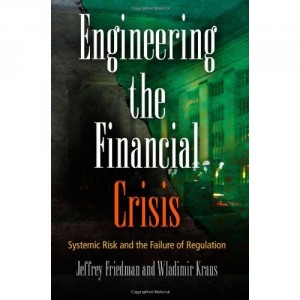
This lacuna has been filled by Jeffrey Friedman, editor of Critical Review, and Wladimir Kraus, in their recently published book: Engineering the Financial Crisis.   The authors make the purpose of their study evident from the very beginning.  They shed themselves of any ideological priors which may have otherwise impaired their analysis, even going as far as to disprove a number of general theories from either side of the spectrum (insufficient regulation versus insufficient economic freedom), and task themselves simply with accumulating, analyzing, and interpreting the evidence.  The data they look at has to do with the regulations which governed the financial institutions that presided over the network of financial instruments which suddenly lost the bulk of their value.  The question they ask is a simple one: based on the facts, was the recession caused by under-regulation or was it something in the regulation itself which may have influenced the ways banks invested?

Friedman and Kraus give reason to believe that it was the latter — perverse regulations — which gave way to the great contraction which took place between 2007 and 2009.  Looking through the relevant legislature which dictates the laws governing the banking industry, the authors find that it was this regulatory web which led banks to invest in the specific financial assets that would soon after be deemed nearly worthless.

Friedman and Kraus emphasize the importance of the fact that the banking industry had no idea — what they call “radical ignorance” — about just what kind of quagmire they were investing themselves into.  They use evidence to illustrate the fact that, predominately speaking, the bankers, regulators, politicians, and other major actors in this crisis had absolutely no idea of the relevant potential for a recession to occur, let alone that the highly rated assets they invested into would soon become relatively valueless.

We can see now the broad thesis of Engineering the Financial Crisis.  Bankers did not buy large amounts of soon-to-be “toxics assets” because the risk had been externalized to the taxpayer. [1] Neither is their any evidence suggesting that bankers purposefully ignored high risk in favor of pursuing high profits.  The majority of assets purchased were actually AAA rated, and because of this the risk-load they carried, as perceived at the time of purchase, was relatively low.  What manipulated the relevant price signals which funneled investment into the housing market were regulations which rewarded these type of investments. To a lesser extent, the authors also point at government programmes which pushed for house ownership and the relatively low rates of interest on new loans which made borrowing seemingly more affordable.

Leading up to the crisis, bankers were generally very risk sensitive, preferring assets with lower revenue returns.  Roughly 93 percent of mortgage bonds held by U.S. Commercial banks were AAA-rated mortgage backed securities (both private label [PLMBS] and agency rated [MBS]), and almost another 7 percent were AAA-rated collectivized debt obligations (CDO). [2] Missing from this collection of assets were any mortgage bonds rated less than AAA, which were usually the bonds which the highest rate of return.

Most commercial banks in the United States were also above their legal capital reserve minimum on the eve of the financial crisis — the twenty largest banks held capital levels averaging 11.7 percent, where the legal minimum was 10 percent of a bank’s total assets (as dictated by the Federal law, whereas the Basel I accords had set it at 8 percent).  More specifically, if one only accounts for “Tier 1” capital [3] banks retained a capital cushion of 50 percent, even while federal law required a minimum of 5%.  In other words, most banks opted to retain a substantial capital cushion, where one would expect a bank interested in maximizing profit (while ignoring risk) to push the boundaries of its legal requirements. [4]

The issue, then, was not about bankers with low risk aversion, seeking high profits by investing mostly in high-risk assets.  The evidence suggests quite the contrary.  U.S. commercial banks invested in what were perceived as low-risk, low-return assets, and on top of this held higher than required capital cushions.  Also going out the window is the “too big to fail” theory, or any other case that argues that it was risk externalization which created an incentive for an over-concentration of investment into the mortgage market.  Simply put, there was a high aversion to risk during the years leading up to the crisis.

Friedman’s and Kraus’ explanation of what caused the crisis can be divided into two parts: what caused the over-concentration of investment into mortgage-backed securities and why these securities, which by 2008 had lost the majority of their value, had been rated so highly by the major rating agencies.  The strength of their book is found in its accounting of the first — what led to the pattern of investment that characterized U.S. commercial bank assets prior to the recession.

Because different types of investments generally have different degrees of risk, a capital requirement minimum that encompasses all assets is illogical.  Rather, it makes more sense to create different capital reserve requirements for different sorts of investments, based on the general perceived riskiness of the different types.  The Basel I accord was an attempt to correct the issues of a homogenous treatment of assets by creating different categories and attaching a capital reserve minimum to each category.  Higher risk assets, therefore, were categorized into higher “risk buckets” and required a greater capital cushion.  In other words, the greater the risk the asset carried, the more it cost the banks to protect against, by reducing the amount of capital available to invest.

The issue, as explained by Friedman and Kraus, is that these regulations led to “regulatory arbitrage”.  For example, a bank could invest into mortgage bonds with a risk-weight of 50 percent, then re-sell these bonds to a government sponsored enterprise (such as Freddie Mac and Fannie Mae), and buy them back as an agency bond.  These agency bonds were risk-weighted at 20 percent, effectively reducing the capital cushion necessary to back the asset, even though the composition of the asset remained exactly the same.  The Basel regulations made it more expensive to issue business loans than home loans, creating a financial incentive to issue more home loans.  Basel I created incentives for banks to make certain types of loans and then securitize them.

A further boon to securitization came with the adoption of the Recourse Rule, which borrowed the Basel II accord’s method of rating privately issued securitized assets by risk.  This system caused banks to increase investment in AAA-rated securitized mortgage bonds, especially since the risk-weight of unsecuritized mortgages remained at 50 percent (as dictated by Basel I).  It remained cheaper to invest in mortgages, rather than other types of loans to consumers and businessmen, and then banks could further increase profitability by securitizing these mortgages and releasing part of their capital reserves for further investments.  This explains the concentration of investment in mortgage backed securities.

We see a pattern between 2001 and 2007 of an increase in housing loans and investment into mortgage backed securities.  We know that at the time these types of investments being made were being pooled into buckets which were considered generally less risky than other forms of investment.  It was not an issue, therefore, of carrying on more risk.  In fact, this pattern of investment was created out of the fact that the regulations incentivized purchase of less risky assets.  The problem which led to the financial collapse, therefore, deals exclusively with the fact that these assets carried more risk than was originally perceived by the regulators (and banks).  In fact, the collapse of the subprime mortgage market came as a total surprise, both for the bankers and the regulators.

It was not just the architecture of the impending financial collapse that the regulatory web was responsible for, but also the magnification of the disaster.  Thanks to the capital reserve minima, many banks faced insolvency even though the circumstances did not really call for it.  In order to remain legally solvent, U.S. banks are forced to maintain a certain capital reserve minimum.  As the crisis unfolded, bonds which had been previously rated at AAA were suddenly downgraded, raising the necessary capital reserve minima for each risk-bucket.  In other words, as ratings fell for different types of bonds, banks were suddenly forced to raise new capital to cover their loss.

Furthermore, regulations forced banks to mark-to-market their assets to reveal their “true value”.  This process was not done on an individual basis; rather, different bonds were lumped together and them marked-to-market as a group.  So, even individual bonds which may have not actually lost  value were readjusted on a bank’s balance sheet as assets that were suddenly worth less than had been perceived prior to the crisis.  It was on the basis of these new market values that a bank’s solvency was judged.  The issue is that by late 2009 many of these same bonds had recuperated much of their value, and so a bank that had been legally insolvent in early 2008 may not have been two years later.  In other words, many banks were forced into insolvency that could have survived the crisis, and other banks had to radically contract outstanding liabilities in order to remain solvent.

The consequence of these regulatory restrictions was a giant credit contraction — much larger than was actually necessary.  And, of course, the monetary contraction only worsened the situation, as it reduced the financial viability of the various investments that depended on this credit.

Friedman and Kraus blame the inadequate rating of mortgage bonds on the cartelization of the major rating agencies — Moody’s, Standard & Poor’s (S&P), and Fitch.  Basel II and the Recourse Rule had effectively tied their capital reserve requirements to the ratings provided by these three agencies.  It was these three rating agencies that had been classified as Nationally Recognized Statistical Rating Organizations by the Securities and Exchange Commission (SEC) in 1975, and the various regulations that relied on risk ratings depended exclusively on this cartel.  None of the three “nationally recognized” rating agencies, furthermore, had accounted for the possibility of a nationwide hosing crisis leading up to 2008.

There were private rating agencies, though, that had recognized the potential for crisis.  According to Friedman and Kraus one such company was First Pacific Advisors, which sold its $1.85 billion investment in mortgage-backed bonds in late 2005.

Friedman’s and Kraus’ analysis hinges on the notion that what was ultimately at fault were these rating agencies.  Had they been more accurate in their risk assessments then banks would not have malinvested in so many mortgage-backed bonds.  But, why had the banks relied exclusively on the risk-assessment provided by the three “nationally recognized” agencies?  Were these banks not aware of the risk assessments being made by private investment companies?

Perhaps the authors put too much weight on the notion that it was this cartelization of the rating agencies which made possible the crisis, and that had there been more competition in this industry the recession may have been less destructive than it turned out to be.  But, Friedman and Kraus do not make clear exactly how many private agencies had foreseen the crisis.  Few investors sold off their mortgage-backed bonds in anticipation of a market crash.  Indeed, the majority of investors were still fairly confident in the strength of the housing market.

Here is where the explanation of the crisis becomes more detached from the data.  Friedman and Kraus leave room for further interpretation, since their explanation for why the different bonds were assessed as they were comes off as inadequate (or, at least, incomplete).  Understandably, they are looking to separate themselves from ideology — even though the book’s conclusions are extremely pro-market — and thus avoid applying far-reaching theories to the evidence they were able to collect

However, that there is still room for further interpretation is not necessarily a bad thing.  As far as their analysis on the impact of regulations on the housing boom and the consequent financial crisis goes, it is difficult to refute.  That there is still room for the application of theory means that their empirical findings can easily be assimilated into grander explanations of the financial crisis.

For the task it sets out to accomplish, Engineering the Financial Crisis is undoubtedly one of the best books written yet on the causes of the Great Recession.  Jeffrey Friedman and Wladimir Kraus painstakingly dig through the data to provide a solid picture of why there was such an overconcentration of investment in the mortgage market.  The evidence clearly shows that it was the web of regulation on the banking industry that shaped the structure of banking investment by favoring certain investments over others.  The entire system collapsed when it turned out that these regulations had depended on agency assessments that had totally miscalculated the risk these favoured assets carried.  Thus, banks had loaded themselves up with mortgage backed bonds, completely unaware of the fact that these bonds would soon be relatively valueless.  It was not the market which caused the crisis, rather the distortions to the market that were created by government intervention.


[1] That banks did not buy mortgage-backed securities and other similar assets because the bankers knew that there was no risk for them is a very specific claim, and it does not include many banking practices which are undertaken because of risk externalization (such as the extent of fiduciary expansion, which in our present banking system is a product of its cartelization under the Federal Reserve System).

[2] Friedman and Kraus 2011, p. 42 (table 1.3).

[3] Basel I divides bank capital by the type of asset, Type I being the safest pool.  Type I is composed of “funds received from sales of common equity shares and from retained earnings.” Ibid., p. 40.

[4] A capital reserve basically allows banks to take losses, since it gives it a cushion of assets it can capitalize on to make up for net losses (before liabilities exceed assets).

Economics

Bank debt-holder guarantees and risk regulations

Legislators in Western countries are in the process of rewriting financial sector regulations. Most commentators encourage the politicians in this mission. Yet few politicians or commentators pause to ask themselves why such regulations are required in the first place – that is, why market mechanisms alone do not properly constrain banks’ risk taking.

The answer is that government guarantees of bank deposits greatly reduce the “risk premium” that banks must pay on their debt capital. Retail deposits (i.e. deposits under some threshold) enjoy the explicit guarantee of the government regardless of the bank’s credit worthiness. Only bank creditors who are not guaranteed by the government (e.g. large commercial depositors and other “wholesale” liability holders) will demand higher interest rates when banks take more risk. And even they will do so only to the extent that they doubt the government will cover their losses should their debtor bank fail.

The history of bank bailouts – especially for the “too big to fail” institutions – vindicates the view that debt holders will be made whole, and therefore justifies the low levels of “bailout doubt” observable in the prices wholesale bank creditors charge banks. Since 1988, 28 of the world’s largest 100 financial institutions (as measured by assets) have failed. This equates to a 1.3% annual probability of default, which should equate to a BB credit rating. In fact, the top 100 banks have enjoyed an average credit rating of A+, which equates to a 0.05% annual probability of default. This apparent anomaly is easily explained by the fact that in only two of these 28 cases of bank failure (Lehman Brothers and Washington Mutual) did the national government allow creditors to suffer losses.

These explicit and implicit government guarantees of bank creditors effectively subsidize bank risk-taking. They remove the normal market discipline on risk-taking: namely, the premium that creditors charge for risk. Given this subsidy, banks can extend their risk taking, and the revenues that come with it, well beyond the point where an unsubsidized risk premium would have stopped them.

Excessive bank risk taking is simply another example of the general principle that subsidies create excess supply. And, as usual, to avoid a wasteful misallocation of resources, governments must then try to rein in the overproduction created by their subsidies. In agriculture, this is typically attempted by imposing production quotas or “caps” on the crops for which the government guarantees above-market prices. In banking, the standard cap used is on leverage. Banks are legally required to fund no less than a specified percentage of their assets with equity capital rather than debt. Since the advent of the Basel Accord on Banking Supervision in 1988, this minimum capital requirement has been expressed as a percentage of “risk weighted” assets.

This approach, of trying to regulate away the excess risk taking encouraged by debt-holder guarantees, failed catastrophically in the crisis of 2007-08. The standard response of policy makers and advisers has been that the approach is right in principle and that the catastrophe was caused by nothing but faulty execution. The regulations need only be corrected. Unlike the Basel 1 and Basel 2 accords, whose measures of bank risk taking were hopelessly inadequate, the post-crisis Basel 3 regulations will get things right.

This is difficult to believe. Bankers will seek out activities whose risks are overlooked or mispriced by the new regulatory regime. In other words, they will continue to engage in the “regulatory arbitrage” that occurred on a massive scale under the Basel 1 and Basel 2 regimes. It is mere wishful thinking to believe that it will not also occur under Basel 3.

“More active supervision” is the mantra that encourages many to indulge in this childish optimism. No matter how “active”, supervisors cannot be expected to win this game of cat and mouse. For the mice have too many advantages. They are more numerous, mostly smarter, better informed and, given the complexity of modern financial products and the global scope of the financial markets, they have a near limitless supply of nooks and crannies in which to hide their risks. What’s more, bankers are far better incentivised to win the game than government employees are.

This inevitable regulatory arbitrage is disastrous, not simply because it prevents regulations from having their intended effect of reducing aggregate bank sector risk-taking, but because it distorts the allocation of capital in the economy. Debt capital is allocated not to those uses that deliver the best return on risk; it goes to the uses that deliver the best return on the bank equity capital required by the government’s rules. In short, bank capital rules undermine the market mechanism that ensures resources go to their most valuable use.

Nor will the politicization of lending be restricted to such unintended effects. The government’s role in deciding the cost of lending to various classes of borrowers (through the risk-weightings and other rules) provides a strong incentive to lobby government officials for preferential treatment. The borrowers who seek discounts, the banks who serve them and the politicians who wish to be seen as the champions of these groups all have an incentive to distort the framework and thereby add to the misallocation of capital. Such shenanigans have already been incorporated into the 2010 Dodd-Frank Bill, which requires banks to hold 5% of loan securitizations on their own books, except when the securitized loans are “qualified mortgages” (which are yet to be specified).

The perverse result of tighter risk regulation will be more risk, as bankers seek ever more ingenious ways of evading the rules, and lower economic growth, as the rules distort the allocation of capital in the economy.

Government guarantees of bank debt-holders and risk regulations are a package deal; the former demands the latter. But the package is calamitous. The regulations cannot do their intended job of eliminating the “moral hazard” created by the guarantees, and the failed attempt merely perverts capital allocation. The guarantees are the problem. The solution is to eliminate them and the attendant regulations that prevent market participants from pricing bank risks properly.

Economics

How To Destroy the British Banking System –- Regulatory Arbitrage via ‘Pig on Pork’ Derivatives.

Financial engineer Gordon Kerr explains how to destroy the British banking system through the use of derivatives which take advantage of the regulatory system, then sets out four measures to solve the problem.

Nine years ago I worked as a structuring engineer in a three-man team within the investment banking unit of a major British bank. One of us was very bright. He stunned me one day with an idea as to how we could:

  1. Produce immediate (but illusory) substantial profits for our bank, thus ensuring that we would enjoy generous personal remuneration;
  2. Generate ‘virtual’ share capital to boost our bank’s capital reserves;
  3. Leave the actual investment risk exposure and profit expectation of our bank almost exactly the same after the transaction as before it.

Was this idea the kind of rocket science derivative engineering that justifies master of the universe labels for the three of us who designed and implemented it? No: it was extremely simple. Here’s how it worked. We transmuted some loan assets into a derivative transaction for regulatory purposes, whilst leaving the actual loan arrangements unaltered.

Continue reading “How To Destroy the British Banking System –- Regulatory Arbitrage via ‘Pig on Pork’ Derivatives.”