Economics

David Miliband’s Rejection of State-Directed Socialism

Driving back from work a couple of weeks ago, I caught a radio 4 interview with David Miliband. As I said here, he has every chance of becoming the Leader of the Labour Party and has a very good chance of becoming the next Prime Minister. We must all listen very carefully to what he has to say as he outlines his vision.

On economics he is a slave to the underconsumptionist cranks that have been refuted again and again throughout history, but like a Zombie, keep coming back to haunt us. A stake in the heart is the only thing for that branch of economics, and it is part of the Cobden Centre’s mission to help provide that stake.

I recall the interviewer questioned Miliband about the Big Society project. This brought to mind a quote from Cobden 150 years before that is the strap-line to this web site,

Peace will come to earth when the people have more to do with each other and governments less.

I have written favourably about The Big Society project before, so I eagerly awaited his response. To my delight, he was very supportive of people doing more things with each other and said that the Labour Party had become too much of a State-supporting Party and that this was not the be all and end all. He also said something surprising: that being a Socialist is really about being socially minded, that it does not necessarily entail the State doing everything, but rather allows the possibility of mutual co-operation. Socialism to me is the State control of the means of production, distribution and exchange, allegedly for the benefit of all. There is promise in Miliband’s interpretation, but there is also a historical justification for it.

Murray Rothbard, in his celebrated 1965 essay Left and Right: The Prospects for Liberty talks about the radical anti state origins of the Socialist movement:

Socialism, like liberalism and against conservatism, accepted the industrial system and the liberal goals of freedom, reason, mobility, progress, higher living standards for the masses, and an end to theocracy and war; but it tried to achieve these ends by the use of incompatible, conservative means: statism, central planning, communitarianism, etc. Or rather, to be more precise, there were from the beginning two different strands within socialism: one was the right-wing, authoritarian strand, from Saint-Simon down, which glorified statism, hierarchy, and collectivism and which was thus a projection of conservatism trying to accept and dominate the new industrial civilization. The other was the left-wing, relatively libertarian strand, exemplified in their different ways by Marx and Bakunin, revolutionary and far more interested in achieving the libertarian goals of liberalism and socialism; but especially the smashing of the state apparatus to achieve the “withering away of the State” and the “end of the exploitation of man by man.” Interestingly enough, the very Marxian phrase, the “replacement of the government by men by the administration of things,” can be traced, by a circuitous route, from the great French radical laissez-faire liberals of the early nineteenth century, Charles Comte (no relation to Auguste Comte) and Charles Dunoyer. And so, too, may the concept of the “class struggle”; except that for Dunoyer and Comte the inherently antithetical classes were not businessmen versus workers, but the producers in society (including free businessmen, workers, peasants, etc.) versus the exploiting classes constituting, and privileged by, the State apparatus. Saint-Simon at one time in his confused and chaotic life was close to Comte and Dunoyer and picked up his class analysis from them, in the process characteristically getting the whole thing balled up and converting businessmen on the market, as well as feudal landlords and others of the State privileged, into “exploiters.” Marx and Bakunin picked this up from the Saint-Simonians, and the result gravely misled the whole left-socialist movement; for, then, in addition to smashing the repressive State, it became supposedly necessary to smash private capitalist ownership of the means of production. Rejecting private property, especially of capital, the left socialists were then trapped in a crucial inner contradiction: if the State is to disappear after the revolution (immediately for Bakunin, gradually “withering” for Marx), then how is the “collective” to run its property without becoming an enormous State itself in fact, even if not in name? This was a contradiction which neither the Marxists nor the Bakuninists were ever able to resolve.

Having replaced radical liberalism as the party of the “left,” socialism, by the turn of the twentieth century, fell prey to this inner contradiction. Most socialists (Fabians, Lassalleans, even Marxists) turned sharply rightward, completely abandoned the old libertarian goals and ideals of revolution and the withering away of the State and became cozy conservatives permanently reconciled to the State, the status quo, and the whole apparatus of neomercantilism, State monopoly capitalism, imperialism, and war that was rapidly being established and riveted on European society at the turn of the twentieth century.

Could Miliband be thinking of re-connecting with this anti state and pro individual Liberty past? We must remember the role that trade unions played in helping to establish the early private and voluntarily administered welfare state. Before the National Insurance Act 1911, friendly societies provided a mixture of health care at a fixed membership free, and employed doctors at affordable wages so the masses of the working-class could afford them.  They provided drug dispensary services, sick pay, and much more. Such was the success of the societies that they provided 75% of the population with welfare services, with the remainder provided for by the Poor Law and private subscription for the paupers and the rich. Lloyd George sought to apply the cover to all people and in the process let his bill be amended to transfer the power of provision away from working-class lay-controlled mutuals to control by the professional medical class, at significant higher wages, and to the state administrators. All power was to the State post 1948 with the establishment of the NHS. Dr David Green’s 1985 book Working-Class Patients and the Medical Establishment: Self-Help in Britain from the Mid-Nineteenth Century to 1948, which I reviewed in August, is a must to read for anyone serious about better medical provision. Could Miliband seek to really dismantle the Leviathan welfare state and really empower the people by devolving power and taxes back to the masses? As he was a Cabinet Minister who presided over one of the largest and most unproductive transfers of wealth from the people to the State, this may well be wishful thinking.

I am indeed intrigued why he makes the distinction between the social element of Socialist and his eagerness to disassociate himself with the politics of the Labour Party, which has always been a pro-state Party since it came anywhere near government.

Could Miliband have recognised that socialism is in fact a truly anti-human ideology?

Mises in his seminal 1920 Essay, “Economic Calculation in the Socialist Commonwealth”, outlined how in the absence of a market based prices system, no central planners could possibly collect all the data that freely produced prices tell us about scarcity of resources. The case for the impossibility of a socialist economy was thus made.

His student, F A Hayek in his essay “Economics and Knowledge”, laid out the case that it was impossible for central planners to collect the various bits of knowledge embedded in each participant in the economy to centrally plan production for all. Hayek’s Nobel Lecture focused on this very point.

Socialism: an anti-human intellectual error

Professor Jesus Huerta De Soto has just launched an English language version of his 1992 book called “Socialism, Economic Calculation and Entrepreneurship. I have previously reviewed one chapter on Entrepreneurship and I now intend to share with you some of the highlights of his opening chapter on Socialism.

First let us recap on the essential role of entrepreneurship. All acts of entrepreneurship are creative and generate new information. This information is transmitted to third parties via the price system; this allows 3rd parties to adjust their behaviour according to the new set of beneficial arrangements. Any intervention to stop or redirect this process will lead to a change of behaviour away from the original behaviour the entrepreneur wanted and will lead to suboptimal results.

By contrast the Socialist aims at usurping this role and getting government departments to do it. This is a big and bold thought process. Huerta De Soto says,

Hence, the question socialism poses is this: Can the coercive mechanism possibly instigate the process which adjusts and coordinates the behaviour of different people and is essential to the functioning of life in society, and can it do so within an environment in which people constantly discover and create new practical information that permits the advancement of civilization? Socialism establishes a highly daring and ambitious ideal, since it involves the belief that not only can the mechanism of social coordination and adjustment be set in motion by the governing body that applies institutional coercion in the social sphere in question, but also that this coercive procedure can even result in a more proper adjustment.

For example, back in July I had a conversation with a potential entrepreneur who has identified an abundant source of farm waste product that could be excellent for fish feed. If his business is developed, farmers will suddenly be made aware that what was once a cost can now be a source of revenue for him. Thus he will adapt his farming processes to now harvest this waste and costly product for profit. The fish farmers will eagerly await this new source of protein and adapt their newer and better buying accordingly. If this has to be approved by a government department or some European paper shuffler, this innovation will not happen, or if allowed with modifications to suit some pre-determined government target or outcome, the act of entrepreneurship may be rendered unprofitable, and so fail to proceed. Farmers will miss out on opportunities to save money on waste and make cheaper food for us all.

With State planning in healthcare and education, the very act of entrepreneurship is positively discouraged as there is no role for it; the relevant department initiates or controls most eventualities. This is a staggering waste of human creativity and it is no wonder these departments, no doubt full of noble and well-intentioned people, produce suboptimal results.

Socialism aims to set a system of institutional coercion of the economic system to produce results that accord with the views and preferences of the social engineers who operate the system.

As a result of this coercion, the actor, who otherwise would have freely exercised his entrepreneurship, is forced, in order to avoid greater evils, to act differently than he would have acted in other circumstances, and thus to modify his behaviour and adapt it to the ends of the person or persons who are coercing him. We could consider aggression, when defined in this way, to be the quintessential antihuman action.

Huerta de Soto defines Socialism as

any systematic or institutional coercion or aggression which restricts the free exercise of entrepreneurship in a certain social sphere and which is exercised by a governing body responsible for the necessary tasks of social coordination in this area.

Following Mises and Hayek, he argues that

Socialism is an intellectual error, because it is theoretically impossible for the agency in charge of applying institutional aggression to gain access to enough information to allow it to issue commands capable of coordinating society.

The error of socialism from the standpoint of society: the static argument

In my business with all my 500 members of staff (supply of fish to the food service sector) each of us have knowledge about what our 6,000 customers require each day, 6 days per week, 52 weeks of the year to feed their customers. We could not possibly communicate this information to a central planning department who could then plan out the fish consumption requirements, procurement, cutting and delivery to the part of the food service sector I supply. And yet, as said, the direction for health and education in this country comes firmly from the centre. It is impossible that the centre could possibly understand and manage the changing health and educations needs of the 60 million people in the country.

Therefore, the knowledge in question is only available to the human beings who act in society, and by its very nature, it cannot be explicitly transmitted to any coercive central body.

As this knowledge is essential to the social coordination of the different individual behaviours which makes society possible, and because it cannot be articulated and thus cannot be transmitted to the governing body, the belief that a socialist system can work is logically absurd.

The dynamic argument

Earlier this year, I watched my local farmer bring in a grass crop frantically in 3 days as he assessed a window of opportunity for him to do so, since rain was coming. He could not send this up to a State planner to make a decision for him – only his local knowledge about this particular time and circumstance, and his informed intuition regarding the weather could lead to this decision. He has crop that he can sell now. A planner in Whitehall would neither have all the information necessary nor respond quickly enough to make this all happen.

In short, we conclude that from the standpoint of the social process, socialism is an intellectual error, since the governing body in charge of intervening via commands cannot conceivably glean the information necessary to coordinate society. It cannot do so for the following reasons:

First, it is impossible for the intervening body to consciously assimilate the enormous volume of practical information spread throughout the minds of human beings.

Second, as the necessary information is of a tacit nature and cannot be articulated, it cannot be transferred to the central authority.

Third, the information actors have not yet discovered or created, and which emerges only from the free process of entrepreneurship, cannot be transmitted.

Fourth, the exercise of coercion prevents the entrepreneurial process from provoking the discovery and creation of the information necessary to coordinate society.

The paradox of planning explained

Thus arises this unsolvable paradox: the more the governing authority insists on planning or controlling a certain sphere of social life, the less likely it is to reach its objectives, since it cannot obtain the information necessary to organize and coordinate society. In fact, it will cause new and more severe maladjustments and distortions insofar as it effectively uses coercion and limits people’s entrepreneurial capacity. Hence, we must conclude that it is a grave error to believe the governing body capable of making economic calculations in the same way the individual entrepreneur makes them. On the contrary, the higher the rung in the socialist system, the more first-hand, practical information essential for economic calculation is lost, to the point that calculation becomes completely impossible. The agency of institutional coercion obstructs economic calculation precisely to the extent that it effectively interferes with free human action.

I wish David Miliband the best of luck. I hope he is serious about getting back to the original anti-state route of the socialist tradition. I hope after experiencing working in the worst government this nation has produced in living memory, he has questioned the foundations of the ideology of socialism and realised that a) it is impossible to achieve and b) it is truly anti-human as it precludes the employment of the freely creative talents of the people. If they were to read up on the history of the spontaneous working class control and provision of medical care via friendly societies, both David Cameron’s “Big Society” Conservatives, and Miliband’s “New New Labour” Party would realise that rejection of State monopoly solutions is a very credible way forward.

If you have any doubts about the inefficiency and inhumanity of watered-down socialism via a mixed economy, I would urge you to read the book mentioned above: Socialism, Economic Calculation and Entrepreneurship by Jesus Huerta De Soto.

Economics

Ten plans for financial reform

Since The Cobden Centre was established by original founder Toby Baxendale, Dr Tim Evans, Dr Anthony J Evans and the author, we have assembled ten plans for financial reform which promise to deliver honest money and social progress. These are set out below.

There is today little doubt that the economic, fiscal and monetary crisis through which we are living was caused by the financial system. It turned out boom and bust had not been ended: we found we had been living on credit in a long unsustainable boom. Some of the flaws in the financial system have been pointed out on this site: in short, government intervention and flawed modern financial theory came together in a catastrophic mix.

Contemporary mainstream debate appears to neglect 200 years and more of monetary history, with an assumption that staying within the status quo is the only option. However, the Currency School vs Banking School debate and the Bullionist v Anti Bullionist Controversy were not, it seems, finally settled.

The Cobden Centre’s staff, fellows and board members have differing views on these plans. They are presented as competing routes to better banking and a more stable, sustainable and responsible system of social cooperation in the general interest.

For further information, please see our literature.

Economics

A Problem with the Baxendale Plan?

On this website Toby Baxendale presented his plan for monetary reform. He offered a reward of £1000 for anyone who can provide a logical reason why it won’t work; naturally this provoked a lot of discussion. In my opinion Toby’s plan has a major problem, and I discussed this with Toby and the Cobden Centre team over email. Toby doesn’t agree that I’ve found a major flaw in his plan. However, we both think that the debate should be opened up. This article summarises the discussion we’ve had so far.

The Cobden Centre recognize the need for monetary reform, as do I. Reform of money and banking is urgently needed to avert future economic crises. I also agree that Austrian Economics provides a sound understanding of the issues. However, I doubt that the Baxendale plan could be successful.  In my opinion if the plan were enacted there would be a burst of price inflation immediately after. The reasons for my concern come from simple economic theory.

What Task Does Money Perform?

Ludwig von Mises described the job of money as follows:

“What is called storing money is a way of using wealth. The uncertainty of the future makes it seem advisable to hold a larger or smaller part of one’s possessions in a form that will facilitate a change from one way of using wealth to another, or transition from the ownership of one good to that of another, in order to preserve the opportunity of being able without difficulty to satisfy urgent demands that may possibly arise in the future for goods that have to be obtained by way of exchange. So long as the market has not reached a stage of development in which all, or at least certain, economic goods can be sold (that is, turned into money) at any time under conditions that are not too unfavourable, this aim can be achieved only by holding a stock of money of a suitable size.” [1]

What Tasks Do Bank Accounts Perform and How Do They Work?

The economics of banking is important here because bank accounts are pivotal to the Baxendale plan. A balance in a bank account that provides on-demand payments and transfers provides services that are similar to those of note and coin money. Again, Mises gives a good description of the situation:

“The cash balance held by an individual need by no means consist entirely of money. If secure claims to money, payable on demand are employed commercially as substitutes for money, being tendered and accepted in place of money, the individuals’ store of money can be entirely or partly replaced by a corresponding store of the substitutes.” [2]

In Mises’ terminology notes and coins are money-in-the-narrower-sense. A bank balance in an on-demand account is a money-substitute. Money-in-the-broader-sense is the sum of money-in-the-narrower-sense and money-substitutes such as bank account balances.

A balance in a bank account is a debt that the bank owes to the account holder. As Toby writes in his article “… your bank-statement is a mere IOU”. Banks invest the money deposited into accounts, often in loans and mortgages. Banks keep only a small amount of “reserves” of money-in-the-narrower-sense. The diagram below shows the situation:


Entries marked in blue on the diagram are money-substitutes. Entries marked in green are money-in-the-narrower-sense.

The Baxendale Plan

Toby Baxendale’s plan is based on a similar plan by Jesús Huerta de Soto, an economist of the Austrian School from Spain. The essence of the Baxendale plan is that it makes all money-substitutes into money-in-the-narrower-sense.  Lorry loads of notes are shipped to banks to make this happen.  After the plan is enacted a bank statement that says £550 means that the bank is holding a corresponding £550 in notes and coins.  The legal relationship between the customer and the bank is altered, after the plan the customer is no longer lending to the bank, instead the bank is acting as custodian of the customer’s cash.  The bank becomes a “money warehouse” [3]. Since the balances of on-demand accounts become possessions of the customer, not debts, they no longer appear on the bank’s balance sheet.  So, after the plan the banks will have an asset surplus.  Rather than allow the banks to profit from this Toby intends to use these assets to pay off the national debt.  Specifically, Toby proposes that the asset surplus be removed and put into a mutual body to pay off the national debt.

Bank Services and Interest Payments

A balance in an on-demand account isn’t just a money-substitute, it entitles the account holder to extra services from the bank. In Britain banking services such as payments and transfers are free, some on-demand accounts also pay interest. A balance in an on-demand account provides the holder with two things. Firstly, it provides a reserve of wealth that may easily be exchanged, just as notes and coins do. Secondly, it provides access to banking services and in some cases interest payments.  Toby plan is that the banks’ assets will be used to pay off the national debt. That should lead us to ask: what role are those assets currently employed in? The answer is that they provide the income that is used to provide free banking services and interest.

It’s the income from a bank’s assets that funds free services and interest-bearing accounts. If the Baxendale plan were enacted then this stream of income would dry up. Banks would have to start charging fees for services and stop paying interest on balances in on-demand accounts. It’s difficult to estimate what the effect of this change would be. Some people would be indifferent to the change, those who use few banking services and don’t qualify for interest-bearing accounts, for example. It’s doubtful though that every account holder will fall into this category — if they did then these extra services would never have been commercial successes in the first place. Many other account holders will be sensitive to this change. I myself have been a user of interest-bearing on-demand accounts for more than a decade; I’ve always used a portion of my balance as savings.

Let’s suppose the plan is enacted and interest payments cease. Those savers like me who hold balances in on-demand accounts in order to receive interest will have to change our ways. The change will be permanent: the type of saver who once held a large balance in an on-demand account as an investment can no longer exist. Consequently, there will be a fall in the demand for these accounts’ balances when the plan is enacted. This is a fall in the demand for money. The savers in question will invest elsewhere, in interest-bearing bonds for example. Banks today offer notice accounts where the account holder must give a few weeks notice before they can withdraw. The Baxendale plan doesn’t extend to timed savings, so these accounts will operate as before; they are the obvious alternative to on-demand accounts.

Higher charges for banking services will also have widespread consequences. Businesses and individuals will have an incentive to avoid using banks for payments and transfers. Alternative methods of payment will become more attractive.  Businesses will be more likely to use debt agreements and reciprocal cancellation. Suppose two wholesale companies A and B regularly trade with each other. Before the plan they make payments using bank services. After the plan they decide this method is too expensive, so they each keep a record of the debt that is owed to them by the other. Then at a regular interval they settle the net debt using money or bank transfer [4]. This will also cause a reduction in the demand for money.

The purchases of alternative investments will trigger what is called an injection effect. The type of saver I mention above will withdraw a part of his or her balance and put it into other investments.  That extra demand will raise the price of such investments. The sellers of these investment products will receive that money and spend it themselves causing further price rises elsewhere. The sellers of these investments are not required to store the money they receive, they can spend it on investment projects. In time the money will spread through a large swath of the economy and price inflation will result. It’s a very similar situation to an injection of money by the central bank. These price rises will impair the planning and economic calculations of all individuals and businesses.

To recap, my opinion is that the Baxendale Plan would lead to damaging price inflation. By removing the extra services that bank accounts provide the plan will cause a fall in demand for money. If the stock of money remains the same while the demand for it diminishes then the value of each unit of money will fall.

Toby Baxendale’s Responses

Toby doesn’t agree with my criticism, we discussed this by email. Toby gave four counter-arguments:

Bank Services

Toby suggested that after the plan banks will use free services and possibly interest payments to attract customers. Toby wrote:

“Banks should charge for services rendered, why not? Maybe they will choose to subsidise the custodianship of cash storage. I sell fish for a living and to get hotels and restaurants to buy all of our fish species we sell, we have to discount the fastest moving lines, for example the salmon, and sell for virtually nothing. We are happy to do this as we work our margin in on the less important lines to our customers. Tesco sell cans of beans at £0.07p. This can not be even covering direct costs, but it gets people to walk into their store to buy other things that they make a full and sustainable margin on.”

This is called “loss leading”, a business offers a product or service at a loss in order to attract customers and build up a relationship with them. This hopefully gives the business an opportunity to sell them other products and services that are profitable. I agree that banks are likely to do this.

But, on-demand accounts attract customers to use other banking services now under the existing banking laws. What we should examine is the change: how would things change if the Baxendale plan were implemented? The situation at present is that a bank gains in two ways from offering on-demand accounts. Firstly, the bank can lend out the funds it receives from account holders, secondly, the account services can be used to attract customers towards other services. If the plan were enacted then afterwards only the latter incentive would apply. So, I think that if the plan were enacted then the provision of free banking services would decline, all other things being equal.

The Scale of the Problem

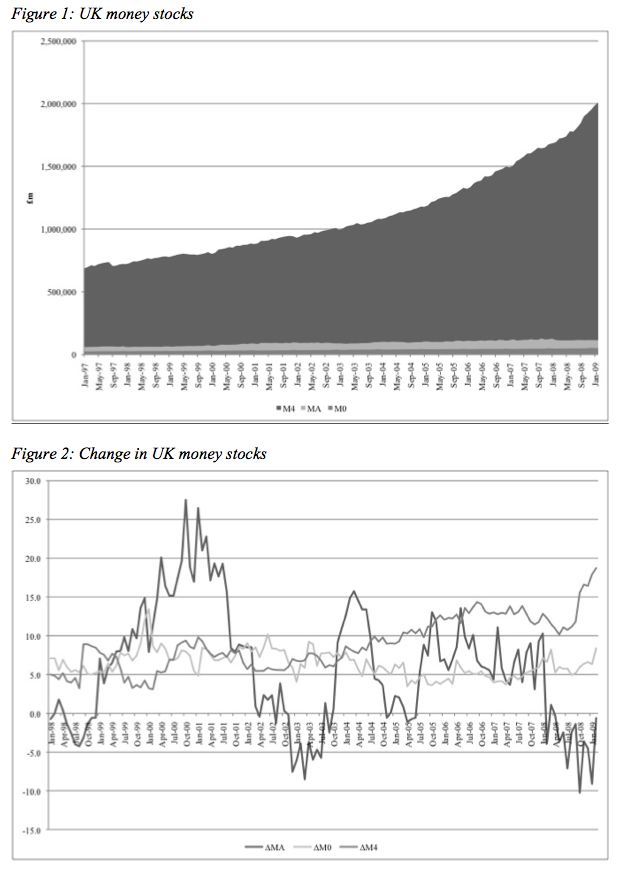
In Toby’s opinion the size of the effect I’ve described here would be small. If the total sum of balances in interest-bearing on-demand accounts is small then the cessation of interest would not have a great effect on the wider economy. Toby found some statistics on this from the Bank of England [5], these show that in March there was £386 billion in on-demand accounts that pay interest. As discussed above quite a large proportion of that amount would remain in on-demand accounts after the plan is enacted, though it’s impossible to accurately predict the proportion.  However, I think it’s still useful to compare this figure to the stock of money-in-the-broader-sense.  Anthony Evans and Toby Baxendale have made a measure of the UK money stock that’s consistent with the concepts of Austrian Economics [6]. By this measure the money stock is presently about £1 trillion. So, interest-bearing balances make up approximately a third of the total. The Bank of England use a different measure – “M4″ – which is based on different principles. According to that measure the money stock is about £2.2 trillion. I’ll concede that if the arguments put forward by Austrian economists against the M4 metric are wrong then I’m wrong about interest-bearing accounts. But, I think the arguments make by Frank Shostak [7] against the M metrics are persuasive.

However, interest payments are only one part of the issue, the cost of banking services is the other. If the banks were to significantly raise the fees for their services then the demand for balances in their accounts would fall.  This depends, to some extent, on how the banks decide to charge. If the banks were to charge a monthly storage fee proportional to the account balance then that would be akin to a negative interest rate. That would be a strong incentive not to hold a large balance, but other charging schemes would have a similar albeit lesser effect. There are several historical precedents for this, Irving Fisher wrote about some of those in his booklet “Stamp Scrip” [8]. Fisher thought that reducing “hoarding” of money could be economically beneficial, I disagree. But, he provides evidence that charging for storage of money reduces the amount of it that people hold.

Price Deflation Afterwards

Toby writes:

“With a fixed money supply, the ongoing productivity gains by the entrepreneurs means that more goods will be offered for sale at better prices, this means the purchasing power of money has gone up. As this is the only way that we have economic progress with a fixed money supply, people will be more fixated on what their money buys rather than what the numerical value is supposedly going up by.”

In the long run Toby is correct, but, in the short run the purchasing power of money is affected by the demand for money. Steady price deflation could occur in the long run after the short term effects I’ve discussed here have played out. But, the stumbling block is the period directly after the plan is enacted. If I’m right and price inflation occurs then the government may call a halt to the plan and reintroduce the current banking system.

Effect of the Plan on Production

Toby writes:

“I concur with you that price realignments will take place as people adjust to the brave new world. This is wholly right and good, as what consumers want will be more aligned with what producers produce. What producers produce will correspond more closely with what savers want to buy when they spend their money. Only bubble based activity will be deprived of credit.”

Here Toby is referring to the Austrian Theory of the Business Cycle. That theory indicates that if the quantity of money and the demand for money remain stable then unsustainable bubbles become much less likely to form. But, like the price deflation argument this is a long term theory. It can’t tell us what will happen while the demand for money is settling down from the initial disturbances caused by the implementation of the plan.

Further Discussion

I’m sure lots of people will have opinions about this, and there are many more questions that remain to be explored. I think it’s likely that there is no way of transitioning to a better monetary regime without disturbances. However, we should endeavour to predict what disturbances may occur and plan for them. For now we can continue the discussion in the comments thread below.

References

[1] Ludvig Von Mises “The Theory of Money and Credit” Liberty Fund Edition, p.170.

[2] ibid, p.154.

[3] Murray Rothbard “The Case Against the Fed”, p.34.

[4] Ludvig Von Mises “The Theory of Money and Credit”, p.314-315 describes cancellation in more detail.

[5] Bank of England “Monetary & Financial Statistics May 2010″ table A6.1 column BF96 p. 52.

[6] Anthony J. Evans & Toby Baxendale “The monetary contraction of 2008/09: Assessing UK money supply measures in light of the financial crisis

[7] Frank Shostak “The Mystery of the Money Supply Definition” The Quarterly Journal of Austrian Economics vol.3, no.4 (Winter 2000).

[8] Irving Fisher “Stamp Scrip” this booklet is no longer in print. It is available here.

Economics

The Emperor’s New Clothes: How to Pay off the National Debt & Give a 28.5% Tax Cut

I offer a £1,000 reward for anyone who can tell me why this logically won’t work, practical politics, for now, being another matter.

What follows is an attempt to show you that this can be done.

Remember the story about the Emperor whose only concern was not the welfare of his people but the state of his clothes?  Lacking a new outfit for his procession, he instructs the finest clothe-makers to propose designs.   Step forward Slimus and Slick, promising that only clever people will be able to see their splendiferous garments; they will be invisible to anyone stupid. In exchange for gold coin – real money – they make something special for the King. The King, seeing nothing when presented with these designs made out of thin air, worries that he must be stupid because he pretended to the fraudsters that they were wonderful. Word goes round that only clever people can see the garments, so everyone cheers the naked King during his procession.  It takes a small child, on top of his father’s shoulders, to exclaim: “the Emperor has got nothing on!” Everyone falls silent. Then, one by one, they start muttering, “the Emperor is naked!”

I am going to tell you that our Emperor – the government – has no clothes and is indeed naked with respect to our money. The sooner we realise this the better.  Then we can make real progress and prevent the imminent misery. Indeed, the realisation of its nakedness should reveal that we have a unique moment in history to do something very special: to make banking secure, pay off the national debt, and even enable a 28.5% income-tax cut.

We all know what notes and coins are: money, or cash.  It allows us to exchange the fruits of our work for the goods of others. When we deposit cash in Bank A – say £100 – we lend this money to the bank. This may come as a surprise to most, as we think what we deposit in a bank actually remains “ours” beyond this point.  But as soon as you make a deposit it becomes the bank’s i.e. “theirs.” They then lend what is called credit of £100 to an entrepreneur, who banks it in bank B. Like magic, we now have you, who have a claim to “your” £100, and the entrepreneur, who also has an equally valid claim to “his” £100. This happens 33 times for every £100 deposited in the UK economy on average, meaning that for every £100 deposited, it is lent out to 33 people. Some of the banks did this up to 60 times. This cash cannot exist in two places at the same time, let alone 60 places at once. So what bank A does, is write you an IOU. Yes, your bank-statement is a mere IOU, the bank saying “ bank A owes you £100 on demand.” This is called a demand-deposit. We now see that demand-deposits are created out of thin air! Indeed, these are just ledger-entries from one bank customer to another.

Tesco groceries can be paid by electronic transfer. All we are doing is moving our bank’s IOU to Tesco’s bank in exchange for their groceries. This is how the world works.  Do we care that we are buying goods and services out of thin air? Like the Emperor, does he care – as long as all believe he is clothed? Well, the customers of Northern Rock did. So when more than a small percentage of them asked for their IOUs from Northern Rock to be repaid – or, as they thought, for “their” money back – it could not be, as the bank had already lent it many times, making it impossible to reimburse all they owed. Indeed, if the government had not pledged to underwrite all deposits, then there would be a very good chance that the whole system would have collapsed.

If we accept that the Emperor is naked then the path to solving all our current financial problems becomes clearer.

Consider this following programme of reform:

  1. Print cash and replace all the demand-deposits/IOUs that exist in the system with that cash. This means the government printing approx £850 billion in cash and injecting it directly into the vaults of the banks and into the accounts of individuals. Thus, if you deposited £100 once thinking it was “yours,” it now really exists in cash, with the bank acting as custodian of your money.
  2. Mandate all banks to hold your cash (100% reserved) on demand at all times.
  3. Wipe from the bank ledgers all the demand-deposits/IOUs as banks would not owe you money anymore. This means the “thin air” money disappears, to be replaced exactly with cash money.  Note: this is not inflationary, as the cash replaces the demand-deposit which acted as money. As we have established, it is only thin-air that the banking system has created to facilitate the multiplicity of lending of the same bit of money, so its total replacement with cash would mean the money supply stays exactly the same.
  4. Require all banks to lend real savings that people knowingly place with banks to lend to businesses to get a return of interest and capital back when the business repays that loan. This is nice, simple and safe utility banking. This is what Mervyn King advocates.
  5. As you are not a creditor of the bank anymore, the banking system will only have its assets and its capital, i.e. no liabilities. This means that there never again could be a bank run.
  6. As for the banks, not having you the depositor as a liability anymore, they will suddenly be £850 billion better off, with no current liabilities and only assets (loans to business etc), post reform. The government can now put those assets into Mutuals, which would then immediately pay off the national debt, and leave the banks in exactly the same position net worth wise as they were prior to the reform, owned by their existing shareholders. As the national debt is still just under the £850 billion, which would be available as surplus assets of the banks, this could still be achieved.
  7. No national debt means no interest costs (currently £40 billion p.a) associated with paying for our borrowing. Therefore, give an immediate 28.5% income-tax cut. Total income-tax raised is £142 billion.

The boy in the story stood on his father’s shoulders. I stand on the shoulders of great men who have advocated part of this reform: Irving Fisher, the greatest American economist, the Nobel Prize winners Soddy, Hayek, Buchanan, Tobin, and Allais. Recently, Kotlikoff of Boston University has published an excellent book, “Jimmy Stewart is Dead” advocating a similar reform. It is endorsed by more Nobel Winners: Akerlof, Lucas, Fogel, Prescott, and Phelps. I count 36 endorsements from the great and the good for the book. All endorse Kotlikoff’s move to what he calls Limited Purpose Banking which is another way to get 100% reserved (i.e. secure) deposits backed by cash rather than thin-air.

The Economist Huerta De Soto, in “Money, Bank Credit & Economic Cycles,” has seen the opportunity that presents itself to reform for 100% money while also paying off the National Debt. Following on from this, I suggest a substantial wealth-creating tax cut for the people. Just like the boy in the story, I do hope that people start to realise that the emperor really has no clothes, and that an enlightened approach can address this.

Economics

Laurence Kotlikoff’s “Jimmy Stewart is Dead”

Jimmy Stewart plays George Bailey who is cast as the “honest” and trustworthy banker in the classic Hollywood film, “It’s a Wonderful Life.” Kotlikoff’s book laments that in the real world of modern banking, such characters no longer exist.

Kotlikoff himself is a Professor of Economics at Boston. Several Nobel Prize winners have endorsed the book: George Akerlof, Robert Lucas, Robert Fogel, Edward Prescott, and Edmund Phelps. I count 36 endorsements from the great and the good of the academic world on the back cover and front pages. I do not recall ever seeing this in a book.

The book is written for the layman. It is very light on economic theory, but does reference some otherworldly models. It is very good at explaining what on the face of it appear to be complex financial phenomena, but are in fact con tricks that in any other industry would earn you a prison sentence. Kotlikoff shows his readers how the financial system has failed in its fiduciary duty, and presents a very simple and elegant solution for its salvation called Limited Purpose Banking (LPB). He also proposes a reduction of the financial service sector regulators in the USA from its current 115 down to one: the Federal Financial Authority (FFA).

In his opening remarks he discusses the Modigliani-Miller Theorem, written in 1958, showing in elegant maths how in the absence of bankruptcy costs, leverage does not matter. If a company takes on more risk by borrowing more, its owners will offset that risk by borrowing less, leaving total debt in the economy unchanged.  Kotlikoff makes no mention of the fact that leverage in itself is not a bad thing if it is made up of people forgoing their consumption today, i.e. saving and committing it to projects that will deliver up goods in the future.   This glaring omission does not impede him from telling the story of our financial meltdown and making a solid policy recommendation for this crisis. It does, however, prevent him from seeing the elephant in the room: that the credit creation process itself is the source of the boom and the bust.

The nature of fractional reserve banking is such that if you deposit your cash in a bank, it will lend it out many times over. This means that multiple claims come to exist on the original real money that was deposited. If you deposit £100 in bank A, which lends it to an entrepreneur who deposits it in Bank B, both you and the entrepreneur now have £100! Like magic, we have £200 in the system, with £100 of it created ex novo by the banking system itself! In the UK, with no legal reserve requirement, we have a only £3 on average kept in deposit for every £100 of IOU’s promised by the banking system.

Kotlikoff provides a mainstream justification for fractional reserve banking, citing the Diamond-Dybvig Model, which holds that we value immediate liquidity for emergencies. We do not need that money all the time, so banks can use this and get us a higher return in the meantime. Therefore, governments must do everything to prevent a bank run if more people want their money back than actually exists in the bank vaults.

This is the theoretical understanding we have today and the model is used to justify all sorts of bank bailouts, as we have seen.

Kotlikoff points out that whilst the bailouts have prevented a collapse of the system of fractional reserve banking, the bailouts do not preserve the purchasing power of money. They just guarantee that the money unit will still exist. This is a very good point. All the bailouts are being funded by more claims on the future taxpayer.  In the UK, we have a system of money debasement called Quantitative Easing, which will just debase and reduce our purchasing power.

In effect, the bailouts do not do what they say they do on the tin, and daily our purchasing power is getting weaker. It is hard enough to get politicians in the UK to acknowledge the scale of our official national debt, but we owe at least as much again “off balance sheet”, in unfunded pension liabilities and Private Finance Initiative obligations.  Debasement will be the most popular way forward for all future governments as they will not want to overtly extract more wealth from us. Dishonesty will be the preferred policy.

Limited purpose banking would be a simple solution to all of this. Banks would be limited to their main purpose of matching savers to borrowers.  All financial companies would act as pass though mutual fund companies. They would be middle men, never would they own the financial assets. They could thus never fail in the “run on the bank” sense — i.e. depositors wishing to withdraw money — but only if they were very bad at business.  This is thus as near as you will get to risk-free banking. Never again would the economy be held liable to bail out the bankers.

Kotlikoff foresees at least two mutual funds being offered, with custodians holding the assets: one that holds cash and one that holds insurance funds. He does stress that innovation could still happen, with a multiplicity of funds being offered.  The Federal Financial Authority (FFA) would regulate the custody element of the safe keeping of the various mutual fund assets. He assumes that regulators will be able to opine, like the current rating agencies, on the soundness of the assets that have been bought by the fund. He would trust the government over the rating agencies. I personally would trust neither! In my industry, selling meat and fish, we have a number of free market created quality assurance bodies such as the British Soil Association for organic certification, the Marine Stewardship Council for fish sustainability that require no government sanction.  These have the confidence of both the consumer and producer. I would suggest that this and not a super regulator is the way forward.

Cash funds are nice and easy; they hold cash and are 100% reserved. They can never go up or down in value. These cash mutual funds represent the demand deposits of the new spec banking system.  All services such as cheque writing and paying bills is done via this vehicle.

I have written about 100% reserve banking here and Steve Baker has specifically examined the 100% reserve banking proposal of Irving Fisher, to which Kotlikoff refers.  He notes that the current economic profession considers these ideas to be “crackpot”; the Diamond-Dybvig model remains dominant.  He goes go on to say, “I want to be clear that I am not an advocate of narrow banking in of itself. Narrow banking is a small feature of limited purpose banking and would hardly suffice to deal with today’s multifaceted financial problems.”

He notes that with the many cash mutual funds in place, the money measure in the USA, MI, would correspond exactly with what the government had printed. So to cover all obligations, a massive print up in US dollars would need to take place — many trillions of dollars to truly purge the system. What Kotlikoff misses is De Soto’s insight, based on the work of Fisher, that there will be a unique moment in history when instead of causing debasement, the printed money would cover all unfunded demand deposits, swapping them out for cash. Wipe out or retire these demand deposits and the banking system has no current creditors, only assets. Take out the equivalent amount of assets from the banking system, so the banking system has the same net worth as before, then put these assets into the mutuals and pay off the national debt. This is not inflationary, requires no debasement, and will help deliver up safe banking.  This is summarised in our Day of Reckoning article.

Insurance mutuals would have all the other banking instruments such as CDO’s in them and could market these funds to whomever they wished. These are essentially what we would term a hedge fund today, though Kotlikoff proposes that these be closed end. This means you have to sell your shares in the fund to redeem your money. Consequently, long term lending can take place in these funds without the fear of a maturity mismatch. The only money this type of fund can lose is what is invested in it. It could never in itself pull down the banking system.

I sense that the author does not feel comfortable with the 100% reserve label, with its “crackpot” associations. In discussing the transfer of Citigroup he says,

“Here we’d need to swap all of CitiGroup’s debt for equity and prevent it from ever borrowing again to fund risky investments. We can now think of CitiGroup as a huge mutual fund with lots of different assets, one big commercial bank with 100 percent capital requirement, or one LPB with a large number of different mutual funds corresponding to the different Citigroup asset classes.”

He also points out that LPB could not actually be that far away if you take into account all the reserves that have been created already. This is something George Reisman has also pointed out.

Kotlikoff defensively shows how LPB would not reduce liquidity. It would not reduce real credit, i.e. savers forwarding money to borrowers. It would stop credit created out of thin air via the banking system, the prime cause of the crisis, but this is not mentioned in his book. It would lead to an optimal size financial sector. Our cash assets would be safe as you can get. Government could still monetise debt as it could still create cash from nothing. The currency and thus the purchasing power of money could not collapse by the actions of the banking system, but only by the actions of the government.

Kotlikoff concludes,

Limited purpose banking is the answer. This simple and easily-implemented pass-though mutual fund system, with its built in firewalls, would preclude financial crises of the type we’re now experiencing. The system will rely on independent rating by the government, but private rating as well. It would require full disclosure and provide maximum transparency. Most important, it would make clear that risk is ultimately born by people, not companies, and that most people need, and have a right, to know what risks, including fiscal risk, they are facing. Finally, it would make clear what risks are, and are not, diversifiable. It would not pretend to insure the uninsurable or guarantee returns that can’t be guaranteed. In short, the system would be honest, and because of that, it would be safe-safe for ourselves and safe for our children.

Although I think he has failed to identify the state sponsored banking system, with its fractional reserve credit creation point as the cause of booms and busts, his solution has many merits and many similarities with the solution proposed by Fisher, De Soto, and others. He missed what I call the golden opportunity, or unique moment in history, to actually enact a reform that delivers up 100% reserve of LPB and pays off the national debt and other unfunded obligations at the same time. My own solution is the De Soto 100% reserve free banking solution with banks working within the existing commercial law to which all non-bank companies must adhere. However, both systems have the same effects and would do the job needed: to sort out the banking system, provide stability, and let capitalism flourish. Yet another workable solution has been proposed by our very own Paul Birch. Kotlikoff’s contribution to the debate, with all the Nobel endorsements, is timely, and I hope policy makers give due attention to innovative solutions like these.

Economics

De Soto and the Relevance of his Banking Reform Proposal Today

This has been copied from Money, Bank Credit, and Economic Cycles which can be downloaded here or bought here.

PREFACE TO THE SECOND ENGLISH EDITION

I am happy to present the second English edition of Money, Bank Credit, and Economic Cycles. Its appearance is particularly timely, given that the severe financial crisis and resulting worldwide economic recession I have been forecasting, since the first edition of this book came out ten years ago, are now unleashing their fury.

The policy of artificial credit expansion central banks have permitted and orchestrated over the last fifteen years could not have ended in any other way. The expansionary cycle which has now come to a close began gathering momentum when the American economy emerged from its last recession (fleeting and repressed though it was) in 2001 and the Federal Reserve reembarked on the major artificial expansion of credit and investment initiated in 1992. This credit expansion was not backed by a parallel increase in voluntary household saving. For many years, the money supply in the form of bank notes and deposits has grown at an average rate of over 10 percent per year (which means that every seven years the total volume of money circulating in the world has doubled). The media of exchange originating from this severe fiduciary inflation have been placed on the market by the banking system as newly created loans granted at very low (and even negative in real terms) interest rates. The above fueled a speculative bubble in the shape of a substantial rise in the prices of capital goods, real-estate assets and the securities which represent them, and are exchanged on the stock market, where indexes soared.

Curiously, like in the “roaring” years prior to the Great Depression of 1929, the shock of monetary growth has not significantly influenced the prices of the subset of consumer goods and services (approximately only one third of all goods). The last decade, like the 1920s, has seen a remarkable increase in productivity as a result of the introduction on a massive scale of new technologies and significant entrepreneurial innovations which, were it not for the injection of money and credit, would have given rise to a healthy and sustained reduction in the unit price of consumer goods and services. Moreover, the full incorporation of the economies of China and India into the globalized market has boosted the real productivity of consumer goods and services even further. The absence of a healthy “deflation” in the prices of consumer goods in a stage of such considerable growth in productivity as that of recent years provides the main evidence that the monetary shock has seriously disturbed the economic process. I analyze this phenomenon in detail in chapter 6, section 9.

As I explain in the book, artificial credit expansion and the (fiduciary) inflation of media of exchange offer no short cut to stable and sustained economic development, no way of avoiding the necessary sacrifice and discipline behind all high rates of voluntary saving. (In fact, particularly in the United States, voluntary saving has not only failed to increase in recent years, but at times has even fallen to a negative rate.) Indeed, the artificial expansion of credit and money is never more than a short-term solution, and that at best. In fact, today there is no doubt about the recessionary quality the monetary shock always has in the long run: newly-created loans (of money citizens have not first saved) immediately provide entrepreneurs with purchasing power they use in overly ambitious investment projects (in recent years, especially in the building sector and real estate development). In other words, entrepreneurs act as if citizens had increased their saving, when they have not actually done so. Widespread discoordination in the economic system exerts a harmful effect on the real economy, and sooner or later the process reverses in the form of an economic recession, which marks the beginning of the painful and necessary readjustment. This readjustment invariably requires the reconversion of every real productive structure inflation has distorted. The specific triggers of the end of the euphoric monetary “binge” and the beginning of the recessionary “hangover” are many, and they can vary from one cycle to another. In the current circumstances, the most obvious triggers have been the rise in the price of raw materials, particularly oil, the subprime mortgage crisis in the United States, and finally, the failure of important banking institutions when it became clear in the market that the value of their liabilities exceeded that of their assets (mortgage loans granted).

At present, numerous self-interested voices are demanding further reductions in interest rates and new injections of money which permit those who desire it to complete their investment projects without suffering losses. Nevertheless, this escape forward would only temporarily postpone problems at the cost of making them far more serious later. The crisis has hit because the profits of capital-goods companies (especially in the building sector and in real-estate development) have disappeared due to the entrepreneurial errors provoked by cheap credit, and because the prices of consumer goods have begun to perform relatively less poorly than those of capital goods. At this point, a painful, inevitable readjustment begins, and in addition to a decrease in production and an increase in unemployment, we are now still seeing a harmful rise in the prices of consumer goods (stagflation).

The most rigorous economic analysis and the coolest, most balanced interpretation of recent economic and financial events support the conclusion that central banks (which are true financial central-planning agencies) cannot possibly succeed in finding the most advantageous monetary policy at every moment. This is exactly what became clear in the case of the failed attempts to plan the former Soviet economy from above. To put it another way, the theorem of the economic impossibility of socialism, which the Austrian economists Ludwig von Mises and Friedrich A. Hayek discovered, is fully applicable to central banks in general, and to the Federal Reserve—(at one time) Alan Greenspan and (currently) Ben Bernanke—in particular. According to this theorem, it is impossible to organize society, in terms of economics, based on coercive commands issued by a planning agency, since such a body can never obtain the information it needs to infuse its commands with a coordinating nature. Indeed, nothing is more dangerous than to indulge in the “fatal conceit”—to use Hayek’s useful expression—of believing oneself omniscient or at least wise and powerful enough to be able to keep the most suitable monetary policy fine tuned at all times. Hence, rather than soften the most violent ups and downs of the economic cycle, the Federal Reserve and, to some lesser extent, the European Central Bank, have most likely been their main architects and the culprits in their worsening. Therefore, the dilemma facing Ben Bernanke and his Federal Reserve Board, as well as the other central banks (beginning with the European Central Bank), is not at all comfortable. For years they have shirked their monetary responsibility, and now they find themselves in a blind alley. They can either allow the recessionary process to begin now, and with it the healthy and painful readjustment, or they can escape forward toward a “hair of the dog” cure. With the latter, the chances of even more severe stagflation in the not-too-distant future increase exponentially. (This was precisely the error committed following the stock market crash of 1987, an error which led to the inflation at the end of the 1980s and concluded with the sharp recession of 1990–1992.) Furthermore, the reintroduction of a cheap-credit policy at this stage could only hinder the necessary liquidation of unprofitable investments and company reconversion. It could even wind up prolonging the recession indefinitely, as has occurred in Japan in recent years: though all possible interventions have been tried, the Japanese economy has ceased to respond to any monetarist stimulus involving credit expansion or Keynesian methods. It is in this context of “financial schizophrenia” that we must interpret the latest “shots in the dark” fired by the monetary authorities (who have two totally contradictory responsibilities: both to control inflation and to inject all the liquidity necessary into the financial system to prevent its collapse). Thus, one day the Federal Reserve rescues Bear Stearns, AIG, Fannie Mae, and Freddie Mac or Citigroup, and the next it allows Lehman Brothers to fail, under the amply justified pretext of “teaching a lesson” and refusing to fuel moral hazard. Then, in light of the way events were unfolding, a 700-billion-dollar plan to purchase the euphemistically named “toxic” or “illiquid” (i.e., worthless) assets from the banking system was approved. If the plan is financed by taxes (and not more inflation), it will mean a heavy tax burden on households, precisely when they are least able to bear it. Finally, in view of doubts about whether such a plan could have any effect, the choice was made to inject public money directly into banks, and even to “guarantee” the total amount of their deposits, decreasing interest rates to almost zero percent.

In comparison, the economies of the European Union are in a somewhat less poor state (if we do not consider the expansionary effect of the policy of deliberately depreciating the dollar, and the relatively greater European rigidities, particularly in the labor market, which tend to make recessions in Europe longer and more painful). The expansionary policy of the European Central Bank, though not free of grave errors, has been somewhat less irresponsible than that of the Federal Reserve. Furthermore, fulfillment of the convergence criteria involved at the time a healthy and significant rehabilitation of the chief European economies. Only the countries on the periphery, like Ireland and particularly Spain, were immersed in considerable credit expansion from the time they initiated their processes of convergence. The case of Spain is paradigmatic. The Spanish economy underwent an economic boom which, in part, was due to real causes (liberalizing structural reforms which originated with José María Aznar’s administration in 1996). Nevertheless, the boom was also largely fueled by an artificial expansion of money and credit, which grew at a rate nearly three times that of the corresponding rates in France and Germany. Spanish economic agents essentially interpreted the decrease in interest rates which resulted from the convergence process in the easy-money terms traditional in Spain: a greater availability of easy money and mass requests for loans from Spanish banks (mainly to finance real estate speculation), loans which these banks have granted by creating the money ex nihilo while European central bankers looked on unperturbed. When faced with the rise in prices, the European Central Bank has remained faithful to its mandate and has tried to maintain interest rates as long as possible, despite the difficulties of those members of the Monetary Union which, like Spain, are now discovering that much of their investment in real estate was in error and are heading for a lengthy and painful reorganization of their real economy.

Under these circumstances, the most appropriate policy would be to liberalize the economy at all levels (especially in the labor market) to permit the rapid reallocation of productive factors (particularly labor) to profitable sectors. Likewise, it is essential to reduce public spending and taxes, in order to increase the available income of heavily-indebted economic agents who need to repay their loans as soon as possible. Economic agents in general and companies in particular can only rehabilitate their finances by cutting costs (especially labor costs) and paying off loans. Essential to this aim are a very flexible labor market and a much more austere public sector. These factors are fundamental if the market is to reveal as quickly as possible the real value of the investment goods produced in error and thus lay the foundation for a healthy, sustained economic recovery in a future which, for the good of all, I hope is not long in coming.

We must not forget that a central feature of the recent period of artificial expansion was a gradual corruption, on the American continent as well as in Europe, of the traditional principles of accounting as practiced globally for centuries. To be specific, acceptance of the International Accounting Standards (IAS) and their incorporation into law in different countries (in Spain via the new General Accounting Plan, in effect as of January 1, 2008) have meant the abandonment of the traditional principle of prudence and its replacement by the principle of fair value in the assessment of the value of balance sheet assets, particularly financial assets. In this abandonment of the traditional principle of prudence, a highly influential role has been played by brokerages, investment banks (which are now on their way to extinction), and in general, all parties interested in “inflating” book values in order to bring them closer to supposedly more “objective” stockmarket values, which in the past rose continually in an economic process of financial euphoria. In fact, during the years of the “speculative bubble,” this process was characterized by a feedback loop: rising stock-market values were immediately entered into the books, and then such accounting entries were sought as justification for further artificial increases in the prices of financial assets listed on the stock market.

In this wild race to abandon traditional accounting principles and replace them with others more “in line with the times,” it became common to evaluate companies based on unorthodox suppositions and purely subjective criteria which in the new standards replace the only truly objective criterion (that of historical cost). Now, the collapse of financial markets and economic agents’ widespread loss of faith in banks and their accounting practices have revealed the serious error involved in yielding to the IAS and their abandonment of traditional accounting principles based on prudence, the error of indulging in the vices of creative, fair-value accounting.

It is in this context that we must view the recent measures taken in the United States and the European Union to “soften” (i.e., to partially reverse) the impact of fair-value accounting for financial institutions. This is a step in the right direction, but it falls short and is taken for the wrong reasons. Indeed, those in charge at financial institutions are attempting to “shut the barn door when the horse is bolting”; that is, when the dramatic fall in the value of “toxic” or “illiquid” assets has endangered the solvency of their institutions. However, these people were delighted with the new IAS during the preceding years of “irrational exuberance,” in which increasing and excessive values in the stock and financial markets graced their balance sheets with staggering figures corresponding to their own profits and net worth, figures which in turn encouraged them to run risks (or better, uncertainties) with practically no thought of danger. Hence, we see that the IAS act in a pro-cyclic manner by heightening volatility and erroneously biasing business management: in times of prosperity, they create a false “wealth effect” which prompts people to take disproportionate risks; when, from one day to the next, the errors committed come to light, the loss in the value of assets immediately decapitalizes companies, which are obliged to sell assets and attempt to recapitalize at the worst moment, i.e., when assets are worth the least and financial markets dry up. Clearly, accounting principles which, like those of the IAS, have proven so disturbing must be abandoned as soon as possible, and all of the accounting reforms recently enacted, specifically the Spanish one, which came into effect January 1, 2008, must be reversed. This is so not only because these reforms mean a dead end in a period of financial crisis and recession, but especially because it is vital that in periods of prosperity we stick to the principle of prudence in valuation, a principle which has shaped all accounting systems from the time of Luca Pacioli at the beginning of the fifteenth century to the adoption of the false idol of the IAS.

In short, the greatest error of the accounting reform recently introduced worldwide is that it scraps centuries of accounting experience and business management when it replaces the prudence principle, as the highest ranking among all traditional accounting principles, with the “fair value” principle, which is simply the introduction of the volatile market value for an entire set of assets, particularly financial assets. This Copernican turn is extremely harmful and threatens the very foundations of the market economy for several reasons. First, to violate the traditional principle of prudence and require that accounting entries reflect market values is to provoke, depending upon the conditions of the economic cycle, an inflation of book values with surpluses which have not materialized and which, in many cases, may never materialize. The artificial “wealth effect” this can produce, especially during the boom phase of each economic cycle, leads to the allocation of paper (or merely temporary) profits, the acceptance of disproportionate risks, and in short, the commission of systematic entrepreneurial errors and the consumption of the nation’s capital, to the detriment of its healthy productive structure and its capacity for long-term growth. Second, I must emphasize that the purpose of accounting is not to reflect supposed “real” values (which in any case are subjective and which are determined and vary daily in the corresponding markets) under the pretext of attaining a (poorly understood) “accounting transparency.” Instead, the purpose of accounting is to permit the prudent management of each company and to prevent capital consumption [1], by applying strict standards of accounting conservatism (based on the prudence principle and the recording of either historical cost or market value, whichever is less), standards which ensure at all times that distributable profits come from a safe surplus which can be distributed without in any way endangering the future viability and capitalization of the company. Third, we must bear in mind that in the market there are no equilibrium prices a third party can objectively determine. Quite the opposite is true; market values arise from subjective assessments and fluctuate sharply, and hence their use in accounting eliminates much of the clarity, certainty, and information balance sheets contained in the past. Today, balance sheets have become largely unintelligible and useless to economic agents. Furthermore, the volatility inherent in market values, particularly over the economic cycle, robs accounting based on the “new principles” of much of its potential as a guide for action for company managers and leads them to systematically commit major errors in management, errors which have been on the verge of provoking the severest financial crisis to ravage the world since 1929.

In chapter 9 of this book (pages 789–803), I design a process of transition toward the only world financial order which, being fully compatible with the free-enterprise system, can eliminate the financial crises and economic recessions which cyclically affect the world’s economies. The proposal the book contains for international financial reform has acquired extreme relevance at the present time (November 2008), in which the disconcerted governments of Europe and America have organized a world conference to reform the international monetary system in order to avoid in the future such severe financial and banking crises as the one that currently grips the entire western world. As is explained in detail over the nine chapters of this book, any future reform will fail as miserably as past reforms unless it strikes at the very root of the present problems and rests on the following principles:

  1. the reestablishment of a 100-percent reserve requirement on all bank demand deposits and equivalents;
  2. the elimination of central banks as lenders of last resort (which will be unnecessary if the preceding principle is applied, and harmful if they continue to act as financial central-planning agencies); and
  3. the privatization of the current, monopolistic, and fiduciary state-issued money and its replacement with a classic pure gold standard.

This radical, definitive reform would essentially mark the culmination of the 1989 fall of the Berlin Wall and real socialism, since the reform would mean the application of the same principles of liberalization and private property to the only sphere, that of finance and banking, which has until now remained mired in central planning (by “central” banks), extreme interventionism (the fixing of interest rates, the tangled web of government regulations), and state monopoly (legal tender laws which require the acceptance of the current, state-issued fiduciary money), circumstances with very negative and dramatic consequences, as we have seen.

I should point out that the transition process designed in the last chapter of this book could also permit from the outset the bailing out of the current banking system, thus preventing its rapid collapse, and with it the sudden monetary squeeze which would be inevitable if, in an environment of widespread broken trust among depositors, a significant volume of bank deposits were to disappear. This short-term goal, which at present, western governments are desperately striving for with the most varied plans (the massive purchases of “toxic” bank assets, the ad hominem guarantee of all deposits, or simply the partial or total nationalization of the private banking system), could be reached much faster and more effectively, and in a manner much less harmful to the market economy, if the first step in the proposed reform (pages 791–98) were immediately taken: to back the total amount of current bank deposits (demand deposits and equivalents) with cash, bills to be turned over to banks, which from then on would maintain a 100-percent reserve with respect to deposits. As illustrated in chart IX-2 of chapter 9, which shows the consolidated balance sheet for the banking system following this step, the issuance of these banknotes would in no way be inflationary (since the new money would be “sterilized,” so to speak, by its purpose as backing to satisfy any sudden deposit withdrawals). Furthermore, this step would free up all banking assets (“toxic” or not) which currently appear as backing for demand deposits (and equivalents) on the balance sheets of private banks. On the assumption that the transition to the new financial system would take place under “normal” circumstances, and not in the midst of a financial crisis as acute as the current one, I proposed in chapter 9 that the “freed” assets be transferred to a set of mutual funds created ad hoc and managed by the banking system, and that the shares in these funds be exchanged for outstanding treasury bonds and for the implicit liabilities connected with the public social-security system (pp. 796–97). Nevertheless, in the current climate of severe financial and economic crisis, we have another alternative: apart from canceling “toxic” assets with these funds, we could devote a portion of the rest, if desired, to enabling savers (not depositors, since their deposits would already be backed 100 percent) to recover a large part of the value lost in their investments (particularly in loans to commercial banks, investment banks, and holding companies). These measures would immediately restore confidence and would leave a significant remainder to be exchanged, once and for all and at no cost, for a sizeable portion of the national debt, our initial aim. In any case, an important warning must be given: naturally, and I must never tire of repeating it, the solution proposed is only valid in the context of an irrevocable decision to reestablish a free-banking system subject to a 100-percent reserve requirement on demand deposits. Any of the reforms noted above, if adopted in the absence of a prior, firm conviction and decision to change the international financial and banking system as indicated, would be simply disastrous: a private banking system which continued to operate with a fractional reserve (orchestrated by the corresponding central banks), would generate, in a cascading effect, and based on the cash created to back deposits, an inflationary expansion like none other in history, one which would eventually finish off our entire economic system.

The above considerations are crucially important and reveal how very relevant this treatise has now become in light of the critical state of the international financial system (though I would definitely have preferred to write the preface to this new edition under very different economic circumstances). Nevertheless, while it is tragic that we have arrived at the current situation, it is even more tragic, if possible, that there exists a widespread lack of understanding regarding the causes of the phenomena that plague us, and especially an atmosphere of confusion and uncertainty prevalent among experts, analysts, and most economic theorists. In this area at least, I can hope the successive editions of this book which are being published all over the world [2] may contribute to the theoretical training of readers, to the intellectual rearmament of new generations, and eventually, to the sorely needed institutional redesign of the entire monetary and financial system of current market economies. If this hope is fulfilled, I will not only view the effort made as worthwhile, but will also deem it a great honor to have contributed, even in a very small way, to movement in the right direction.

Jesús Huerta de Soto
Madrid
November 13, 2008

_________________________________________________________

[1] See especially F. A. Hayek, “The Maintenance of Capital,” Economica 2 (August 1934), reprinted in Profits, Interest and Investment and Other Essays on the Theory of Industrial Fluctuations(Clifton, N.J.: Augustus M. Kelley, 1979; first edition London: George Routledge & Sons, 1939). See especially section 9, “Capital Accounting and Monetary Policy,” pp. 130–32.

[2] Since the appearance of the first English-language edition, the third and
fourth Spanish editions have been published in 2006 and 2009. Moreover,
Tatjana Danilova and Grigory Sapov have completed a Russian translation, which has been published as Dengi, Bankovskiy Kredit i Ekonomicheskie Tsikly (Moscow: Sotsium Publishing House, 2008). Three thousand copies have been printed initially, and I had the satisfaction of presenting the book Octo- ber 30, 2008 at the Higher School of Economics at Moscow State University. In addition, Professor Rosine Létinier has produced the French translation, which is now pending publication. Grzegorz Luczkiewicz has completed the Polish translation, and translation into the following languages is at an advanced stage: German, Czech, Italian, Romanian, Dutch, Chinese, Japan- ese, and Arabic. God willing, may they soon be published.

Economics

Time to Celebrate the Entrepreneur

Do you think it is very worrying that not one government policy encourages the entrepreneurs of the world to create wealth?

Without wealth creation we are doomed to a long slow decline in the productive capacity of the economy. We are doomed to the stagnating to slow growth economy that all the policies of our Great Leader, Gordon Brown, is inflicting upon us. It is all because he does not understand how wealth is created and the role of entrepreneurship in society. Most politicians are the same, I am afraid to say, with a few shining lights and notable exceptions.  This is desperately worrying for all of us.

How is Wealth Created?

I have said here on this site before http://www.cobdencentre.org/2009/09/can-the-manipulation-of-interest-rates-create-wealth/  “I would like you to absent the concept of money and consider a situation of barter. As a butcher, when I kill an animal, I may get for the sake of argument, 10 cuts of meat: this is my production. I only need 2 for my immediate consumption, so with the remaining 8 cuts, I trade with Andrew, a garment manufacturer, for some garments to keep me warm. I consume 2 cuts and I save 8 cuts in order to trade for other goods and services. I need to produce to consume: I need to save/invest to consume.

“If I wish to consume more of Andrew’s garments as I have a family to dress and keep warm, 8 cuts of meat may well not be enough to purchase these new needs and requirements of mine. At this point in time, I am faced with a choice, either my production has to increase so I can generate more cuts to exchange for other goods, or I accept my fate and stay where I am. I decide that I can invent a method of cutting up the parts quicker by using a sharper knife, thus I seek to invent the “steel” or knife sharpener that improves my productivity from generating 10 cuts in a day to 15. With these 5 extra cuts, I can get more garments.

“The problem is, that in order to get the steel built, I need to spend some of my time that would be making the 10 cuts. Thus, I have to save and forgo some consumption while I have the steel built. I also have to rely on my savings — those stored cuts of meat — that I have not consumed to keep me afloat. This is what an economist may mean when he says adding capital to an economy lengthens the structure of production. The steel in this example adds a stage to the capital structure of society, to make me more productive, so I can consume more things.

“To be clear, saving is the only thing that allows this to happen. In this example, my personal capital structure has gone from me with a knife in my hand consuming two cuts a day and exchanging 8 saved portions, to me and a knife and a steel to produce 15 cuts of which I consume 2 and exchange 13 saved cuts. Now Andrew will be doing the same, i.e. lengthening his structure of production to meet my new found desires for more goods. He will also have to save — i.e. forgo consumption — to invest with the sustenance that savings gives him, to become more “capitalistic” or capital intensive in his production structure, to meet my demand.”

In summary, during the passage of time, only an act of saving to invest in a longer capitalistic method of production can lead to more goods and services being produced and consumed. No amount of creating money out of thin air creates more goods and services.

The Austrian School Role of the Entrepreneur in Economics

Humans Act

One of the great contributions of Ludwig von Mises to our understanding of the world, in his book ‘Human Action’ is that humans act and they act purposefully to satisfy their most urgent needs and requirements. Absent action and you would not have a moving human society, but a static world with no existence at all. We rank our most immediate preferences first and our most remote preferences last, thus we always have a downward sloping demand curve for things.

Sub Categories of Action: the Entrepreneur

All men act, they are in economic theory either an entrepreneur, a capitalist, a landowner, a worker or a consumer. These are ideal types, ideal styles. The reality is that we are all a combination of more than one of the above.

In the real world everybody is an entrepreneur except the children and elderly we look after, and wards of state that we pay in various forms to do nothing, such as the unemployed and those on incapacity benefit.

Israel Kirzner shows us in his books ‘Competition and Entrepreneurship’ and also in ‘Perception, Opportunity, and Profit’, how the spontaneous discovery of new opportunities by alert individuals is a defining characteristic of entrepreneurship. For example, a man who is more alert than another to satisfying the most urgent needs and requirements of other men, such as Bill Gates in inventing Microsoft and its worldwide and world changing software is rewarded by his fellow consumer entrepreneurs more so than the man who comes and fixes the boiler as he is providing a more valuable and needed service. Gates’s unique ability over the years to be alert to the potential opportunity, to think, to create to make happen, makes him the richest man in the world.

The Economy as Dynamic Creative Process

De Soto, in his books ‘The Theory of Dynamic Efficiency’ and ‘The Austrian School, Market Order and Entrepreneurial Creativity’ shows us that as the economy is predicated by acting man seeking ways to satisfy his most urgent needs and requirements first, and with limited resources, everything in politics should be geared to letting the full creative talents of the most humble entrepreneur to the giants on entrepreneurship flourish.  Past Popes such as John Paul the II and Leo XIII, in ‘Centesimus Annus’ and ‘Rerun Novarum’ have been wonderful in expressing the moral ethic of human being s able to express our own creativity unhindered so long as we hinder no one else.

To our current political class, astonishingly, it is never about creating, but about distributing: X, the group of more deserving persons, is going to get Y taken from them, and it will be promptly redistributed to the less deserving class. In most cases the less deserving class is the successful entrepreneur who has satisfied the most urgent needs of consumers the most and been rewarded for doing so by his consumers!

How the Political Class Understands Economics: the Neo-classical Way

Lord Lionel Robbins, a great early Austrian  School economist from the LSE, sadly left us with a very negative legacy concerning entrepreneurship in his otherwise exceptional book, ‘An Essay on The Nature and Significance of Economic Science’. My copy is online here, http://mises.org/books/robbinsessay2.pdf    This would be the starting point marking when economics is described as the science which studies the utilisation of scare resources which may be put to alternative uses in order to satisfy human needs.  So the economic problem is a technical one of allocation.

This contrasts with the real world creative dynamic actors who are constantly alert to creating new means to satisfy new ends by using all their creative talents and those of others they can muster in order to satisfy the largest number of ends. This is entrepreneurship as a discovery process. No economics is about choosing between competing uses to satisfy set ends.

In the Neoclassical world – and we must remember the School of Keynes and Friedman, the Keynesians and the Monetarist  are but subsections of the Neoclassical School – it is impossible for there to be pure entrepreneurial profit or genuine discovery, as they are enclosed in a world where there is call for intervention in the distribution of scarce resources. Technical allocation is the height of the Neoclassical Mission. The man who ‘discovers’ the wheel, the internal combustion engine, the computer etc are all acts of great creativity and are examples of where pure entrepreneurial profit is generated. To the technician/administrator/bureaucrat/resource allocator of the Neoclassical School, there is no role for this, but when it does happen, lo and behold there is a role of how to technically allocate its benefits!

The Role of Knowledge and Information

I was fortunate to study under Dr Robert Orr at the LSE who was a protégé of the outstanding political philosopher, Michael Oakeshott. I will never forget my first introduction to his 1962 classic book, ‘Rationalism in Politics’, where Oakeshott cleverly distinguished between “practical knowledge” and “scientific knowledge.” The former he describes as the dispersed know-how that we all have that allows us to do things that cannot be formalised, like the tacit knowledge a cook has when he/she cooks a fantastic dinner. Putting the food together in various combinations and heating for various times are, after all, simple acts that could be described in a very formulaic fashion.  But how many of us have that practical, unquantifiable knowledge to cook an outstanding dinner? The former, formulaic knowledge,  is the scientific knowledge or technical knowledge that we can formalise such as the knowledge of science itself. The study of entrepreneurship or economics in general is about the study of which entrepreneurs use this practical knowledge to bring about co- ordination and more goods and services by doing more things to satisfy more people. Scientific knowledge may boost this process as entrepreneurs exploit the information that the scientific knowledge produces. The danger is when the people who study economics and the application of entrepreneurship or the use of this dispersed practical knowledge or know how think they can scientifically manage it.

Harmony / Coordination and not the Creative Destruction of Schumpeter

Technical direction by the ‘enlightened’ entrenched administrators who dominate large parts of our lives is no match for the co-ordinating forces of entrepreneurship. The price mechanism throws up information that suggests opportunities to alert entrepreneurs to supply goods and services or solutions to satisfy peoples’ most urgent needs. This co-ordination can never be facilitated by administrators. Each time a profit opportunity is found and then satisfied, a creative and co-ordinating act has happened. Entrepreneurship is coordination. Each act of entrepreneurship in fact smoothes out dis-co-ordination in society. It is the most civilising act. This is very different to the creative destruction of Joseph Schumpeter who, in ‘Capitalism , Socialism and Democracy’ says that entrepreneurs enter established industries that start to exercise some monopoly power, thus allowing a smaller, nimbler competitor to enter and value-destruct and then value re-create something new and better.  Schumpeter, unlike his Austrian contemporary, Mises, viewed booms and busts to be caused by innovation and not by excessive credit creation.

The Austrian Approach

So for the Austrian, we all act to satisfy our ends.  Some do it better than others, some do it to many others, and these latter entrepreneurs are, in truth, the dynamic, creative, co-ordinating and above all harmonious drivers of the economy and facilitators of a peaceful society. This is in direct contrast with the homo oeconomicus of Robbins and the Neoclassical School, whose modern members are Keynesians and Monetarists. Resource allocation between competing needs is the name of their game.

They conflate scientific knowledge with the practical. This allows them to advocate constant spending by a thing they describe as a third party: Government. Government is meant to inject new money into the economy to get us all moving again. There is a horrible inevitability here: like a Greek tragedy, it is played out on epic proportions. There is no such thing as a government standing above and separate from us that can stimulate us. The government can only take from one section of the population and give to other sections of the population. When they spend money, they are spending the money you would have spent.  The positive government spending multiplier is exactly negated by the negative spending multiplier from where the government has extracted  the money in the first place. The net effect is zero extra spending. However.  It does not stop there.  For a great dis-co-ordination in the practical knowledge of people will take place when a government spends as the entrepreneurs will now be confused as to which activity in the economy will produce a sustainable outcome. Which bits of price information are driven by the most urgent needs of consumers that needs satisfying? Which are driven by the technical director of some government department directing who he thinks – or his political master thinks – the given set of resources should be allocated?

We are told we should print more money. I tell no lie, I witnessed one economist, Roger Bootle, see here http://www.cobdencentre.org/2010/02/policy-exchange-and-the-near-consensus-on-the-merits-of-qe/  say we should, if need be, print money indefinitely until people knew we were so serious that we would not allow a deflation! He equates a growing money supply with more wealth. But a growing money supply without more goods and services means a lowering of each money unit’s purchasing power! This has nothing whatsoever to do with the creation of wealth, as I have demonstrated above. Both endless spending and endless printing of money are the policies of the mystic and witch doctor!

In conclusion,the correct and urgent policy for the political class must be to remove all restrictions on the ability of each person to use their best entrepreneurial endeavours.  Each person can then take advantage of the practical knowledge that is out there and create, ex novo, new combinations of the factors of production to produce new things. Abolish all laws that prevent and hamper business unnecessarily; pro-union legislation; employment law excesses; presumption of guilt by you, the employer, for anything your staff does, thus absenting you from any individual responsibility. Stop paying the people who abuse the benefit system, who form the massive, larger than the army size workforce we have idle on unemployment and or incapacity benefit. Stop wasting resources going to war. Stop printing money and creating confusion as it is harder for an entrepreneur now more than ever to distinguish between what is or is not a bubble supported activity that is never going to be sustainable. This latter disruption in the co-ordinating ability of entrepreneurs to bring about economic harmony is the worst part of the legacy that this current government will gift the next. 

Until they understand the nature of entrepreneurship, we are in for a prolonged and rough recession.

Economics

The Ethics of Capitalism: A Secular and a Theological Justification

The current debate about bankers’ bonuses is often seen as one of fairness pitted against the greed of those nasty capitalists,.

To me, bankers are lawfully working within the system – one  that is rotten to the core. The banking system is the greatest of all examples of State corporate capitalism. We have a central bank that is State owned, we have a legal tender law that prevents competition in the provision of the production of money, and we have private sectors banks which are licensed by the State to be its agent when it wants to monetise its very own debts and create inflation at the expense of its citizens: people who have been prudent and thrifty as well as those on fixed income.

The State has one important central intention: to hide its prolific over spending.  We have private sector banks that have legal privilege granted to them so they can use their depositors’ money to lend out many times over to entrepreneurs. They are the only type of business in the whole country  permitted do this. All other commercial enterprises at all points in time need to keep their current creditors whole, otherwise they are insolvent. There is no requirement at all in this country for any bank to keep even one penny in reserves against their depositors’ funds. In fact, it has been a stated fact of law since 1811 in Carr V Carr that “his” deposited funds are not his, but are in fact the banks’.

This fractional reserve banking system we have can only work with a lender of last resort i.e. the State owned central bank with legal tender laws. This means that in partnership with the State, the State can monetise its debts (at the expense of you and me) and the banks can keep as little reserves as they can get away with to make a return on capital that you and I in the real capitalist private sector could never do.  This encourages risk. Indeed with the banks now able to borrow at the taxpayers’ expense via the discount window (heavily subsidised short term central bank funding) and know there is a guarantee of a bail out should their gambles go wrong makes the state and the bankers two equal partners in a very unjust process.

The resulting situation is what I call ‘corporate capitalism’  (thoroughly amoral) as opposed to ‘capitalism’, which is totally moral.  This needs some explaining, as I suspect worthy people are shooting arrows at the wrong target.

We know that the free market capitalist system is without doubt the most efficient creator and allocator of resources. Adam Smith taught us that “It is not from the benevolence of the butcher, the brewer, or the baker, that we can expect our dinner, but from their regard to their own interest” in his Wealth of Nations. Self interest or the profit motive drives man to create and to provide all the multiplicity of goods and services we have enjoyed and will enjoy.

Mises in his famous book Socialism, showed us that if Society was run by planners, the price system which allows resources to flow to their most desired uses would not function. Indeed it would impoverish anyone nation that tried it. If, say. the planner could not correctly witness all the competing bids and resource allocations for metals that were capable of being used in the construction of railroad tracks (that involves many companies competing for scarce resources) he would never know which metal would be the most cost effective to build his railroad.  No one planner would be able to economically calculate, or indeed, no army of planners would be able to calculate and allocate all the resources of Society in the socialist economy better than the many millions of participants in the economy allocating resources via the price mechanism. The experiment in the Soviet bloc with socialism impoverished at least three generations and lead to wide scale death and a general shortage of life, and misery.

Hayek, in his very famous essay “The Use of Knowledge in Society” added to the critique of Mises by pointing out that absenting the price system would mean that the central planning officials would need to absorb the entire knowledge of all the people in society to effectively plan their needs. This was absurd and impossible.

All State planned schemes, from the provision of money to the provision of health and education – even in our cosy mixed economy – could be done better by an unhampered market.  We are thus weary of all bloated government departments and officials who say they can do something better for us – they can’t.

The efficiency case for an unhampered market, or free market capitalism is clear and unchallengeable. The subjective actions of freely consenting adults in a capitalist system produce the most amount of goods in the most efficient way.  But is there an objectively moral case for the capitalist system? I attempt to answer it in the remaining part of this Insight article.

First Principles: Secular Argument

I Argue

One thing that distinguishes human beings from all other life forms is our ability to communicate with each other via talking. Only human beings can make a proposition. The question of what is just or unjust only arises because I can debate or argue this point with another person.  To be able to argue my position I must be in control of my physical and mental self. I must own myself in order to be to be a human being.  I have the total right to use all my physical and mental faculties to participate in life, otherwise I cannot even exist as a human being expressing an opinion. I do not know many people who would argue with this. If I did not own my own faculties I could not participate in life except under the command of who owned me.  This also implies that just so much as I own myself, I do not own anyone else. It also follows that if I do something that violates another human being without their consent I violate their right to express their very humanness.

Thus, I deduce that by my very being , I own myself , I own my own property as me, I have a right not to be interfered with so long as I do not interfere with anyone else.  It clearly follows that if I were to interfere with someone else’s property, they would not own it.  This would deprive them of their own humanity, I suggest. This is a deduction from the axiom that to exist I need to argue. I come to this conclusion via the Haberrmasian axiom of interpersonal argument that has been so cleverly adapted by Hans Herman Hoppe in his book The Economics and Ethics of Private Property.

To argue against this you explicitly acknowledge control of your faculties, at the very least. Following Kant’s Golden Rule that a norm should be universal in its applicability should it be objectively valid, this proposition surely fulfils this requirement to be a totally objective axiomatic principle.

All ethical propositions, such as socialism, that say that you owe a duty to the State to provide for others,  are violations of the very distinguishing thing that makes you a human being and not a rock or a colony of ants.  To advocate any form or socialism, be it of the democratic variety, the communist variety, or indeed the mixed economy is to violate your very essence of being a human.

John Locke in his “Two Treatises of Government” spells out that property or,  if you like all resources exist prior to any government. Man mixes his labour with what he finds and it is by right his. Government cannot ‘dispose of the estates of the subjects arbitrarily’. Locke left us with a conundrum called “Locke’s proviso.” This is where if a man mixes his labour to own something that was not owned before; he must always leave a “sufficient” amount for other human beings.

Jesus Huerta de Soto, one of the greatest living polymath Austrian School teachers in his essay “The Ethics of Capitalism” , shows us how possibly the other living giant of the Austrian School, Israel Kirzner in “Discovery, Capitalism, and Distributive Justice”  has solved this proviso of Locke. And allows us to build the objective moral ethic of capitalism.

Socialist, social democrats and a large body of modern day liberals and conservatives have a distributive conception of justice that is about a top down approach of redistribution of scarce resources from those who do have to those who that have less, or nothing, or whose lobby groups has succeeded in extracting something from those that have. Kirzner shows us how as all human being are creative actor: they are always engaging in entrepreneurial activity to generate new goods and services.  All human beings are alert to opportunity, some to a greater degree than others. The fruits of this alertness arises via their actions. This is universally so. To not act would not create these things. So he proposes an axiom that all human beings have a natural right to the fruits of their own entrepreneurial creativity.  As these things are created out of nothing, it implies that the acting person has an undoubted right to the quiet and peaceful enjoyment of the fruits of his or her labour. If it did not exist before, it cannot be a negative to anyone else.  So Locke’s proviso is overcome by the understanding of society as dynamic and spontaneous constantly evolving process with alert actors constantly creating new goods and services that they must have an unquestionable right to own.

De Soto coins the term ‘Dynamic Efficiency’ to describe this process. He also points out that the free market capitalist system – that we know is the most efficient system – is also the most just and in fact, these two concepts are indeed two sides of the same one coin. Any form of intervention is immoral as it impedes the creative capacity of individuals to express their creativity and create all the wide range of goods and services we have. It should be pointed out that top down provision of health, education, transport, industry etc is inefficient and hence unjust as it suppresses the creative activity of human beings.  Absent the profit motive and you will get sub optimal results.

Do Soto points out that the last Pope, Pope John Paul II in his Centesimus Annus, which built on the earlier work of the Rerum Novarum of Pope Leo XIII, established the universal moral capitalist ethic by acknowledging the natural right (God given) to express your very creativity unhindered so long and you hinder no one else.

First Principle: Theological – God Endowed Rights

I Exist

Writing about the morality of capitalism in glowing positive terms as I have done above and setting it in the backdrop of universally applicable objective axioms is not as unfashionable as talking to any thinking person about God, but only just! Such is the secular society we live in; you are considered to be an ill informed mystic should you engage in “god bothering.”  The See of Peter would naturally see this differently and I am very grateful for De Soto to direct me to the pro capitalist teachings of the Catholic Church.

Are the above self evident axioms that are universally applicable in all times and in all places to everybody there because we are human or are they there because they are God endowed?

I can ague both, but I favour self evident God endowed over self evident secular, although the latter can stand on its own legs. Why?

I wrote an article about the proof God three years ago for LewRockwell.com. In short, I take the Aristotelian inspired position that as I exist I know that other physical things exist. I know that each and every one of these physical things must have been caused by another physical thing. I know that nothing is infinite. If it was, I would not exist as for it to be infinite, it would occupy all time and space and I would not exist. As I exist, I know this cannot be the case. I know there is a beginning to the universe and that there are physical boundaries  to the universe, therefore I know there cannot be an infinite series of physical causes and effects as there would be no boundary and no beginning. Therefore what caused the first physical thing must indeed be immaterial if it cannot be a physical cause. This immaterial thing is what I label as ‘God’.  So I conclude God does exist and the only act I can attribute to God by a priori reasoning is that God created everything. As I like to exist I am very grateful for this and can only conclude that God has good intentions.  If I do not like to exist, I can choose not to and commit suicide. God is therefore good for me and objectively good for all human beings.  As God has created everything, he has endowed us with the ability to reason and engage in the formation of reasoned propositions, the latter which is undoubtedly a unique attribute to mankind the former quite possible unique to mankind, sets the foundation for the derivation of the rights of man and the very ethics of capitalism.

Further reading

Economics

Jesus Heurta De Soto for Nobel Prize in Economics

I like this proactive thinking from TCC’s Consultant Communications Manager, Antoine Clarke. He is promoting a Facebook page about a campaign to get outstanding Spanish economist Jesus Huerta De Soto nominated for a Nobel Prize in economics. This is a most deserved cause and one that my TCC colleagues and I fully support. If you are on Facebook, please join here.