|
|
By Steven Baker MP, on 20 December 11
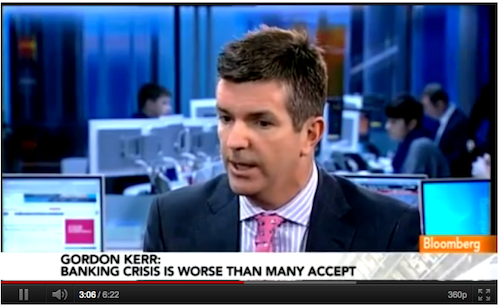
Following his recent paper The law of opposites: Illusory profits in the financial sector, TCC Advisory Board member and founder of Cobden Partners Gordon Kerr appeared on Bloomberg. The video is here.
 Click for video
Gordon dealt with the flaws in IFRS, the reasons for the debt crisis, the case for hardening money, the need for international money in support of trade and more.
Later in the day, I said in the Commons that the Government’s response to the ICB report seemed to take accounting for granted, asking the Chancellor to consider the issue seriously in the forthcoming white paper.
By Anita Acavalos, on 1 July 11
It is with no feelings of joy that we republish this article, first posted on 8 February 2010
Guest contributor Anita Acavalos, daughter of Advisory Board member Andreas Acavalos, explains the political and economic predicament in Greece.
In recent years, Greece has found itself at the centre of international news and public debate, albeit for reasons that are hardly worth bragging about. Soaring budget deficits coupled with the unreliable statistics provided by the government mean there is no financial newspaper out there without at least one piece on Greece’s fiscal profligacy.
Although at first glance the situation Greece faces may seem as simply the result of gross incompetence on behalf of the government, a closer assessment of the country’s social structure and people’s deep-rooted political beliefs will show that this outcome could not have been avoided even if more skill was involved in the country’s economic and financial management.
The population has a deep-rooted suspicion of and disrespect for business and private initiative and there is a widespread belief that “big money” is earned by exploitation of the poor or underhand dealings and reflects no display of virtue or merit. Thus people feel that they are entitled to manipulate the system in a way that enables them to use the wealth of others as it is a widely held belief that there is nothing immoral about milking the rich. In fact, the money the rich seem to have access to is the cause of much discontent among people of all social backgrounds, from farmers to students. The reason for this is that the government for decades has run continuous campaigns promising people that it has not only the will but also the ABILITY to solve their problems and has established a system of patronages and hand-outs to this end.
Anything can be done in Greece provided someone has political connections, from securing a job to navigating the complexities of the Greek bureaucracy. The government routinely promises handouts to farmers after harsh winters and free education to all; every time there is a display of discontent they rush to appease the people by offering them more “solutions.” What they neglect to say is that these solutions cost money. Now that the money has run out, nobody can reason with an angry mob.
A closer examination of Greek universities can be used as a good illustration of why and HOW the government has driven itself to a crossroad where running the country into even deeper debt is the only politically feasible path to follow. University education is free. However, classroom attendance is appalling and there are students in their late twenties that still have not passed classes they attended in their first year. Moreover, these universities are almost entirely run by party-political youth groups which, like the country’s politicians, claim to have solutions to all problems affecting students. To make matters worse, these groups often include a minority of opportunists who are not interested in academia at all but are simply there to use universities as political platforms, usually ones promoting views against the wealthy and the capitalist system as a whole even though they have no intellectual background or understanding of the capitalist structure.
This problem is exacerbated by the fact that there is no genuine free market opposition. In Greece, right wing political parties also favour statist solutions but theirs are criticised as favouring big business. The mere idea that the government should be reduced in size and not try to have its hand in everything is completely inconceivable for Greek politicians of all parties. The government promises their people a better life in exchange for votes so when it fails to deliver, the people naturally think they have the right or even the obligation to start riots to ‘punish’ them for failing to do what they have promised.
Moreover, looking at election results it is not hard to observe that certain regions are “green” supporting PASOK and others “blue” supporting Nea Dimokratia. Those regions consistently support certain political parties in every election due to the widespread system of patronages that has been created. By supporting PASOK in years where Nea Dimokratia wins you can collect on your support when inevitably after a few election periods PASOK will be elected and vice versa. Not only are there widely established regional patronage networks but there are strong political families that use their clout to promise support and benefits to friends in exchange for their support in election years.
Moreover, in line with conventional political theory on patronage networks, in regions that are liable to sway either way politicians have a built in incentive to promise the constituents more than everyone else. The result is almost like a race for the person able to promise more, and thus the system seems by its very nature to weed out politicians that tell people the honest and unpalatable truth or disapprove of handouts. This has led people to think that if they are in a miserable situation it is because the government is not trying hard enough to satisfy their needs or is favouring someone else instead of them. When the farmers protest it is not just because they want more money, it is because they are convinced (sometimes even rightly so) that the reason why they are being denied handouts is that they have been given to someone else instead. It is the combination, therefore, of endless government pandering and patronages that has led to the population’s irresponsible attitude towards money and public finance. They believe that the government having the power to legislate need not be prudent, and when the government says it needs to cut back, they point to the rich and expect the government to tax them more heavily or blame the capitalist system for their woes.
After a meeting in Brussels, current Prime Minister George Papandreou said:
Salaried workers will not pay for this situation: we will not proceed with wage freezes or cuts. We did not come to power to tear down the social state.
It is not out of the kindness of his heart that he initially did not want to impose a pay freeze. It was because doing so would mean that the country may never escape the ensuing state of chaos and anarchy that would inevitably occur. Eventually he did come to the realisation that in the absence of pay freezes he would have to plunge the country into even further debt and increase taxes and had to impose it anyway causing much discontent. Does it not seem silly that he is still trying to persuade the people that they will not pay for this situation when the enormous debts that will inevitably ensue will mean that taxes will have to increase in perpetuity until even our children’s children will be paying for this? This minor glitch does not matter, though, because nobody can reason with a mob that is fighting for handouts they believe are rightfully theirs.
Greece is the perfect example of a country where the government attempted to create a utopia in which it serves as the all-providing overlord offering people amazing job prospects, free health care and education, personal security and public order, and has failed miserably to provide on any of these. In the place of this promised utopian mansion lies a small shack built at an exorbitant cost to the taxpayer, leaking from every nook and cranny due to insufficient funds, which demands ever higher maintenance costs just to keep it from collapsing altogether. The architects of this shack, in a desperate attempt to repair what is left are borrowing all the money they can from their neighbours, even at exorbitant costs promising that this time they will be prudent. All that is left for the people living inside this leaking shack is to protest for all the promises that the government failed to fulfil; but, sadly for the government, promises will neither pay its debts nor appease the angry mob any longer. Greece has lost any credibility it had within the EU as it has achieved notoriety for the way government accountants seem to be cooking up numbers they present to EU officials.
Dismal as the situation may appear, there still is hope. The Greeks many times have shown that it is in the face of dire need that they tend to bond together as a society and rise to the occasion. Family ties and social cohesion are still strong and have cushioned people from the problems caused by government profligacy. For years, the appalling situation in schools has led families to make huge sacrifices in order to raise money for their children’s private tuition or send them to universities abroad whenever possible. This is why foreign universities, especially in the UK, are full of very prominent and hard working Greek students. Moreover, private (as opposed to public) levels of indebtedness, although on the rise, are still lower than many other European countries.
However, although societal bonding and private prudence will help people deal with the consequences of the current crisis, its resolution will only come about if Greek people learn to listen to the ugly truths that sometimes have to be said. They need to be able to listen to statesmen that are being honest with them instead of politicians trying to appease them in a desperate plea to get votes. The time for radical, painful, wrenching reform is NOW.
There are no magic wands, no bail-outs, no quick and easy fixes. The choice is between doing what it takes to put our house in order ourselves, or watching it collapse around us. This can only come about if Prime Minister George Papandreou uses the guts he has displayed in the past when his political stature and authority had been challenged and channels them towards making the changes the country so desperately needs. Only if he emerges as a truly inspired statesman who will choose the difficult as opposed to the populist solution will Greece be up again and on a path towards prosperity. He needs to display a willingness to clean up the mess made after years of bad government and get society to a point where they are willing to accept hard economic truths. One can only hope…
Further reading
By Toby Baxendale, on 26 April 10
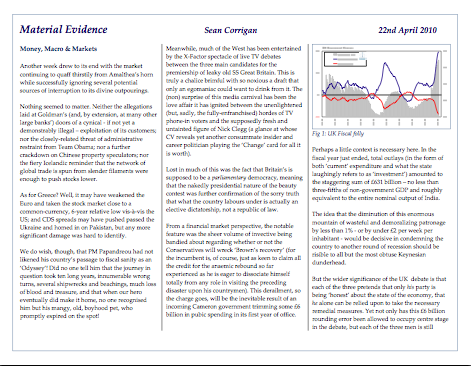
Corrigan once again treats us to his analysis of the debt levels facing us here in the UK, how desperate it is, and what denial all our politicians seem to be in.

Download the report here.
By Toby Baxendale, on 15 December 09
Here’s a sobering thought. If you are due to pay 50% income-tax in the new tax year, do not be fooled: it will come closer to 80% when you add on a few mandatory extras such as the full 17.5% VAT on most of your spending coupled with the 12.8% National Insurance paid by your employer on your behalf. (I have ignored a few allowances – but also the ‘stealth taxes’ pulling back on the other side such as Stamp Duty, Airport Tax, Car Tax, Tax on fuel … it just goes on and on.)
Think about this number for a moment. It means that for 80% of the year you will be working hard for the state and 20% for you and your family plus any philanthropic causes you contribute to. This means you will be working from the 1st of January to the end of September for the State. It won’t be until towards the end of September in to October, November and December that you will truly be working for yourself in any sense.
This is a subtle and pernicious form of modern day slavery, for sure.
Alistair Darling, our hapless Chancellor, tells us that those with the biggest and broadest shoulders should share the largest burden of funding the deficit that his Government – and only his Government – have created over the last ten years.
I am reminded of Ayn Rand’s great novel published in ……. Atlas Shrugged, Part 3, Chapter 7. Here is John Galt speaking:
If you saw Atlas, the giant who holds the world on his shoulders, if you saw that he stood, blood running down his chest, his knees buckling, his arms trembling but still trying to hold the world aloft with the last of his strength, and the greater his effort the heavier the world bore down on his shoulders — what would you tell him to do? To Shrug.
Ayn Rand’s prophetic warning – that it is the businessmen of the world who create the wealth in the first place, which allows what a ‘statist’ like Darling wishes to do to advance his Party’s vision of social progress – will, one day, if pushed far enough, cause this country’s wealth creators to just shrug their shoulders and move on and away. At worst, what will be left is a society bereft of those who actually make money – or such a diminishing pool that the state will implode, consuming itself to death with no new wealth to replenish it.
In Capitalism: The Unknown Ideal, Rand reminds us:
Businessmen are the one group that distinguishes capitalism and the American way of life from the totalitarian statism that is swallowing the rest of the world. All the other social groups – workers, farmers, professional men, scientists, soldiers – exist under dictatorships, even though they exist in chains, in terror, in misery, and in progressive self-destruction. But there is no such group as businessmen under a dictatorship. Their place is taken by armed thugs: by bureaucrats and commissars. Businessmen are the symbol of a free society – the symbol of America.
Well, the UK State has run out of money. It will borrow £200 billion next year to pay its ever-ballooning payroll. Meanwhile we, here in the UK, are relying on the good will of our lenders to bankroll our state workers on a week-by-week basis. Yes, the UK is existing on a hand to mouth basis only. This is what it means to have a £200 billion deficit to fund. The government takes £4 in tax and spend £5 on its programs. It does not have the political courage to take immediate efforts to make this £4 in and £4 out, as any prudent family must budget.
When human beings began to peacefully exchange goods and services, civilised society was created. Money is the medium that facilitates this exchange to our satisfaction. Society, and its closely associated derivative, money, which facilitates peaceful exchange, is arguably the greatest invention of mankind. All other things flow from the basic functions of exchange being enabled to be fulfilled: it is, quite simply, this that has lifted us up from primitive existence. We should be glorifying those, like Ayn Rand’s fictional John Galt, who – far from being labelled fat cats – are a shining beacon of hope in desperate times. Rand goes further:
“So you think that money is the root of all evil?” [leaving it aside that this is a common misquote: St Paul suggests that the love of money is the root of evil, a distinction lost to those who damn the rich out of hand.] “Have you ever asked what is the root of money?” continues Rand. “Money is a tool of exchange, which can’t exist unless there are goods produced and men able to produce them. Money is the material shape of the principle that men who wish to deal with one another must deal by trade and give value for value. Money is not the tool of the moochers, who claim your product by tears or of the looters, who take it from you by force. Money is made possible only by the men who produce. Is this what you consider evil?
“Until and unless you discover that money is the root of all good, you ask for your own destruction. When money ceases to become the means by which men deal with one another, then men become the tools of other men. Blood, whips and guns–or dollars. Take your choice–there is no other.”
A modern day John Galt is none other than Michael Spencer, who I have the good fortune of knowing. He is the billionaire founder of ICAP, the largest inter deal broker on the planet. He employs 4,500 people, transacts £1.4 trillion of trades per day, has 50 offices world wide. His charity day at the office raises half of he total amount that the whole BBC Children in Need raises. Glory to the forces of free market capitalism, that most potent wealth creating force known to mankind.
Michael Spencer was interviewed by the Daily Telegraph on the 5th of December and said: “If the Conservatives are not elected and if Labour continue to increase taxes as they probably will then, regrettably, we would presumably have to reconsider moving domicile.”
The prospect of working 80% of the year for the State, like the Titan Atlas holding up the world is becoming too much for the likes of Spencer. We are approaching the tipping point. We need our Spencers and the whole army of entrepreneurs more so now then ever to create the wealth to get us out of the Labour Party induced mess we are in today.
By Toby Baxendale, on 11 December 09
By Steven Baker MP, on 9 December 09
Via FT.com / UK / Politics & policy – Do-it-yourself warning as state cuts back, further evidence of the need for genuine social progress through mutual cooperation:
The relationship between the individual and the state will need to be radically redefined as the next government cuts billions of pounds from local authority spending, council finance chiefs and chief executives are warning.
Some individual council services could face cuts of 30 per cent or more over three years after 2011, a joint study by Solace, the Society of Local Authority Chief Executives, and Cipfa, the Chartered Institute for Public Finance and Accounting, has concluded.
By Toby Baxendale, on 1 December 09
In this article, I argued that a useful measure of GDP needs to extract the government sector, as all it represents is a movement of wealth from the productive private sector to the productive and not so productive government sector. The private sector is the well spring of wealth creation and the government sector can in itself create no wealth, it can only redistribute it to achieve outcomes that it determines to be more desirable.
One of our regular readers commented as follows:
I have trouble with the suggestion that government spending cannot — at least in theory — result in wealth creation.
The commentator goes on to give an example of taxes creating a useful service, that of a national railyway that creates wealth and an example of printing money that, given to the right projects, will create wealth. They are as follows;
Suppose FooCorp sends their packages by carrier pigeon. This is slow and expensive (pigeons need to be trained and fed, and packages go missing when they fly past hunting grounds). FooCorp realises that they can increase efficiency by investing in a private rail network. The cost savings delivered by the network are greater than the cost of the investment, and FooCorp reaps the rewards. This, presumably, is wealth creation. If so, why is wealth not created if a taxpayer-funded rail network benefits the taxpayers more than it costs them?
And:
Suppose that rather than confiscating our wealth directly through taxes, the government confiscates it indirectly by printing money. The government spends its new money not on bank bailouts or welfare programs, but instead on the fusion researchers, who eventually deliver cheap power for all UK citizens. Again, it would seem that though the original funds were ill-gotten, the result has been genuine wealth creation.
I do not deny the possibility that in these specific individual, stylised examples a government can create wealth. However, in the round, they can never create more wealth than a freely functioning economy.
Economic Calculation in the Socialist Commonwealth
This is the title of a very famous essay – for the full downloadable PDF, see here.
Ludwig von Mises masterfully shows us how rational economic calculation in a socialist system is impossible. Only a half-baked system of production is possible under socialism. Empirically, we saw this in Eastern Europe and the Soviet system. The message is very simple;
- In the free market, people transact for goods and services via voluntary exchange, facilitated by the use of money.
- Money is the price you pay for the goods.
- The price mechanism tells us all sorts of information as to the scarcity of those goods and services (higher prices) or their abundance (lower prices). They also indicate the need or wants of consumers as they will pay more for more wanted goods and services and less for less wanted goods and services.
- Entrepreneurs look out for these price signals so they can direct the factors of production in better ways and combinations to satisfy those most urgent needs of the consumer.
- If government owns the means of production, there is no price for capital goods.
- The central planner has to make up a price to get a capital input.
- How is this done?
- It can only be done at best by educated guesswork.
The Pretence of Knowledge
This is the tile of a very famous speech by Hayek: see here
Also see Hayek FA 1937 Economics and Knowledge, Economica V4 N13 33-54 and 1945 The Use of Knowledge in Society, The American Economic Review .
Hayek built on the work of his teacher Mises by adding the following;
- Planning the production process in the free market economy is done by billions of people exchanging goods and services, facilitated by the medium of money.
- Prices to entrepreneurs are indispensible communication points in their planning process, showing the entrepreneur what factors of production and being demanded to produce what goods and services.
- This knowledge is dispersed and comes from a multiplicity of sources.
- Central planners cannot possible have brains big enough to take over the role and plans of all the entrepreneurs in society and all the spending individuals, thus they have a “knowledge problem.”
Although this was all debated well before the advent of super calculating computers, no program can ever take into account the changing needs and preferences of individuals. Also getting into the computer all of the combined information all the time in all circumstances for all times and places to replicate the market place cannot as of yet be done and I suspect never will be done.
Conclusions
So in answer to our commentator, I would advise a quick reading of the above mentioned classics as I think they are unbeatable in their logic. A government may get lucky with a plan and subsequent taxation of wealth to spend on that plan but, overwhelmingly more so than not, they will fail for the given reasons.
In the mixed economy we exist in today, Lord Andrew Adonis, the current Secretary of State for Transport, is doing just as our commentator suggests and is planning to build a high speed rail network that will undoubtedly bring benefits by moving the great cities of our nations closer together. More trade will take place than before, that is for sure. This I hope will be one of those lucky central planning projects.
The reported £34 billion is a lot of money to spend. Would the private sector have undertaken this? We do not know the answer to the latter for sure, but I would note the following pre big government;
- All the great roads until the 40’s, but now only toll roads as the road system has been nationalised, were built by the private sector;
- This is the same for all the railways, the canals and other infrastructure systems;
- And all the bridges;
- All the health care provision;
- All the education provision;
- Power supply;
- The tunnels;
- And the sewers.
I could go on and on…
If we consider food retail, we find Tesco created with £34 billion of private money invested in its capital. Do we really think that the government could provide for this in a better way?
When governments issue debt, it crowds out private sector bond issuance and fewer big capital projects are provided for by the market system. To create a better functioning market place, governments should be forbidden from raising bonds, then the needs of the market could be met as people will still want to save and they would look more favourably on corporate issuance.
Indeed, we should look once again at how bonds could be the basis of all welfare provision, as I discussedhere, from “How do we fund a Deficit” onwards.
Our commentator gives the second example of using QE or creating money out of nothing to give to some scientists who develop a superior technology that drives masses of benefit. Again, I would say this is possible and more down to luck than having the many millions, if not billions, of economic actors, working through the price mechanism solving problems and allocating resources in the most efficient way, as only entrepreneurs can.
I would back the market, comprising all of us cooperating, over any central planning agent any day of the week!
Government can create the climate for lasting wealth generation by:
- Upholding the rule of law;
- Upholding the sanctity of contract;
- Avoiding war unless attacked;
- Removing legislation that obstructs the market.
There is much more but these are some key areas. I would like to refocus our commentator on thinking of ways the government can create the climate of wealth creation, rather than attempting to be the wealth creator itself.
Further reading
By Steven Baker MP, on 19 November 09
Through tomorrow and Saturday, ESCP Europe and The Cobden Centre are hosting a Colloquium on Sound Money. The Colloquium is to be directed by Founding Fellow Dr Anthony J Evans and chaired by Corporate Affairs Director, Steve Baker.
A team of academics, banking professionals, entrepreneurs and politicians will meet to discuss:
- What is Money?
- The Interest Rate and Intertemporal Coordination
- The Gold Standard and the Great Depression
- Deflation and Prosperity
- Free Banking vs 100% Reserves
- Central Banking
- Proposals for Reform
The authors whose work will be under consideration are Carl Menger, Joseph Salerno, Frank Shostak, Ludwig von Mises, Friedrich A Hayek, Joan and Richard James Sweeney, Murray Rothbard, Lawrence Reed, Lawrence H White, George Selgin, Vera Smith, Tim Congdon, Richard Salsman and Jesús Huerta de Soto.
By Ewen Stewart, on 16 October 09
 UK Household Savings Ratio (click to enlarge)
Equity Strategist Ewen Stewart makes the case that the national debt will within 5 years be over £150,000 per family of 4 with debt repayments of twice the present defence budget, up from £31 billion in 2008/9 to £70 billion in 2013/14. He explains the root causes of our difficulties and indicates a route to recovery.
It’s all over. What a fuss about nothing. The economy will soon be growing again and, look, the FTSE100 is up almost 50% since the March low. Even house prices, according to the Halifax, have risen 6 months in a row. The doom mongers were wrong. Central Banks and Keynesian public spending programmes, together with QE, have worked. Brown indeed has saved the world!
Well that would be one interpretation and a very short sighted one too, for this recovery shows all the hallmarks of a drug addict who claims to be going straight injecting a further mighty dose of the substance that has caused such decay in the first place to prolong the party.
The problem is that the underlying fault lines in the UK economy remain and, thanks to the Government’s response, are even more pronounced.
The underlying problem is, in my view, an addiction to debt, a banking system which is over-leveraged, and now government finances that are out of control. This country that has been living considerably beyond its means for a very long time. Artificial efforts to prop this up, through printing money or inappropriately low interest rates, at best are a short term delaying tactic and at worst risk stoking a loss of confidence and ultimately inflation.
It is my central conjecture that much of the economic growth over the last decade was less the result of genuine private wealth creation but more the result of a number of unique factors which were both unsustainable in their nature and damaging to long term growth. If this view is correct the scale of the over-leverage and the action required to alleviate the problem become even more pronounced.
Continue reading “Happy days are here again? Another view from the City”
By Gordon Kerr, on 13 October 09
Gordon Kerr explains the futility of the Government’s planned asset fire sale.
The Government plans “a fire sale of assets worth £16 billion” to raise funds for our national coffers. All of the assets mooted -– the Tote, the Dartford Crossing, the Channel Tunnel rail link –- generate cash. In normal market conditions, they would be highly valued by the private sector. But these are not normal market conditions and, even if they were, the sale would be absurd.
Since these assets all generate cash, there is no net gain to the public purse from selling them. When their cash yield is greater than the interest cost of Government debt, the public purse is better off holding them than selling them to pay off debt.
More importantly, the sales are likely to be only partial. Recent experience has shown that the Government cannot bring itself to allow major infrastructure companies to fail. If Dartford Crossing plc teetered on the brink of collapse, the government would almost certainly support it but that which the private sector produces better than the public sector should be in wholly private hands, free of all taxpayer-backed guarantees.
Lenders to these “privatised” businesses would benefit from at least an implicit government guarantee. The government will be selling the upside of investing in the assets to the private sector whilst underwriting the bulk of the risk.
This amounts to selling assets to oneself, while giving away free money.
|
|