Economics

A rush from sugar or a rush to gold?

“We think we have an agreement, but we are not sure what it is.”
- Negotiator at the Euro zone “crisis summit” last week, as reported in The Economist.

“You don’t have to be paranoid to be terrified.” – Ditto.

If a ballistics expert were so poor at his job that his artillery routinely fired missiles into the sea or, worse still, at his own men, he would soon be removed from office. He might perhaps be purged more dramatically, pour encourager les autres. No such logic would seem to apply, however, in either politics or economics in the west, where discredited practitioners of failed theories are allowed to pontificate and spend into absurdity. We cannot say with certainty what was spooking European investors prior to last week’s make-or-break summit (the 14th such “crisis summit” in 21 months), but it seems plausible to argue that they were concerned about an unsustainable build-up of credit, credit risk and leverage. Happily, those concerns have now been put to rest, because the euro zone’s leaders have pledged more credit, more credit risk, and more leverage. To put it another way, Messrs Sarkozy and Merkel have bought more time, albeit time paid for with yet more borrowed money. A three ring circus of blind, incontinent clowns would have more class.

We know from previous climactic bailouts that money, being so debased by our central banks, doesn’t get you very far these days. We have now had a €1 trillion bailout whose benign market impact lasted all of a day. By Friday last week, Italian 10 year bond yields were back up at 6% – the “danger zone” – which does rather make one wonder just what the hell our monetary and political “leaders” think they are achieving with all this thinly disguised but very costly can-kicking. Evolution Securities’ fixed income research team called the bailout plan “a sugar rush” of stimulus. A one-day wonder is neither here nor there; what matters is where Italian government bond yields are in six or 12 months’ time.

The euro zone’s leaders faced at least three specific objectives. Resolution to each would have been and remains necessary but not sufficient to ease the crisis:

  1. Put Greece out of our misery.
  2. Recapitalise the banks.
  3. Do something magical and sexy with the EFSF.

What we actually have is a peculiar fudge even by the standards of eurofudge whereby a Greek default mysteriously doesn’t appear to trigger credit default swap protection, as Alen Mattich of the Wall Street Journal points out. Separately, and not for the first time, banks are being tasked with mutually exclusive objectives: keeping the lending taps open without compromising and indeed actively improving the quality of their balance sheets. This is impossible. The Economist (whose coverage of the summit this week has been excellent) cites Morgan Stanley’s Huw van Steenis, who suggests that European banks might end up pursuing a “crash diet” that results in a shrinking of balance sheets by up to €2 trillion over the next year, which would be a disaster for SMEs and others. And in the meantime, a credit bust that is the natural response to too much inherent leverage and financial engineering is being “solved” by.. leverage and financial engineering. At least the acronym for the Special Purpose Investment Vehicle is a fair reflection of the intellectual bankruptcy being deployed. One summit attendee noted of the bailout plan that “the more zeroes the better”. It is unclear whether he was referring to taxpayers’ further involuntary capital commitments, or to political non-entities.

One cannot really avoid the conclusion first reached by writer Adam Fergusson in his study of the Weimar era collapse and hyperinflation, ‘When Money Dies‘:

What really broke Germany [and which may end up breaking the euro zone] was the constant taking of the soft political option in respect of money.

Talk of hyperinflation will, one trusts, ultimately be both premature and irrelevant, but wishful thinking is no sustainable basis for an investment approach when we have the current crop of political and economic no-talent clowns calling the shots. Last week we hosted our external investment panel, an oversight committee in effect, and one of the panellists pointed out that the anticipation and preparation for acute inflation, like that for financial panic, cannot be finely timed. One minute the system is deemed to be secure. The next minute, pensioners are queuing up outside Northern Rock.

Since we have mentioned the ‘W’ word, we have an obligation to discuss what strategies best preserved the wealth of German investors during that dark period. (“Life was madness, nightmare, desperation, chaos” writes Fergusson. We are not quite there yet – but we also note that sensible financial commentators have already begun to refer to Japan as our Weimar in waiting.) Other, more valuable foreign currencies, for example. In 1923, that meant the US Dollar. This time round, since the Swiss National Bank has lost the plot, we would favour the Canadian and Singapore Dollars. Back then, the answer lay in gold, and we think it does this time, too, as the finest currency protection paper money can buy. One can also consider gold and silver mining companies – John Hathaway of Tocqueville Asset Management has written very nicely about the ‘Golden Mulligan’ being presented to investors who missed the gold bull on the way up. Markets very rarely offer second chances; investors without any form of gold exposure would, we think, be well advised to step on board now. Other forms of real assets will play their part (we note the substantial increase in the cost of British agricultural land). And since sins of omission can also be costly, investors looking for ‘safe havens’ would be well advised to be highly selective in their choice of bonds (if they choose bonds at all), as well as common stocks.

Those who have studied the Weimar experience suggest that the point of no return in the inflationary process did not come about through currency depreciation alone, nor from the growing velocity of money in circulation (as German savers tried desperately to spend their fast- eroding paper wealth), nor from the balance of payments deficit. In fact it came from a devaluation of political principles. Yale Economist Robert Shiller has suggested that one of the reasons for equity investors’ irrational exuberance in the 1990s (it was Shiller, and not Greenspan, who coined the phrase) was the fall of the Berlin Wall – which seemed to conclusively display the superiority of western free market capitalism over the discredited Soviet model. Now the superiority of the western model is so apparent that we have cash-strapped eurocrats looking to raise money from the Communist leaders of a country, most of whose citizens live in abject poverty. This writer is proud to call himself British; he would be disgusted to be regarded as European.

This article was previously published at The Price of Everything.

Economics

Greece: deflate or default

The original worry was whether Greece would default. Then it became a question whether it should it default. Now it is a question of how it will default. To hazard a guess, I should think that after the wizards of Brussels determine how much of a default is necessary to keep German (et al.) bail-out money forthcoming, the only remaining question will be when the default will occur. It is clear that the vast majority seem convinced that default is the only option, or that it is the best one, or, at the very least, that it is the most expedient one at this time.

Default is not a word to throw around casually. When an individual defaults on his mortgage, it involves great pain – he loses his house, his car, and whatever other assets he posted as collateral. Default does not mean that debts are forgiven and he starts afresh (although the vulgar form of default seems to imply this). Default causes our individual pain – it is something that he tries to avoid at all costs.

Before the Greek default occurs – which is increasingly becoming a foregone conclusion – we must look at two facets. First, what will this default mean? Second, is there a better way?

A nation can default two ways. Implicitly, by inflating the real value of its debt away by increasing the money supply, or explicitly, by not paying back the full value of its debts. If the eurozone is to continue to include Greece as a member, it is clear that an implicit inflationary default is impossible. (Some commentators seem to belabour this point, as if Greece exiting the euro and inflating away its problems would prove a panacea.) With this avenue gone the attention focuses on the explicit default, soon to be delivered.

Haircuts imposed on creditors form what seems to be the preferred planned default. In reality, a haircut only allows for one-half of a default to occur.

The half that we will see is the pain imposed on creditors. Lenders kind enough to loan their funds to the Greek government likely never expected that they would not be repaid. At least, they likely never expected the extent to which they would not be repaid (which could be as little as 20 to 50 cents on the euro). It is easy to take solace with caveat emptor, but that is only half the story.

If I default on my house, it is not only my bank that suffers a loss; I must as well. I must lose all available assets in an attempt to make my bank as whole as possible. There are not so many plans to sell Greek government assets to pay for its debts (of course, the related question is whether anybody would want such assets. I am sure that few creditors would rather take a union-saddled Greek government agency, complete with strike-induced headaches, rather than cut their losses at 100 percent).

If Greece wants to default, it must abide by the rules of the game. The current “default” plan for Greece is nothing of the sort; it is a gift. Few Greeks seem willing to sacrifice sovereign control to foreigners by relinquishing assets, and perhaps rightly so. But if assets will not be sold to try to cover its debts, Greece must look for a different avenue to default.

Cutting expenditures is one path. While Greeks strike at the very thought, if the choice was clear to them – lose sovereign assets to take a cut on your pension – their attitude might quickly change. Creditor nations avoid this trade-off by being ambiguous as to what a Greek default would actually mean to Greeks. This very ambiguity makes the game continue longer than it must. As excessively high expenditures are what got the country into the mess to begin with, it seems to be a logical place to start to try to exit recession. Austerity might be a dirty word, but it is a necessary one.

There is one other option left to the small Hellenic republic. It is not without precedent, but it too is a dirty word in some circles. Greece may not be able to pursue an external devaluation through inflation, but she can pursue an internal devaluation through price decreases. Deflation might cause some to run to the exits, but it is increasingly proving its worth. Ireland has recently started exiting its recession through deflation, and occurrence making it ever less likely that the country will default. Deflation is not necessarily easy – public and private workers will have to take salary cuts, austerity programs will have to be intensified (and fulfilled!) – but it allows the country to avoid the costs of losing national sovereignty and creditors taking losses on their loans. Some may think deflation is a dirty word, but no more than the alternatives. And it has already been successfully tested in other ailing European economies.

Economics

The official start of the European transfer union

There are basically three scenarios for the future of the European Monetary Union as I argue in my book The Tragedy of the Euro.

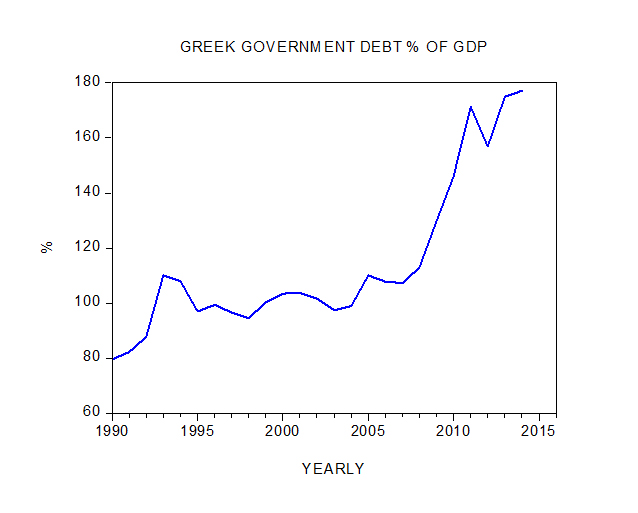
First, the Stability and Growth Pact (SGP) is reformed and enforced with automatic sanctions for countries not complying with its conditions. This requires harsh austerity measures, privatizations, labor market reforms and reduction of living standards in the periphery. The case of Greece shows that this option may just not be viable considering political structures and socialist voters resisting a reduction of the state’s size. Indeed, for 2011 the Greek deficit is expected to be at 9.5% of GDP, far above of the 3% limit established by the SGP and the 7.4% target established by the European Commission.

The second scenario is a break-up of the monetary union. The periphery has no interest in exiting the Eurozone. Periphery governments are benefitting from guarantees by the core and from monetary redistribution. An exit would imply a substantial reduction of living standards in the periphery. But why are core countries not leaving the Euro? While a euro exit would be in the interest of the common population, the political elite and their financiers from the banking sector want to continue the Euro project. As we have seen in the summit on the second Greek bailout, German Chancellor Merkel not only defied the “no-bailout clause” of the Maastricht Treaty but also a resolution of the German parliament against purchasing commonly-guaranteed bonds from February 2011. This leads us to the third scenario, which we are approaching fast: a transfer union and a European superstate. The EU summit of Thursday, 21st of July 2011 marks a big step in this direction.

The Greek government will get an additional €109 bn. bailout loan until 2014. Maturities for Greek bonds from the first bailout were raised from 7.5 to 15 years (originally it was 3 years). Interest rates were reduced from 4.2 % (originally at 5.2 %) to 3.5 %. Likewise, interest rates on loans to Portugal and Ireland were reduced.

The day brought also another bailout of banks. Banks, insurance companies and other private investors can swap their old Greek government bonds against new ones with a longer maturity. Joseph Ackermann, CEO of Deutsche Bank, estimates write-downs for banks around 21%. Politicians sell the  so-called “participation of private investors” in the bailout as a great success. However, it is just another bailout for the banking system, limiting losses to 21% and putting taxpayers’ money on the hook. Old bonds are swapped into new bonds that are guaranteed by the EFSF and such by European taxpayers. Without the second bailout the Greek government would have had to default. Banks would have had to take much higher losses in a restructuring. Estimates of losses range between 50-70%. After the swap, banks are effectively protected. The financial industry, the governments’ main financier, can be very happy about this covert bailout.

The most important consequence of 21st of July was the official establishment of a transfer union by granting more powers to the EFSF (the European bailout fund). In the Eurozone, there have always been transfers through monetary redistribution: The ECB accepts bonds from the periphery as collateral thereby monetizing deficits indirectly. Last year, the ECB even started to buy government bonds from the periphery outright, spreading the burden of the bailout to all users of the currency. Yet, from now on, direct purchases by the ECB may become unnecessary. The burden of the bailouts will be more concentrated. Not all currency users will pay in form of a dilution of the Euro but rather taxpayers in countries that effectively guarantee the EFSF.

The EFSF now can give credit lines to countries that are expected to have financing problems. In addition, the EFSF may purchase government bonds on the secondary market. The role of the ECB is thereby partially taken over by the EFSF.

The possibility of financing through the EFSF reduces the pressure for countries to eliminate deficits and reduce government debts. Why introduce harsh austerity measures, reform labor markets and privatize the public sector if there are loans available from the EFSF at ridiculously low interest rates? If you want to win elections, you should not reform but spend. Only through deficit spending one can maintain the artificially high living standards in the periphery. Indeed, debts are still on the rise. Deficits are huge and far from being eliminated. Most probably, Greece, Ireland, Portugal and soon Spain, Italy and even Belgium will borrow exclusively from the EFSF. To be effective, the size of the EFSF will have to be extended. The main guarantor will be Germany. Considering peripheral funding needs, a report from Bernstein calculates:

As the guarantees of the periphery including Italy are worthless, the guarantee Germany would have to provide rises to €790bn or 32% of GDP.

If France is downgraded, the German share increases to €1.385 trillion — 56% of GDP.

The transfer union implies a transfer of power to the European Commission. We get ever closer to a European superstate. Incentives to reduce deficits will be reduced both in the periphery and in the core. Germans will start to resist cuts in public spending. Why save if the savings flow to the periphery? Instead of reducing German pensions to guarantee Greek pensions, German voters will push for more public spending. To pay for welfare states and transfers, more taxes (maybe a European tax) and money production will become necessary. The centralization of power allows for harmonization of regulations and taxes. Once tax competition ends, there will be a tendency towards ever higher taxes. With the transfers, the power of Brussels will continue to rise. There seems to be only one bold, albeit costly way, to stop the process towards a EUSSR: withdrawal from the transfer union. With an exit from the Euro, Germany could bring down the whole Euro project and save Europe.

Society

I predict a riot

It is with no feelings of joy that we republish this article, first posted on 8 February 2010

Guest contributor Anita Acavalos, daughter of Advisory Board member Andreas Acavalos, explains the political and economic predicament in Greece.

In recent years, Greece has found itself at the centre of international news and public debate, albeit for reasons that are hardly worth bragging about. Soaring budget deficits coupled with the unreliable statistics provided by the government mean there is no financial newspaper out there without at least one piece on Greece’s fiscal profligacy.

Although at first glance the situation Greece faces may seem as simply the result of gross incompetence on behalf of the government, a closer assessment of the country’s social structure and people’s deep-rooted political beliefs will show that this outcome could not have been avoided even if more skill was involved in the country’s economic and financial management.

The population has a deep-rooted suspicion of and disrespect for business and private initiative and there is a widespread belief that “big money” is earned by exploitation of the poor or underhand dealings and reflects no display of virtue or merit. Thus people feel that they are entitled to manipulate the system in a way that enables them to use the wealth of others as it is a widely held belief that there is nothing immoral about milking the rich. In fact, the money the rich seem to have access to is the cause of much discontent among people of all social backgrounds, from farmers to students. The reason for this is that the government for decades has run continuous campaigns promising people that it has not only the will but also the ABILITY to solve their problems and has established a system of patronages and hand-outs to this end.

Anything can be done in Greece provided someone has political connections, from securing a job to navigating the complexities of the Greek bureaucracy. The government routinely promises handouts to farmers after harsh winters and free education to all; every time there is a display of discontent they rush to appease the people by offering them more “solutions.” What they neglect to say is that these solutions cost money. Now that the money has run out, nobody can reason with an angry mob.

A closer examination of Greek universities can be used as a good illustration of why and HOW the government has driven itself to a crossroad where running the country into even deeper debt is the only politically feasible path to follow. University education is free. However, classroom attendance is appalling and there are students in their late twenties that still have not passed classes they attended in their first year. Moreover, these universities are almost entirely run by party-political youth groups which, like the country’s politicians, claim to have solutions to all problems affecting students. To make matters worse, these groups often include a minority of opportunists who are not interested in academia at all but are simply there to use universities as political platforms, usually ones promoting views against the wealthy and the capitalist system as a whole even though they have no intellectual background or understanding of the capitalist structure.

This problem is exacerbated by the fact that there is no genuine free market opposition. In Greece, right wing political parties also favour statist solutions but theirs are criticised as favouring big business. The mere idea that the government should be reduced in size and not try to have its hand in everything is completely inconceivable for Greek politicians of all parties. The government promises their people a better life in exchange for votes so when it fails to deliver, the people naturally think they have the right or even the obligation to start riots to ‘punish’ them for failing to do what they have promised.

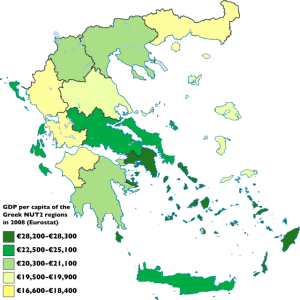
Moreover, looking at election results it is not hard to observe that certain regions are “green” supporting PASOK and others “blue” supporting Nea Dimokratia. Those regions consistently support certain political parties in every election due to the widespread system of patronages that has been created. By supporting PASOK in years where Nea Dimokratia wins you can collect on your support when inevitably after a few election periods PASOK will be elected and vice versa. Not only are there widely established regional patronage networks but there are strong political families that use their clout to promise support and benefits to friends in exchange for their support in election years.

Moreover, in line with conventional political theory on patronage networks, in regions that are liable to sway either way politicians have a built in incentive to promise the constituents more than everyone else. The result is almost like a race for the person able to promise more, and thus the system seems by its very nature to weed out politicians that tell people the honest and unpalatable truth or disapprove of handouts. This has led people to think that if they are in a miserable situation it is because the government is not trying hard enough to satisfy their needs or is favouring someone else instead of them. When the farmers protest it is not just because they want more money, it is because they are convinced (sometimes even rightly so) that the reason why they are being denied handouts is that they have been given to someone else instead. It is the combination, therefore, of endless government pandering and patronages that has led to the population’s irresponsible attitude towards money and public finance. They believe that the government having the power to legislate need not be prudent, and when the government says it needs to cut back, they point to the rich and expect the government to tax them more heavily or blame the capitalist system for their woes.

After a meeting in Brussels, current Prime Minister George Papandreou said:

Salaried workers will not pay for this situation: we will not proceed with wage freezes or cuts. We did not come to power to tear down the social state.

It is not out of the kindness of his heart that he initially did not want to impose a pay freeze. It was because doing so would mean that the country may never escape the ensuing state of chaos and anarchy that would inevitably occur. Eventually he did come to the realisation that in the absence of pay freezes he would have to plunge the country into even further debt and increase taxes and had to impose it anyway causing much discontent. Does it not seem silly that he is still trying to persuade the people that they will not pay for this situation when the enormous debts that will inevitably ensue will mean that taxes will have to increase in perpetuity until even our children’s children will be paying for this? This minor glitch does not matter, though, because nobody can reason with a mob that is fighting for handouts they believe are rightfully theirs.

Greece is the perfect example of a country where the government attempted to create a utopia in which it serves as the all-providing overlord offering people amazing job prospects, free health care and education, personal security and public order, and has failed miserably to provide on any of these. In the place of this promised utopian mansion lies a small shack built at an exorbitant cost to the taxpayer, leaking from every nook and cranny due to insufficient funds, which demands ever higher maintenance costs just to keep it from collapsing altogether. The architects of this shack, in a desperate attempt to repair what is left are borrowing all the money they can from their neighbours, even at exorbitant costs promising that this time they will be prudent. All that is left for the people living inside this leaking shack is to protest for all the promises that the government failed to fulfil; but, sadly for the government, promises will neither pay its debts nor appease the angry mob any longer. Greece has lost any credibility it had within the EU as it has achieved notoriety for the way government accountants seem to be cooking up numbers they present to EU officials.

Dismal as the situation may appear, there still is hope. The Greeks many times have shown that it is in the face of dire need that they tend to bond together as a society and rise to the occasion. Family ties and social cohesion are still strong and have cushioned people from the problems caused by government profligacy. For years, the appalling situation in schools has led families to make huge sacrifices in order to raise money for their children’s private tuition or send them to universities abroad whenever possible. This is why foreign universities, especially in the UK, are full of very prominent and hard working Greek students. Moreover, private (as opposed to public) levels of indebtedness, although on the rise, are still lower than many other European countries.

However, although societal bonding and private prudence will help people deal with the consequences of the current crisis, its resolution will only come about if Greek people learn to listen to the ugly truths that sometimes have to be said. They need to be able to listen to statesmen that are being honest with them instead of politicians trying to appease them in a desperate plea to get votes. The time for radical, painful, wrenching reform is NOW.

There are no magic wands, no bail-outs, no quick and easy fixes. The choice is between doing what it takes to put our house in order ourselves, or watching it collapse around us. This can only come about if Prime Minister George Papandreou uses the guts he has displayed in the past when his political stature and authority had been challenged and channels them towards making the changes the country so desperately needs. Only if he emerges as a truly inspired statesman who will choose the difficult as opposed to the populist solution will Greece be up again and on a path towards prosperity. He needs to display a willingness to clean up the mess made after years of bad government and get society to a point where they are willing to accept hard economic truths. One can only hope…

Further reading

Economics

Greece should return to a gold standard

Fallacies and Misconceptions about the Greek Crisis

One frequently gets the impression from reading the mainstream media that Greece has a monetary policy problem and not a fiscal problem. This is incorrect. Yet many commentators seem to argue along the following lines: This crisis is due to the straitjacket of the single currency with its one-size-fits-all monetary policy, or at least aggravated by the constraints of this system. Greece would have more “policy options” in dealing with its troubles if it had control of its own national currency.

Then there is, connected to this, an underlying – and not very flattering – notion that the Greeks are somewhat unfit to live and work in a ‘hard money system’, which presumably the euro is. The Greeks, this seems to be the allegation, like borrowing and spending too much. I am paraphrasing here but this is certainly the underlying tone of the narrative. The Germans and Dutch and French can live without the constant aid of conveniently cheap national money – but the Greeks can’t.

This is nonsense, and dangerous nonsense at that. Let’s first look at what Greece’s alleged “options” would look like if the country suddenly had the drachma back. The idea in the mainstream media seems to be that they could have lower rates and an even easier monetary policy than they have today under the ECB, and that such a policy would be suitable to the country as a whole. We have to remember that the ECB is already running an ultra-expansionary monetary policy, that the ECB is already the single biggest owner of Greek government debt, and that the ECB is very generously funding all euro banks (including the Greek banks) under lending programs that allow a lot of toxic waste to be used as collateral. But, I guess, a newly independent drachma-central bank could print even more money, hand that money to the Greek banks and the Greek government to allow them to stagger on, and then have a go at – what’s that pernicious phrase, again? – “inflating the debt away”. Well, good luck – we will debunk this shortly.

But there is another, slightly more sophisticated sounding argument out there. According to this ingenious interpretation, the Greek government is insolvent not because it habitually spends more than it takes in but because the Greek economy is not growing fast enough. If only the Greeks were more competitive and could sell more stuff abroad, then their government could happily continue spending! So again, the problem is with the inappropriately “hard money” of the Eurozone when what is needed is “soft money” — a super-easy monetary framework, in which the currency can be debased and international competitiveness and government solvency be restored with cheap money and low rates.

Luckily, I have never needed the help of any of those debt advisory services for consumers who face personal bankruptcy, so I am not speaking from experience here. Yet, I very much doubt that the first advice these services give to individuals at risk of getting crushed under mountains of credit card debt, is that they should get better jobs so their income rises. Yet, this seems to be the standard advice from mainstream economists for governments. Governments are expected to manipulate the economy via their paper money monopolies in order to generate the economic growth they need in order to sustain their lavish spending. Economic reality has to be made to perform to the demands of state largesse.

Also, I wonder, if soft money is such a great idea, why should we confine it to Greece? Should we then not all ask our central banks to run an even easier policy to “stimulate” growth? Well, most central banks are already trying this without much success. Could it be that there is something fundamentally wrong with fighting a crisis that is the result of too much debt and cheap credit with yet more debt and even cheaper credit?

I am not quite sure what is scarier, the present crisis or the fact that such economic nonsense is widely considered accepted wisdom.

A soft drachma would be of no benefit

But back to Greece. First of all, it should be clear, that a reintroduction of national paper money in Greece and the subsequent debasement of this money would not prevent bankruptcy. It would accelerate it, as the original debt was contracted in euros, and any attempt to repay it in debased “new drachmas” would constitute a default. (Of course, the Eurocracy may try and label it “restructuring” or “re-profiling”, but the rest of us have to live in the real world.) And even if repayment in new and debased drachmas was finally agreed, it would still constitute a massive loss to euro-area lenders such as the reckless German and French banks that foolishly lent to Greek politicians with blissful abandon and that are really the designated beneficiaries of the bailouts. They might as well write-off the Greek euro debt now.

Reality is not optional. The Greek government is bust, which means it cannot and will not repay its debt in anything of material value. Introducing a soft drachma doesn’t change anything.

However, many commentators suggest that even after default and substantial write-downs at the banks and pension funds, Greece should still leave the euro. Why? First of all, there is no need for an exit. The euro is a form of paper money, and paper money is not debt. The euro, just like the dollar, pound and yen, is an irredeemable piece of paper. The governments that issue it promise to exchange these notes for – nothing! The creditworthiness of these states is immaterial. The Eurozone is a currency union, not a credit union or fiscal union. I explained this here.

But I suppose the argument for post-default exit is essentially the one I cited above, namely that a soft national currency is more in character with the Greek’s alleged tendency to financial extravagance. Even if we accepted the distasteful national stereotype behind this, this argument would still be nonsense.

Debasing the currency can never be in the interest of Greek society – or any other society for that matter. Of course, weakening the exchange value of the new drachma would be a temporary shot in the arm to the export industry. As Jamie Whyte explained so lucidly here, and using the UK to illustrate the point, a weak currency is a subsidy to exporters funded by a tax on importers. Debasing the currency never furthers overall prosperity. In terms of access to internationally traded goods and services, the Greek population would get instantly poorer.

Additionally, easy money is a subsidy to the banks and the borrowers, and a de-facto tax on savers, who – contrary to the caricature in the media- do in fact exist in Greece. The recommended soft money policy for Greece would mean that savers lose purchasing power via a combination of artificially low interest rates, international currency depreciation, and rising domestic inflation. But sadly, savers do not count for much in today’s macro-economic debates, which are all geared toward borrowers and dominated by Keynesian ideas of boosting the growth statistics and generating artificial “aggregate demand”. Such a policy bias has far-reaching and long-lasting consequences. Saving and the accumulation of real capital are the backbone of any economy and the only method we have for increasing productivity and thus generating lasting prosperity. It is the savers who put the capital into capitalism.

Continue reading at Paper Money Collapse

Cobden Centre Radio

Cobden Centre Radio: Europe’s Deep Freeze of Debt

In this latest Cobden Centre Radio programme, I interview Professor David Howden, a member of our Advisory Board, about his new book, Deep Freeze: Iceland’s Economic Collapse, co-authored with Professor Philipp Bagus.

Amongst other subjects, we fly south from Iceland down to Ireland, then compare how these two North Atlantic islands are coping with their respective economic crises, before Howden considers Portugal, Greece, and Spain, and how the fate of these nations may be tied to the immediate fate of the Euro, by weighing up the latest evidence from an Austrian perspective:

Subscribe to our podcast here:

Subscribe to Podcast

Economics

The day the ECB lost its last credibility

January 14th 2011 is the day on which the Greek government ultimately would have failed. Only extreme interventions by the ECB, breaking former promises, are holding the Greek government afloat. On January 14th, Fitch downgraded Greece from BBB- to BB, a rating considered junk status. Fitch was the last of the big three rating agencies after S&P and Moody’s that had rated Greece above junk.

The ratings are essential for governments because of the collateral rules of the European Central Bank (ECB). When governments spend more than they receive as tax revenue, they issue government bonds. These government bonds are bought by the banking system because banks can use government bonds as collateral for new loans from the ECB. This mechanism is explained in detail in my book The Tragedy of the Euro. The ECB does not accept just any kind of security or government bond as collateral for its valuable loans. The ECB wants some quality, and requires a minimum rating by one of the three rating agencies for these securities.

During the financial crisis the ECB had lowered the required minimum rating for its open market operations from A- to BBB- in order to help out banks because the rating of securities, especially mortgage backed securities, were falling. The reduction was supposed to be an exception and was to expire at the end of 2010.

The uncertainty of Greece’s rating triggered the sovereign debt crisis in 2010. Due to budgetary problems, Greece was in danger of losing the minimum A- rating. What would happen in 2011 when the minimum rating would be raised back to A- and Greece’s rating would not meet this requirement?

The market started to have doubts about Greece’s being able to repay its debts. And it was feared that the ECB would stop financing the Greek deficit indirectly. If the ECB would stop accepting Greek bonds as collateral for loans, no one would buy Greek bonds. The government would have to default on its obligations.

In January 2010 Jean-Claude Trichet, ECB president, still maintained a hard money rhetoric:  “We will not change our collateral framework for the sake of any particular country. Our collateral framework applies to all countries concerned.”

Market participants interpreted this statement as a pledge that the ECB would not extend the exceptional reduction of the required minimum rating to BBB- just to save the Greek government. Along the same line, chief economist of the ECB, Jürgen Stark, stated in January that markets were wrong in believing that other member states would bail Greece out.

As Greek problems intensified in March 2010, Trichet, in contrast to his January statement, announced that emergency collateral rules would be extended through 2011. Greek bonds regained the potential to serve as collateral.

Yet, the Greek situation was worse than central bankers had expected. Markets started to believe that Greece would even fail to meet the BBB- rating in 2011, an expectation that finally became reality on January 14th with the downgrade by Fitch. They continued to sell Greek bonds.

In May 2010 at the height of the debt crisis, the independence of the ECB began evaporating when it announced it would drop all rating requirements for Greek government bonds. The ECB would accept Greek bonds as collateral no matter what. Only by this measure does the ECB continue to accept junk rated Greek bonds as collateral.

By contradicting its previous approach and becoming an executor of politics, the ECB lost its credibility. The ECB presented itself more and more as the inflationary machine—in service of high politics—that had been intended by French and other Latin politicians.

From the beginning, the Euro has been a political project. In order to save the project, the ECB disregarded its mandate of price stability and changed its collateral rules to accommodate the bailout of Greece. Far from being a copy of the Bundesbank that during its history repeatedly dismissed inflationary wishes of politicians, the ECB proved to be an instrument of politicians toward a centralization of power in Europe.

In 2011 we are at a decisive moment regarding the future of the European Union. Either the EU takes a leap forward toward a strong centralized European state, or we will move towards more freedom as competition is fostered. The ECB has shown on which side it stands.

Economics

Regulating while Europe burns

Britain and the Eurozone hover on the Brink of Banking and Monetary Collapse. Our response? More Regulation.

The European Central Bank’s head, Jean Claude Trichet, appears to have realised what a mistake he made in single-handedly engineering the bailout of Greece only six months ago.

As I pointed out at the time this was simply a massive transfer of wealth from taxpayers to banks, funds and other investors in Greek Government bonds.  Those smart and wealthy investors are now banking these profits very rapidly as we can observe by noting the rises in credit default swap prices.

Yesterday M. Trichet announced plans to raise Euro interest rates and decrease long term support for the banking system.  It will be interesting to see if and by how much rates are raised since the Spanish banking system will probably collapse if Euro rates rise by even 1 per cent.

Why will this happen?  It was a poorly reported consequence of the bailout two years ago that a significant consequence of forcing rates to zero is to inflate asset prices.  Both effects are forced and hence, to use the popular term of the decade, unsustainable.  The crash that we are about to experience will be far greater than that which would have occurred if the ordinary rules of capitalism had been allowed to operate in 2008.   Sanity could have been restored to the banking system had governments stayed out of the mess.   Liquidations would have led to changed business models and the appreciation by consumers of banking products that governments cannot protect them from losing money.

And what has the UK Government’s response been during this joyous week, which has already been widely reported as a good time to bury bad news?

In addition to pledging that we will donate several billion to the Irish cause, it has been announced that those who make their living by selling us mortgage products must take a course in mortgage loans.

This is yet another example of what Kevin Dowd has labelled “sham regulation”.  The presence of an accreditation mark on an IFA’s business card is intended to imply that the consumer should trust his mortgage advice and sign up for the loan he recommends.

Let me recommend that sellers and buyers of these products take a very short education by reading and understanding the rest of this article.  If enough of you lobby the FSA, these few words might even be adopted as the new FSA official mortgage education qualification.

When considering mortgage loan offers there are only two relevant criteria:

a)    The length of the fixed interest period;

b)    The all-in cost of the loan.

I would mention a third, but much less important point: break costs.  Borrowers’ circumstances may deteriorate and the consumer should be aware of the costs of defaulting or switching lenders during the fixed period.  Simply ask and compare.

Let us consider point a).  Why do I focus on fixed rate loans, when historically in the UK and today in many countries like Spain floating rate loans were / are much more common?  The answer is simple.  The financial risk of a home purchase is usually considered to comprise only the risk of up or down variance in the house’s value after purchase.  This assessment only applies to houses bought for cash.  If a loan is required the consumer should quickly decide whether he wishes i) to take this amount of risk or ii) twice this risk.

Buying a house and borrowing on a floating rate basis amounts to taking roughly twice the house price risk because if rates rise not only do house prices usually fall but of course your payments rise as well.  Therefore borrowers who wish to expose themselves to one times the risk of the house price variance should borrow on a fixed rate basis.

Point b) the all-in cost, can be calculated by entering all payments into either an Excel spreadsheet or even some calculators.  All fees at inception and redemption should be included.  Then press the “Net Present Value” button and compare the offers.  (For the less financially savvy reader, NPV is simply a way of expressing a stream of payments over time as a cost today.  For example, if the interest rate is 5% you would be indifferent as to a choice between paying £100 away today or £105 in one year’s time).

That is the end of the mortgage loan training course.  Set out above is a universal guide.  No other criteria matter – least of all the identity of the lender, unless you take a floating rate loan and expose yourself to being gamed by the bank.  Many lenders brazenly jack up the rates they apply to loyal customers and offer “discounts” to new borrowers.  These banks rely on lethargic consumers not to refinance quickly.  This risk is almost impossible to assess in advance and is another reason to fix your rate for as long as possible.

It would be wonderful if the FSA’s official course were to comprise no more than the above few paragraphs, but sadly I fear the actual course will be replete with mumbo jumbo and simply constitute yet another barrier to entry into the financial services business.  Mortgage industry hucksters will thus receive state support for their present modus operandi, namely the maintenance of the pretence that, like a Savile Row suit, you are a very special customer and need an expert, like me, to tailor a loan to your specific requirements.

Economics

THE GHOST OF MILTIADES

Sean Corrigan has sent us one poem we missed by Thomas Moore that has much relevance today. Enjoy.

Toby Baxendale.


“The Ghost of Miltiades” is about Greek war bonds. As noted earlier, Greece had been fighting for independence  from the Ottoman Turks since 1821.  In 1824-5, the fledgling Greek government obtained two large, high-interest from English banks, which were then turned and floated as bonds on the London market.  Andreas Luriottis was the Greek agent in London.  The whole thing did not end well and the value of the Greek bonds collapsed accordingly — ending with the “Benthamite” trader wailing about his subsequent losses and trying to sell them back to the Greeks. “Jerry” is Jeremy Bentham, of course.

[Ah quoties dubius Scriptis exarsit amator! – ah, how often has a message inflamed a doubting lover - Ovid]

The Ghost of Miltiades came at night,
And he stood by the bed of the Benthamite,
And he said, in a voice, that thrill’d the frame,
“If ever the sound of Marathon’s name
Hath fir’d they blood or flush’d thy brow,
Lover of Liberty, rise thee now!”

The Benthamite, yawning, left his bed –
Away to the Stock Exchange he sped,
And he found the Scrip of Greece so high,
That it fir’d his blood, it flush’d his eye,
And oh, ’twas a sight to see,
For never was Greek more Greek than he!
And still as the premium higher went,
His ecstas rose – so much per cent.,
(As we see in a glass, that tells the weather,
The heat and the silver rise together,)
And Liberty sung from the patriot’s lip,
While a voice from pocket whisper’d “Scrip!”
The Ghost of Miltiades came again; –
He smil’d as the pale moon smiles through rain,
For his soul was glad at the patriot strain;
(And poor, dear ghost — how little he knew
The jobs and the tricks of the Philhellene crew!)
“Blessings and thanks!” was all he said,
Then, melting away, like a night-dream, fled!

The Benthamite hears — amaz’d that ghosts
Could be such fools — and away he posts,
A patriot still? Ah no, ah no –
Goddess of Freedom, thy scrip is low,
And, warm and fond as they lovers are,
Thou triest their passion, when under par.
The Benthamite’s ardour fast decays,
By turns he weeps, and swears, and prays,
And wishes the d–l had Crescent and Cross,
Ere he had been forc’d to sell at a loss.
They quote him the Stock of various nations,
But, spite of his classical associations,
Lord how he loathes the Greek quotations!

“Who’ll buy my Scrip! Who’ll buy my Scrip?”
Is now the theme of the patriot’s lip,
And he runs to tell how hard his lot is
To Messrs. Orlando and Luriottis,
And says, “Oh Greece, for Liberty’s sake,
Do buy my Scrip and I vow to break
Those dark, unholy bonds of thine –
If you’ll only consent to buy up mine!”
The Ghost of Miltiades came once more; –
His brow, like the night, was lowering o’er,
And he said, with a look that flash’d dismay,
“Of Liberty’s foes the worst are they
Who turn to a trade her cause divine,
And gamble for gold on Freedom’s shrine!”
Thus saying, the Ghost, as he took his flight,
Gave a Parthian kick to the Benthamite,
Which sent him, whimpering, off to Jerry
And vanish’d away to the Stygian ferry!

— Thomas Moore, 1828

Economics

Material Evidence: Greece has been the very essence of Keynesian folly

The latest Material Evidence from Sean Corrigan:

What seems to escape every one of these fatuous macromancers is that, for years now, Greece has been the very essence of Keynesian folly: that the heavy hand of the state, by distributing a corrupting largesse derived from the government-supported evil of fractional reserve banking and constituted of laughably mispriced, fiat-money lending, had so successfully ‘stimulated’ the country and artificially boosted the shibboleth of its GDP that it is now reduced to a state of penury so extreme — and is plagued with a false sense of entitlement so engrained — that all conceivable solutions to its woes now seem like bad ones.

Material Evidence, 7 May 2010

Download the report here.