Drawing on the work of Nobel Laureates in economics from three traditions, plus numerous other distinguished scholars, Cobden Centre Chairman, economist and successful entrepreneur Toby Baxendale presents an informal introduction to our proposal for honest money and the benefits consequent on the reform. See also our precis of Irving Fisher’s 100% Money.
Fact
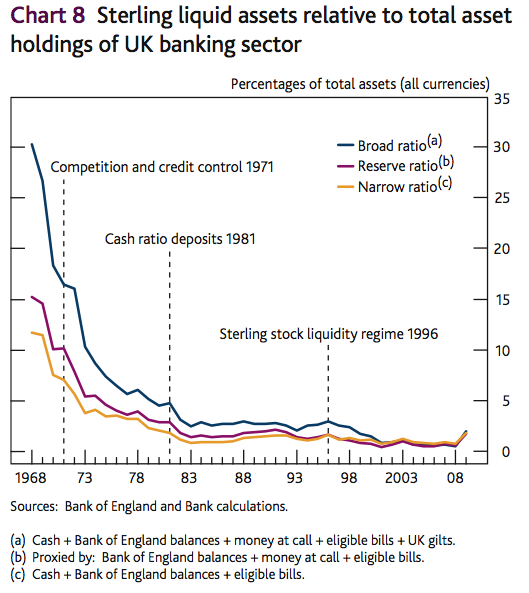
- The average overhang of credit to money of all banks in the United Kingdom is 34 x to its reserves i.e. its actual money base1.
- If more than one person in 34 walks into all banks simultaneously to withdraw their deposits, there will be a system wide bank run and a mass liquidity event with systematic default and insolvency.
- We saw the start of this with Northern Rock in the summer of 2007.
- We attempt to paper over the cracks and restore confidence in the banking system still today – with little success2.
A practical, politically-acceptable proposal
Our proposal is, as Irving Fisher wrote, “The opposite of radical”:
- Require 100% cash reserves to be held against all demand deposits; there can never be a crisis if a bank always holds 100% cash against all its demand deposits.
- Parliament can do this with one Act.
A similar Act took place in 1844. The Bank Charter Act or “Peel’s Act” established a 100% reserve requirement for bank notes that were issued claiming to be redeemable in gold. The reality was that there were 23 notes in issue for every one unit of gold at the time, creating instability, “panic” and general economic chaos. Not a too dissimilar situation from today where we have 34 claims on money to one unit of money. Politicians in the 19th century did not see the creation of unbacked credit through accounting entries as a problem, since it was only done on a very small scale. The problem then was rampant note issue (claims to real money) well over and above the monetary base, as this was the preferred method the bankers used at the time.
It is often forgotten but when you place £1m in a savings account (in cash) in say the Royal Bank of Scotland, which has no legal reserve requirement, they then lend £970k (in credit) , keeping on average 3% of cash back in reserves, to an entrepreneur in say HSBC, who then deposits that money in HSBC. We now have one claim to the original £1m and one claim to the £970k. The money supply has moved from £1m to £1.97m – just like magic! This is credit expansion.
The reality is that across all the banks in the United Kingdom licensed by the Bank of England, we have for every £1 of money (in cash), £34 in claims to money (credit)!
Peel’s problem was the over issue of notes to gold: our problem is the over issue of credit to money.
Continue reading “A day of reckoning: how to end the banking crisis now”
- See the Bank of England’s Financial Stability Report. Oral evidence from Sir Fred Goodwin (RBS) and Mr Andy Hornby (HBOS) to the Treasury Select Committee was at variance with our calculations:
Q1864 Mr Love: Sir Fred, can I ask you, following on from those questions, how leveraged was RBS at the time of the Lehman’s dissolution?
Sir Fred Goodwin: I think there would have been a variety of different ways of looking at the leverage ratio.Q1865 Mr Love: I am just looking for a rough idea, order of magnitude.
Mr Fred Goodwin: Towards the higher end but there would be others higher than us. We would have loans to deposit.Q1866 Mr Love: What was the ratio?
Sir Fred Goodwin: 110% but there would be others similar to that, there would be some higher and some lower. We were to the right of the middle, we were at the higher end of the middle.Q1867 Mr Love: Mr Hornby, can you tell us what it was for HBOS?
Mr Hornby: Yes, our loans and advances were around £450 million, our customer deposits were about £250 million, therefore the percentage of one to the other was around 57%.See http://www.publications.parliament.uk/pa/cm200809/cmselect/cmtreasy/144/144i.pdf – Page EV246, Q1864 [↩]
- See for example, Caithness, ”My Lords, the Banking Bill which we are currently discussing in the House is very complex and detailed, but it does nothing to resolve the current banking crisis, which lies at the heart of our economic problems. The noble Lord, Lord Peston, has just said that it is the fault of the bankers. I agree with him up to a point, but would go further and say that the fault that really needs correcting is our whole banking system.” [↩]