|
|
By Sean Corrigan, on 17 September 09
 Superhighway to Serfdom
By kind permission of Sean Corrigan, we make available the September edition of his Resource Ruminations “Superhighway to Serfdom”:
“The danger of modern liberty is that, absorbed in the enjoyment of our private independence, and in the pursuit of our particular interests, we should surrender our right to share in political power too easily. The holders of authority are only too anxious to encourage us to do so. They are so ready to spare us all sort of troubles, except those of obeying and paying! They will say to us: what, in the end, is the aim of your efforts, the motive of your labours, the object of all your hopes? Is it not happiness? Well, leave this happiness to us and we shall give it to you. No, Sirs, we must not leave it to them. No matter how touching such a tender commitment may be, let us ask the authorities to keep within their limits. Let them confine themselves to being just. We shall assume the responsibility of being happy for ourselves”
Benjamin Constant, ‘The Liberty of Ancients Compared with that of Moderns’, 1816
…
Imagine, if you will, that we stand today at a cross-roads and that we see to our right a minor road which branches away to climb rapidly upward in an ultra- (even a hyper-) inflationary surge to ruin. On our left, we find a trackway which twists downward, descending rapidly into a Slough of Despond after threading its way past the rusting ironwork, boarded windows, and unfinished building work of a renewed financial crisis and after jolting its users horribly about in the ruts and potholes of further, poor political decision-making as they motor to their doom.
In all likelihood, however, our state-employed bus driver will avoid these two offshoots and will rather stick steadfastly to the busy highway along which we are currently speeding, a broad Road of Good Intentions along whose dreary verges we see an army of labourers sweating over the construction of an ever more ramshackle confusion of governmental props, buttresses, and scaffolding as they try manfully to shore up the crumbling Babel of bad debt and faltering businesses to be found there, at least beyond the next election date.
Read the full report.
By Toby Baxendale, on 15 September 09
 Calamity Brown
The Cobden Centre’s Chairman, Toby Baxendale, explores Gordon Brown’s total responsibility for the meltdown of the UK economy.
It is said that the USA Sub Prime mortgage market – i.e. mortgages sold to people who had less chance of repaying the debt than the lender would normally lend to — is the cause of the Recession. How did the lenders get this money to lend to the less than creditworthy borrower?
From 1996 – 2007 in the USA, there was a spectacular increase in the money supply and thus credit grew from $5 trillion to $10 trillion, a frightening double increase in circulating money, if you take the M3 measure.
It is said by our Prime Minister that the bursting of this American bubble and the loss of confidence in the capital markets across the world is nothing to do with the UK Government’s policies, indeed “its not my fault .”
Like a school boy caught doing something wrong the Prime Minister says “its nothing to do with me, it was him, him and him”, i.e. anyone but himself. How can what happens in the USA cause anything to happen in the UK?
If you think about it, in the USA, you have a currency that is called the Dollar that is legal tender. In the UK you have something called the Pound Sterling that is legal tender.
Now for any dollar-based dodgy mortgage security, denominated in dollars, to be sold to a UK financial institution, such as one of our formally Great Banks, the bank must sell Sterling and buy dollars to pay for the security.
Under our Chancellor from 1997 – 2007 and now Prime Minister during this period, we have seen the money supply grow from £700 billion to £2 trillion if you take M4 as the leading indicator: such a massive increase in the circulating credit in the economy is un heard of in all our history!
Only armed with excess Sterling — newly minted money — can a bank consider buying sub-prime mortgages.
These schemes would never have been considered in normal markets as you place your loans, as a banker, in the strongest, most secure deals first and you avoid placing your clients’ money at risk if your clients’ money is scarce. If it is plentiful and you have run out of conventionally sound investments, you then look at the more risky investments.
Only the then Chancellor and now Prime Minister could have allowed such excesses to develop. He and he alone is the person who could have not printed the money and not allowed the excess credit creation.
The Smoking Gun is in his hand.
The destruction he and he alone has caused effects the lives on untold millions of people around our country as we now have:
- Short-time working hours,
- Layoffs, redundancies,
- Mass unemployment and invalidity,
- Large-scale reduction in the values of retirement pensions: people having to work longer to stay still,
- A collective 30% pay cut verses other workers in the World, for a full 60 million of us as our currency has shrunk in value against most of the World’s other currencies.
- More importantly, lets pause a minute and consider this number: £800 billion…….. It is the National Debt for next year that David Cameron will inherit when he is PM. It is more than the collective debts off all the governments collectively rolled together since William the Conqueror!
Madoff got life for blowing away peoples savings. His Ponzi scheme was the largest yet know in history.
Nothing compares with the scale of destruction that Gordon Brown has caused: that lays firmly at his feet and no one else’s.
We have listened to his delusional mumbo jumbo for long enough. If he had any Grace he would resign. I fear he will not go quietly.
I have an image in my mind of the lovely Sarah Brown dragging him from Downing Street with Gordon muttering 5, 6 or 7 new initiatives to combat this, that or the other ailment that He has caused.
She tells him “it’s over Gordon, do not worry, I have booked us a long needed holiday in a nice holiday home in Libya with our new friends!”
Let us then hope the new Administration will not repeat the mistakes of the current one.
By Steven Baker MP, on 11 September 09
Revised and updated: reconciling our conflicting views of the market through consistent principle and morality. This post originally appeared on www.stevebaker.info.
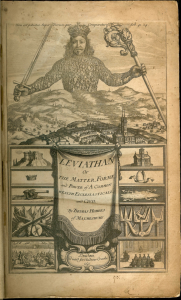
 Leviathan, 1st Edition, 1st Print, from Toby Baxendale's original
A Christian friend is an avowed socialist and another associate is determinedly left wing. I asked them recently what socialism meant to them. The answer was essentially “people being good to one another”: kindness, compassion, fairness and justice, even liberty. Who would oppose that?
But can force make it so?
Though I write with great affection for my friends, when I hear or read “socialism”, I understand a quite different thing: misery. Everywhere Marxist theory was determinedly put into practice, the result was tremendous suffering, not utopia, and yet Marxist ideas persist in our thinking.
Socialism, though formally hopeful, causes misery because a socialist society must force individuals to take particular courses of action for the good of all. For example, Lenin’s acclaimed Marxist philosopher Bukharin wrote:
For a long time yet, the working class will have to fight against all its enemies, and in especial against the relics of the past, such as sloth, slackness, criminality, pride. All these will have to be stamped out. Two or three generations of persons will have to grow up under the new conditions before the need will pass for laws and punishments and for the use of repressive measures by the workers’ State.
And so socialist societies have justified sustained repression.
When the Soviet Union fell, it seemed we all accepted that public ownership of the means of production was a dead end. New Labour and the “Third Way” came to prominence, despite the third way being nothing new, merely the idea that government can successfully intervene in a market economy to bring about positive outcomes. The problem is, it does not work.
Today, we have a financial crisis, a credit crunch, but few reflect that for a long time we have laboured under the most pervasive price control of all: deliberate manipulation of the rate of interest. Around the world, millions have waited with trepidation for committees of wise men to announce the interest rate. We have had a combination of historically low levels of saving combined with historically high levels of borrowing. Where did this mismatch come from? The rate of interest has been deliberately suppressed, misleading people into saving less and borrowing more than would have been sustainable.
The phenomenon is rather like a gym in which the treadmills may be remote controlled. If just a few people slow down, the central controller does nothing. But imagine the controller sees “too many” people slowing down at once for a break. “This will not do!” he cries, “We must have higher levels of activity!” He turns up all the treadmills at once, and keeps turning them up as exhaustion builds. Eventually large numbers collapse at once. Do we take a break and rebuild ourselves? No! We must inject adrenalin, take sports drinks, anything to get back to peak activity immediately. Eventually, this must end in catastrophe for the participants, but with artificially-low interest rates and quantitative easing, this is what we do to individuals and corporations in the economy.
The consequence is social disaster: high levels of government debt, unemployment and the direct creation of new money, a phenomenon which can only widen wealth inequality because new money is given to the wealthy. Yet this is the consequence of just one intervention in the free market.
When people set out to intervene in the economy by force of authority, they usually fail to realise a simple point: you cannot control the economy without controlling people. The economy comprises the actions of thinking, purposeful human beings with their own ends and means. Socialism requires intervention in that striving, intervention that at best has unintended consequences because the information necessary to intervene successfully is simply not available. Jamie Whyte’s The kindness of geniuses explains charmingly.
Those of us of good faith all want the same thing: prosperity, kindness, compassion, fairness, justice, liberty. People being good to one another. The twentieth century teaches us that state planning of the economy does not deliver these things, so how should society be organised?
Views of the free market
I asked my friends how they reacted to the term free market. They understand this term to mean exploitation. I understand it to mean freely-chosen cooperation for mutual benefit.
As we were sitting in a bar, I asked “Where was the exploitation when you bought that last round?” We wanted a drink, we had earned it in our own ways and the barman was happy to serve it to us. Perhaps the barman was there against his will, but how are we to know? Are we all to approach every transaction with a questionnaire? Should the barman have asked us if we had been exploited before serving us? Are we to invent possible exploitation somewhere up the supply chain for beer? Is it intrinsically exploitative for one man to serve beer to another?
Of course, this is absurd, but people suppose the free market inherently exploits without demonstrating how. This is not to deny the existence of isolated exploitation, but to question how free exchange is inherently exploitative, or corrupting, or the cause of whatever harm is perceived by the commentator. This is Marxist thinking and we know where it leads.
Before me, I have four books which begin to reconcile these difficulties:
Continue reading “Moral Markets and Honest Money”
By Toby Baxendale, on 17 August 09
Sean Corrigan, Chief Investment Strategist at Diapason Commodities Management, in his 13 August briefing, comments on the illusion of prosperity created by new money and discusses the growth of the US Federal Government deficit in the face of historic falls in receipts plus increases in outlays.

Sean emphasizes in practice the point made by Hayek that new money creates an illusion of prosperity which lasts only as long as the supply of new money:
With a commendable – if belated ‐ recognition of the unstable nature of the Chinese maxi‐flation process (which is about as well‐founded as a seaside hotel in a storm‐surge), the market’s heightened fears of even a partial abatement of the PBoC’s largesse triggered the largest correction in the runaway Shanghai composite suffered in six months. At the same time, the market has yet to resolve its migraine—inducing cognitive dissonance over the state of those Western economies where monetary expansion is also proceeding apace and where it is similarly being channelled through state‐owned, ‐controlled, or ‐ supported entities, if not quite, so far, on the prodigious scale that Beijing has managed.
And on the US Federal Government deficit, Sean gives the historic context before indicating how 60% of new debt this year has been directly monetized, “magicked into cash”:
The potential implosion in US creditworthiness is being led by a fall in Federal Government receipts which was only once greater, in 1931, while the rate of increase in outlays in peacetime has only been exceeded in the New Deal years of 1931, ‘34 & ‘36 when, of course, they were starting from a much lower base. The difference between the two has only twice been wider – amid the global disaster of 1931 itself ‐ and in 1942 – America’s first full year of participation in WWII. In detail, 12‐m trailing outlays are rising at 20% YOY ‐ the fastest nominal pace since 1976 ‐ while receipts have fallen 14.8% YOY ‐ their fastest drop in at least 40 years. The percentage cover for outlays has been a pacesettingly poor 56% so far in calendar 2009, taking the deficit to no less than 78% of receipts and to a staggering 14% of private GDP where it is on track to reach between $1.6‐$1.8 trillion for the full year ‐ equivalent to the entire GDP of Spain, Russia, or Brazil.
Please refer to the report for full details.
By Steven Baker MP, on 27 July 09
Via No need to panic about GDP | Anthony Evans | Comment is free | guardian.co.uk :
GDP doesn’t tell us how economic activity affects living standards. It fails to distinguish between a bubble and sustainable growth. It doesn’t forewarn about inflation. And perhaps most importantly – it doesn’t help the average person on the street know whether they’re more likely to become unemployed. After all, declining incomes actually increase the demand for many types of goods and services, which is why plenty of workers are prospering in the downturn. As the old saying goes, statistics are like bikinis – what they reveal is interesting, but what they conceal is critical. And macroeconomic aggregates are more of a full Victorian bathing suit.
…
The industry built around forecasting gives economics an aura of scientism that is destined to disappoint. A narrow focus on statistical releases can blind us to the bigger picture. The crisis isn’t just a failure of monetary policy, but a failure of the monetary regime.
By Steven Baker MP, on 12 July 09
Via UK can’t afford another fiscal rescue, warns IMF – Telegraph:
In calculations that will spark further criticism over the state of the public finances, an IMF paper presented to world’s leaders has laid bare how the UK’s indebtedness has left it unable to provide the vital stimulus the economy could need over the next 18 months.
Every other G20 country apart from the UK and Argentina has been able to budget for temporary spending increases or tax cuts next year to help drag their economies out of recession, according to the paper, presented to a recent G20 meeting in Basel. Even Germany, whose finance minister Peer Steinbruck has accused the UK of “crass Keynesianism”, plans to spend a full 2pc of its economic output on such measures next year.
|
|