Economics

Do it for the money

Last year two police women (WPCs) were discovered to have a reciprocal child-minding arrangement. It was initially declared unlawful. Child minders who receive payment for their services must be registered with Ofsted. And receiving payment is not restricted to receiving money. Anything of value counts, including “free” minding of your own child. These unregistered WPCs were wrongdoers.

Public outrage at the absurdity of preventing friends from looking after each other’s children caused Ed Balls, the Secretary of State for Children, Schools and Families, to intervene. He declared that reciprocal childminding was not a kind of payment after all. The WPCs congratulated him on this small victory for common sense.

Which just goes to show that the common sense of WPCs cannot be relied upon. For, despite Mr Balls’ great powers, he cannot by mere proclamation stop reciprocal childminding from being a kind of payment. His decision simply exempts this barter payment from the tax that Ofsted’s rules and registration fees impose on childminding when other forms of payment are used.

If one of those WPCs quit her police job but offered to continue minding her friend’s child for £50 a day, Ofsted’s requirements would reimpose themselves. The child may be cared for by the same person in the same place, but the introduction of money to the deal would bring with it the state’s administrative and financial burdens. Mr Balls’ “common sense” intervention thus encourages a barter economy in childcare.

This is a silly thing to do. Because money is a better method of payment than barter. While the WPCs barter, they can consume the value of the childminding work they do only in the form of childminding for themselves. This means that they will restrict the amount of childminding they supply to the amount they want to consume. If they paid each other in cash, this restriction would disappear.

As all economists know, money increases the opportunities for trade. Limit its use and many potential transactions will not take place; valuable goods and services will not be produced. And, when they are, they will often be produced by the wrong people.

For where money-based exchange is restricted, people must produce a wider range of goods, either for their own consumption or to increase the chance of having something they can swap for something they want. This is unfortunate, because the more things you do, the worse you will be at them.

In short, discouraging the use of money constrains trade, which limits the division of labour, which leads to inefficiency. Politicians ought not do it. Yet they do it all the time. They impose burdens on activities when done in exchange for money that they otherwise leave alone.

Consider the minimum wage. I am not allowed to pay someone £4 to spend an hour shopping for me. According to our government, that would be unfair, even if my employee agreed to it. Yet I am free to add an hour to my own shopping by walking to a distant supermarket in search of a £4 saving.

I am also allowed to spend an hour cooking my dinner, even if I would be unwilling to pay someone more than £3 to do it for me. Contrary to what you may have read on the Directgov website, working for less than £5.80 an hour is not illegal in Britain. It is illegal only if the payment is made in money.

Taxes have the same effect. Since most are levied on money-based transactions (with the notable exceptions of poll and property taxes), they inhibit trade and, hence, the division of labour. And the greater the rate of tax, the greater this malign effect.

Suppose, for example, that you are willing to pay up to £10 an hour to have some work done, and that the cheapest qualified labourers are willing to work for anything over £9 an hour. Then you should find someone to do the job. But if incomes are taxed at 20 per cent, the most the labourers can earn from you is £8 an hour and they will be unwilling to take on your job. You will have to do it yourself or go without.

Britain’s enormous regulatory and tax burdens on trade lead to an excess of do-it-yourself. People with neither talent nor inclination cook, garden, teach, drive and shop, to name but a few of the more common amateur activities. They are thereby drawn away from doing things they are better at and enjoy more.

What is the cost of such restrictions on the division of labour? Terry Arthur of the Institute of Economic Affairs has estimated that, at current tax levels, the cost is two thirds of every pound of tax collected. In other words, the marginal cost of transferring a pound from private hands into the coffers of Her Majesty’s Revenue is 67 pence.

Mr Arthur may be wrong, of course; estimating such “invisible”, deadweight costs is notoriously difficult. But even if his estimate is three times the real cost, the implications are profound. Taxes, minimum wages and the other regulatory burdens the government places on money-based commerce are far more costly than politicians and voters seem to realise.

Indeed, most do not recognise this cost at all. Some lament the futility of a system in which people are taxed only to receive their money back in the form of government provided services, such as education and healthcare. But they fail to see that the spinning of this money-go-round creates a terrible economic drag.

Alas, there is no prospect of an end to this waste, even if politicians understood it. When invisible costs are incurred for the sake of visible benefits, a politician will never consider them too great.

Economics

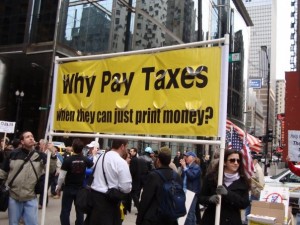
An image to behold

Occasionally, in this globally interconnected world of ours, one comes across an image that says so much. I was sent this photograph yesterday by that great blogger Donal Blaney. Quite rightly, he thought it would be a hit with the team at TCC!

Economics

How To Destroy the British Banking System –- Regulatory Arbitrage via ‘Pig on Pork’ Derivatives.

Financial engineer Gordon Kerr explains how to destroy the British banking system through the use of derivatives which take advantage of the regulatory system, then sets out four measures to solve the problem.

Nine years ago I worked as a structuring engineer in a three-man team within the investment banking unit of a major British bank. One of us was very bright. He stunned me one day with an idea as to how we could:

  1. Produce immediate (but illusory) substantial profits for our bank, thus ensuring that we would enjoy generous personal remuneration;
  2. Generate ‘virtual’ share capital to boost our bank’s capital reserves;
  3. Leave the actual investment risk exposure and profit expectation of our bank almost exactly the same after the transaction as before it.

Was this idea the kind of rocket science derivative engineering that justifies master of the universe labels for the three of us who designed and implemented it? No: it was extremely simple. Here’s how it worked. We transmuted some loan assets into a derivative transaction for regulatory purposes, whilst leaving the actual loan arrangements unaltered.

Continue reading “How To Destroy the British Banking System –- Regulatory Arbitrage via ‘Pig on Pork’ Derivatives.”

Economics

The Exodus of the Business Community

Here’s a sobering thought. If you are due to pay 50% income-tax in the new tax year, do not be fooled: it will come closer to 80% when you add on a few mandatory extras such as the full 17.5% VAT on most of your spending coupled with the 12.8% National Insurance paid by your employer on your behalf. (I have ignored a few allowances – but also the ‘stealth taxes’ pulling back on the other side such as Stamp Duty, Airport Tax, Car Tax, Tax on fuel … it just goes on and on.)

Think about this number for a moment. It means that for 80% of the year you will be working hard for the state and 20% for you and your family plus any philanthropic causes you contribute to. This means you will be working from the 1st of January to the end of September for the State. It won’t be until towards the end of September in to October, November and December that you will truly be working for yourself in any sense.

This is a subtle and pernicious form of modern day slavery, for sure.

Alistair Darling, our hapless Chancellor, tells us that those with the biggest and broadest shoulders should share the largest burden of funding the deficit that his Government – and only his Government – have created over the last ten years.

I am reminded of Ayn Rand’s great novel published in ……. Atlas Shrugged, Part 3, Chapter 7. Here is John Galt speaking:

If you saw Atlas, the giant who holds the world on his shoulders, if you saw that he stood, blood running down his chest, his knees buckling, his arms trembling but still trying to hold the world aloft with the last of his strength, and the greater his effort the heavier the world bore down on his shoulders — what would you tell him to do? To Shrug.

Ayn Rand’s prophetic warning – that it is the businessmen of the world who create the wealth in the first place, which allows what a ‘statist’ like Darling wishes to do to advance his Party’s vision of social progress – will, one day, if pushed far enough, cause this country’s wealth creators to just shrug their shoulders and move on and away. At worst, what will be left is a society bereft of those who actually make money – or such a diminishing pool that the state will implode, consuming itself to death with no new wealth to replenish it.

In Capitalism: The Unknown Ideal, Rand reminds us:

Businessmen are the one group that distinguishes capitalism and the American way of life from the totalitarian statism that is swallowing the rest of the world. All the other social groups – workers, farmers, professional men, scientists, soldiers – exist under dictatorships, even though they exist in chains, in terror, in misery, and in progressive self-destruction. But there is no such group as businessmen under a dictatorship. Their place is taken by armed thugs: by bureaucrats and commissars. Businessmen are the symbol of a free society – the symbol of America.

Well, the UK State has run out of money. It will borrow £200 billion next year to pay its ever-ballooning payroll. Meanwhile we, here in the UK, are relying on the good will of our lenders to bankroll our state workers on a week-by-week basis. Yes, the UK is existing on a hand to mouth basis only. This is what it means to have a £200 billion deficit to fund. The government takes £4 in tax and spend £5 on its programs. It does not have the political courage to take immediate efforts to make this £4 in and £4 out, as any prudent family must budget.

When human beings began to peacefully exchange goods and services, civilised society was created. Money is the medium that facilitates this exchange to our satisfaction. Society, and its closely associated derivative, money, which facilitates peaceful exchange, is arguably the greatest invention of mankind. All other things flow from the basic functions of exchange being enabled to be fulfilled: it is, quite simply, this that has lifted us up from primitive existence. We should be glorifying those, like Ayn Rand’s fictional John Galt, who – far from being labelled fat cats – are a shining beacon of hope in desperate times. Rand goes further:

“So you think that money is the root of all evil?” [leaving it aside that this is a common misquote: St Paul suggests that the love of money is the root of evil, a distinction lost to those who damn the rich out of hand.] “Have you ever asked what is the root of money?” continues Rand. “Money is a tool of exchange, which can’t exist unless there are goods produced and men able to produce them. Money is the material shape of the principle that men who wish to deal with one another must deal by trade and give value for value. Money is not the tool of the moochers, who claim your product by tears or of the looters, who take it from you by force. Money is made possible only by the men who produce. Is this what you consider evil?

“Until and unless you discover that money is the root of all good, you ask for your own destruction. When money ceases to become the means by which men deal with one another, then men become the tools of other men. Blood, whips and guns–or dollars. Take your choice–there is no other.”

A modern day John Galt is none other than Michael Spencer, who I have the good fortune of knowing. He is the billionaire founder of ICAP, the largest inter deal broker on the planet. He employs 4,500 people, transacts £1.4 trillion of trades per day, has 50 offices world wide. His charity day at the office raises half of he total amount that the whole BBC Children in Need raises. Glory to the forces of free market capitalism, that most potent wealth creating force known to mankind.

Michael Spencer was interviewed by the Daily Telegraph on the 5th of December and said: “If the Conservatives are not elected and if Labour continue to increase taxes as they probably will then, regrettably, we would presumably have to reconsider moving domicile.”

The prospect of working 80% of the year for the State, like the Titan Atlas holding up the world is becoming too much for the likes of Spencer. We are approaching the tipping point. We need our Spencers and the whole army of entrepreneurs more so now then ever to create the wealth to get us out of the Labour Party induced mess we are in today.

Economics

FT.com | Westminster Blog | Pre-Budget report: Line-by-line summary

Via FT.com | Westminster Blog | Pre-Budget report: Line-by-line summary, banking elements of the pre-budget report:

50 per cent levy on any individual discretionary bonus in the banking sector of over £25,000 introduced immediately; expected to raise £500m

There will be no windfall tax on UK bank profits

Economics

The Four of Horsemen of the Apocalypse – Frank Field MP

Via The Four of Horsemen of the Apocalypse – Frank Field MP:

For some time now it has been possible to see the four horsemen of the apocalypse on the horizon. Most economic commentators ignore their existence and the potential damage that could be inflicted on our economy if they all swept through at once.

Horse one symbolises the ruinous state of public accounts. [...]

Horse two is the harbinger of inflation. [...]

Horse three warns of a rapidly collapsing tax base. [...]

Horse four sounds a jobless recovery. [...]

The economic and political outcome is too grim to describe if all four horses of the apocalypse swoop down at once.

[...]

Recommended reading.

Economics

Lloyds seeks £23bn to exit state scheme – Times Online

Lloyds will announce within days a controversial £23 billion fundraising that will bolster its balance sheet and finally repair the damage caused by its disastrous takeover of rival HBOS.

The fundraising, being finalised this weekend, will be one of the biggest seen in London.

The bank will ask shareholders to inject about £12 billion through a rights issue. Taxpayers, who own 43% of Lloyds, will have to cough up about £5 billion.

via Lloyds seeks £23bn to exit state scheme – Times Online . (Emphasis mine.)

Economics

New Book Reveals the Total Cost of Gordon Brown’s mishandling of the economy as £3 TRILLION

Fleeced

Fleeced

Via the Taxpayers’ Alliance:

That’s £50,000 for every man, woman and child in the UK

In their new book Fleeced! Matthew Elliott, CEO of the TaxPayers’ Alliance and David Craig, author and management consultant, expose the financial, fiscal and political crisis resulting from a decade spent under the stewardship of Gordon Brown. The book is a devastating indictment of Gordon Brown’s time as Chancellor and Prime Minister. The authors bring together for the first time figures of Government spending before and during the recession, and Government losses since the recession began and argue that the cost of Gordon Brown’s mishandling of the economy has hit an eye-watering £3 trillion.

Read more here.