A must-watch interview: RT’s Laura Smith talks with Steve Baker MP:
|
||||||
|
A must-watch interview: RT’s Laura Smith talks with Steve Baker MP:
So Tom Palmer begins the editorial introduction to his anthology, After the Welfare State: Politicians Stole Your Future… You Can Get It Back…. Along with this introduction, Palmer contributes three of the volume’s nine essays. As is apparent from his opening statement, Palmer has a very low opinion of the welfare state. He considers it responsible for the economic and financial turmoil in which much of the world currently finds itself. In the next sentence to the one just quoted, he continues:
A main theme of the anthology is that the current welfare spending by western liberal democracies is no longer sustainable, especially that on health care and pensions. Addressed primarily to the young persons Palmer considers dispossessed of their rights, freedom and dignity by those of his generation and their forebears ‘who either created or failed to stop’ the welfare state, the aim of his anthology is to prepare them for when today’s welfare states have collapsed under the weight of their undeliverable promises. This his anthology seeks to do by informing them of what are argued to have been the superior voluntary arrangements for welfare in such countries as Britain and America before government there decided to muscle into its provision, replacing these voluntary arrangements with the current more heavy-handed, inferior ones. Palmer sets the scene in an opening essay entitled ‘The Tragedy of the Welfare State’. There he argues that, by offering benefits at the public expense, welfare states inexorably encourage improvident levels of consumption. They do so, he argues, because the costs of what they let each take fall predominantly on others. Each consequently has a motive to take whatever is available, despite all ultimately losing from their collective profligacy, and even despite knowing they will all lose after they have stripped the welfare cupboard bare by their immoderation. Palmer writes:
As well as encouraging improvident consumption, Palmer also holds the welfare state responsible for several other social maladies of our time. These include, most notably, xenophobia and recurrent economic crises. Palmer implicates the welfare state in xenophobia, when he writes:
Palmer implicates welfare states in economic and financial crises, when he traces the immediate origins of the current such crisis besetting much of the world since 2008 to the intervention of the US government in the housing market so as to increase home ownership. That intervention, claims Palmer, created a property bubble by encouraging sub-prime mortgages of which most were almost certainly bound to fail. Palmer writes:
How exactly the US government precipitated the current world financial crisis receives greater elaboration in the contribution by Swedish economist Johan Norberg. Entitled ‘How the Right to “Affordable Housing” Created the Bubble that Crashed the World Economy’, Norberg’s essay explains how the US housing bubble was inadvertently, but predictably, engineered by policies of successive administrations wedded to extending home ownership beyond where the market would have. There is, however, more than one way to skin a cat. Even had successive US administrations never intervened in the housing market, Europe today would still be suffering from a major debt crisis because of its indigenous profligacy in relation to welfare spending. Member states of the European Monetary Union are now locked into a sovereign debt crisis of epic proportion that threatens to blow the entire project of European Union asunder. In his opening essay, Palmer blames Europe’s welfare states for the crisis they currently face, as do several other contributors to his volume. Palmer writes:
How Greece fell into its current plight is explained by Greek law professor Aristides Hatzis in his contribution entitled, ‘Greece as a Precautionary Tale of the Welfare State’. Along with a companion piece by Piercamillo Falasca, entitled ‘How the Welfare State Sank the Italian Dream’, Hatzis’ essay is among the most interesting in the collection. As the two authors explain in connection with the country about which they write, and which both face bankruptcy, until comparatively recently both had sound economies, with public debt under control. Concerning Italy, Falasca writes:
At that point, explains Falasca, Italians yielded to the temptations of ever more extravagant and unaffordable welfare benefits with predictably deleterious consequences, as he further explains:
The combined effect of these policies was to end the Italian miracle and turn the country into the economic basket-case it currently is. According to Falasca, the ultimate problem engendered by Italy’s headlong rush into the deadly embrace of the welfare state has been a cultural one. He writes:
Neither do the Greeks, according to Aristides Hatzis in his contribution. Their current economic plight is even worse than that of the Italians. According to Hatzis, it is likewise due to their equally as hazardous recent flirtation with over-generous state welfare. Hatzis observes:
All that changed for the worse shortly afterwards, when the Greek socialist party PASOK gained power. According to Hatzis, it was that party’s ‘radical statist and populist agenda’ that is directly responsible for most of Greece’s current plight:
As an index of the profligacy to which the vote motive impelled Greece’s two main parties, Hatzis provides the following statistics about his country:
Truly we are witnessing today a real Greek tragedy. Unsustainable levels of public spending on welfare, however, are by no means confined to Greece and Italy. According to Cato Institute senior fellow Michael Tanner, no European country, nor even the USA, has cause for complacency. He supplies the following chastening information in his contribution to the anthology:
‘What is not debatable,’ Tanner concludes: ‘is that the welfare state is no longer affordable. It is time to look for alternatives that won’t bankrupt future generations.’ Where are these alternatives to be found? According to Palmer, the answer lies in the past, namely, in the voluntary arrangements in place before welfare states coercively crowded them out. Such voluntary arrangements portend what could — and, in Palmer’s view, should — increasingly replace welfare states as their collapse becomes ever more imminent. These earlier arrangements are the subject of the contributions by David Green and David Beito. David Green is director of the British social policy institute Civitas. In his contribution, entitled ‘The Evolution of Mutual Aid’, he offers a brief overview of the arrangements for the mutual aid of workers and their dependents accorded by the so-called ‘friendly societies’ that flourished in Britain for more than a century before the advent of the welfare state. Green reports:
Similar voluntary arrangements prevailed in the USA under the name of ‘fraternal societies’, American historian David Beito relates in his contribution entitled, ‘Mutual Aid for Social Welfare: The Case of American Fraternal Societies’. Beito observes there that:
Beito argues these past welfare arrangements were superior both to charity and state provision, attributing their superiority to the reciprocity on which fraternal societies rested, unlike the other two welfare providers. He writes:
The conditionality and reciprocity of the welfare fraternal societies provided gave their members a powerful incentive for moral probity and familial responsibility, now largely vanished under the current impersonal state arrangements. Figures for welfare dependency in America cited by Beito suggest its burgeoning welfare state has undermined both the work ethic and a sense of personal responsibility, especially among African American citizens:
In his concluding essay, Palmer draws together the various threads laid out in the preceding essays by offering an overview of what he claims to be the classical liberal perspective on poverty and its amelioration. In some ways the most ambitious contribution to the volume, this essay is also the least satisfactory. As well as a senior fellow at the Cato Institute, Palmer is also executive vice president for international programs at the Atlas Network in which latter capacity, readers of his anthology are informed: ‘He oversees the work of teams working around the world to advance the principles of classical liberalism.’ This is a weighty responsibility. By taking on such a sacred cow as the welfare state, it is beholden on him to ensure the criticisms he levels against it on behalf of classical liberalism are well-founded and always find their mark. Otherwise, rather than advance the classical liberal ideals of limited government and individual responsibility, Palmer’s volume would only serve to discredit them. Although Palmer’s anthology and his own contributions contain much that is both true and illuminating, his final essay is marred by a certain unfortunate propensity towards hyperbole. He tends to exaggerate both the defects attributable to the welfare state, as well as the extent to which classical liberalism opposes all forms of public provision of welfare. For example, there was nothing integral to the welfare state, even in the U.S., that necessitated successive U.S. governments should in recent times have chosen to extend home ownership in the way that they did. Hence, it seems an exaggeration to attribute, as Palmer does, the current global financial crisis to the welfare state, rather than to other, separate misguided interventionist policies. It seems equally as misguided of Palmer to attribute xenophobia to the welfare state or to have claimed classical liberalism opposed to all restrictions on immigration. The welfare state no more necessarily causes, or is born from, aversion and hostility to foreigners than its absence is an invariable sign or productive of universal amity. Think of present-day Somalia, for example. Moreover not only was it woefully inaccurate of Palmer to cite, as he does, the British economist Phillipe Legrain as a classical liberal, because of his support for open borders and free trade, he is arguably equally as wrong to equate classical liberalism with opposition to immigration controls. Not only has Legrain exhibited no sign of championing limited government, in 2008 he produced a publication for Sweden’s Globalisation Council in which he argues for the compatibility of open borders and the welfare state. Moreover, many eminent and undoubted classical liberals have argued against open borders, for reasons having little to do with xenophobia. They include Henry Sidgwick and Ludwig von Mises to name but two. More importantly, it creates an unfavorably wrong impression of classical liberalism in those who need to be won over to its cause to state, as Palmer does in the concluding paragraph to his volume, that:
Virtually all major classical liberals, from John Locke and John Stuart Mill, through Henry Sidgwick to Friedrich Hayek and Milton Friedman, have agreed on the indispensable need for a public welfare safety to prevent total indigence, as Palmer acknowledges, albeit somewhat grudgingly. Even that great apostle of strictly limited government, Ludwig von Mises did, writing in his 1936 book Socialism: An Economic and Sociological Analysis:
So long as the poor remain with us, there will be need for some form of public provision to meet their needs, over and above charity and mutual-aid. The task ahead for classical liberals is to bring public provision of welfare once again within legitimate undamaging limits, not condemn it out of hand by suggesting that it is always and everywhere inferior to alternative forms of provision. See Tom Palmer’s response: “The Protean Welfare State“. This article was previously published at The Library of Law and Liberty. I do not doubt that the Government is sincere in its wish to make Britain “open for business” and to deliver greater life chances through reform of the welfare state. I gave some time to the Centre for Social Justice and now I see many of their ideas filtering through to public policy. I support those reforms from both a practical perspective and in view of their moral necessity. The Prime Minister is correct to talk of the culture we have lost, particularly in respect of private shame. I am put in mind of C S Lewis’ book The Abolition of Man: there is, after all, such a thing as right and wrong. Lewis predicted humanity’s ultimate destiny on the path which embraces subjective morality: a dystopian society in which “we find the whole human race subjected to some individual men, and those individuals subjected to that in themselves which is purely ‘natural’ — to their irrational impulses.” Some readers will recognise the problem and the dangers but reject the state’s role in finding a solution. However, we do not live in that world where the state is comprehensively rejected. There is a welfare state and it needs reform. The Government is getting on with it, and in the right direction too. However, what the Government is not addressing is the de-civilising effects of inflation, that is, increasing the money supply. What is commonly called “inflation” – a rise in the general price level – is an automatic consequence of debasing the currency. And currency debasement has been fierce in our lifetimes: the consequences have been and remain profound. There is a presentation which, in one form or another, I have given many times. It shows, in a few charts:
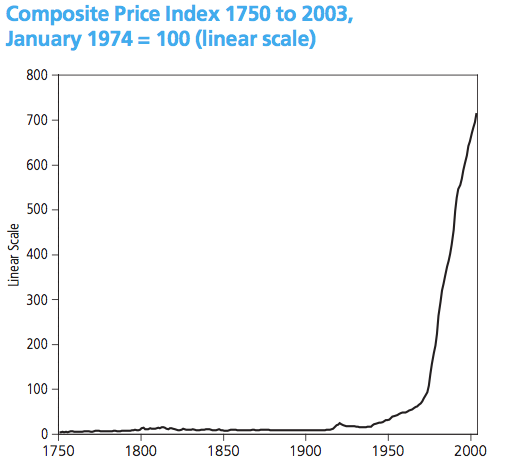
By the end of the presentation, I have explained our banking, fiscal and economic crisis. Given that what it shows is a monetary and fiscal catastrophe, people receive it surprisingly well. As far as I can tell, people can handle the truth and they want it. One of the key slides is a price index from 1750-2003: The grotesque debasement since 1971 – when Bretton Woods finally collapsed – hides the detail of the nineteenth century on a linear scale, so I include the same chart on a log scale. The log chart shows that, despite a number of crises and fluctuations, a pound in 1900 bought about the same basket of goods as a pound in 1800. In contrast, money has lost almost all its value since the Second World War. The Ethics of Money Production by Jörg Guido Hülsmann is particularly relevant at this point. Hülsmann writes:
He goes on to write of inflation’s tendency to centralise government, to extend the length of wars, to enable the arbitrary confiscation of property, to institutionalise moral hazard and irresponsibility, to produce a race to the bottom in monetary organisation, to encourage excess credit in corporations and to yoke the population to debt. He explains how “The consequence [of inflation] is despair and the eradication of moral and social standards.” That all sounds familiar. Hülsmann’s work is not scripture of course, but neither are his ideas isolated. Consider Ayn Rand:
It is my firm view that inflation – the debasement of money – was the primary cause of the banking crisis. That inflation was a deliberate policy choice of welfare states. You may recall Eddie George’s remarks in 2007 and now Mervyn King has said, “Of all the many ways of organising banking, the worst is the one we have today.” Moreover, if Hülsmann, Rand and other scholars including Mises and Hayek are to be believed, then inflation is also a major contributor to the moral and spiritual decline of our country. No amount of welfare reform alone will solve that. All is not lost however. To return to that log-scale price index, money’s value was substantially more volatile in the first half of the nineteenth century than in the second. In 1844, the Bank Charter Act, Peel’s Act, took from the banks the privilege of extending bank notes in excess of specie (coins of inherent worth). It was recognized that this extension of candy-floss credit un-backed by prior production of real value was a systemic cause of economic and banking crises. Unfortunately, that Act left the banks unmolested in their ability to create deposits. As our system of money and bank credit has evolved, that loophole, combined with central banking and the socialisation of risk, has delivered us into our present predicament. It falls to our generation to solve this problem and that is why we established The Cobden Centre. As Martin Wolf wrote in the Financial Times on 9th November 2010, “The essence of the contemporary monetary system is creation of money, out of nothing, by private banks’ often foolish lending.” And then we wonder why house prices have raced out of reach. We wonder why the basement garages in Canary Wharf are full of supercars while what was once our industrial heartland languishes in state dependency. I admire the Prime Minister and the coming welfare reforms. I will back them gladly. But, until we end inflation as a way to fund the promises of the welfare state, we shall not have done the decent thing. We shall not have established objective morality in banking and in that lifeblood of society: money. Honest money is a prerequisite for social progress and it must be delivered if reform is to succeed. ”The National Health Service is the closest thing the English have to a religion,” wrote the former Tory chancellor Nigel Lawson in his memoirs. Daniel Hannan MEP was torn to pieces politically for daring to say that in his view the service provided was not optimal. In the book he co-authored book with Douglas Carswell, The Plan: Twelve Months to Renew Britain, they suggest alternative solutions. In the late summer of 2009, in the run up to the General Election the following year, this sparked David Cameron into a defensive stance, and being the astute politician he is, he sensed the political mood music and declared his “wholehearted commitment” to the NHS. He suggested that the NHS represented a “simple, practical, common sense, human understanding of a fantastic and precious fact of British life”. He added “That’s why we are committed to the NHS and the principle of a healthcare system that is free at the point of use, based on need and not the ability to pay.” It is generally understood that if you wish to be taken seriously in this country, you must never be critical of the NHS. Suggest a reform here and a fine tuning there, but don’t so much as imply that fully taxpayer-funded and state-provided health care might not the best solution for the people. Should you dare go down that line of thinking, you are sure to be dismissed as a wide-eyed loony! It is assumed that the market for health care is naturally monopolistic as the medical profession can organise at the expense of the consumer, who is ignorant. Naturally, the State needs to step in and protect the ignorant consumer. This is akin to saying that food producers know more about food (essential for life!) and they will have a tendency to organise at the expense of the consumer, so the State should step in and we can have a National Food Service (God forbid: an 18 month wait for a can of Baked Beans!) and all those starving people that the private sector does not provide for will be fed! Also private provision will never cover the poor, already sick, and the needy; therefore the State must step in. Historically this has notbeen the case. David Green in 1985 wrote a magnificent book Working Class Patients and the Medical Establishment: Self-help in Britain from the Mid-nineteenth Century to 1948. He shows that health care provision prior to the 1911 National Insurance Act was spontaneously provided by worker-organized mutual or friendly societies. Indeed, 75% of all provision was via these organizations with the balance paid for by private provision by those who could pay on the nose directly for medical related services; and for the utterly impoverished small minority, the Poor Law provision. Interestingly, these societies were paid for by a flat subscription fee for all. Green shows that only 4.5% of applicants were turned down. These societies employed doctors, on the whole provided drug dispensing services and sick pay for their members. Doctors were often elected and answerable to the committee of lay people of the society. This democratic control was detested by a vocal minority of doctors as it afforded accountability. They also detested the dominant consumer. Many, though, were happy and content. The societies, who negotiated individually with doctors, would ensure a good wage for the doctor, but some in the General Medical Council viewed this to be “infamous conduct” — lowering your wage to be affordable to the masses was enough to get you struck off. Ironically the Trade Union thugs and dinosaurs of the 70’s and 80’s would have no doubt approved of this closed shop, restrictive practice which was so much at the expense of the working-class patient. How the original trade unionists, who were so supportive of the friendly societies, would be spinning in their graves. The great success of the mutual provision of a private welfare state was in effect its own downfall. Lloyd George sought to extend the benefits that the freely chosen mutual provision of the masses had achieved to cover the very poor. Green shows us how during the passage of the bill, the medical profession, which did not like working for the proles and being governed by lay committees, managed to advance arguments that would deliver control of the goods and services provided by the mutual societies, demanded by the patients and the lay committees that ran them, to the medical profession themselves. It was successfully argued that the pay that the Doctor received on contract to the Society prevented him from providing a full unbiased professional service for the benefit of the patient. It was argued that the practice of certain doctors in competing for the individual subscriptions of members by undercutting other doctors was bad for the provision of medical care. Working-class fraternalism was the BMA’s worst enemy, as competition for patients kept the doctors’ pay at levels that the masses of working-class people could afford. The commercial insurance companies too had long detested the competition that the Societies had given them and with the BMA, they formed themselves into the Combine and extracted concessions to the Bill. Green says
Post 1911, the doctors were paid out of the state insurance provision and ultimately by the state via the National Health Service, post 1948. Popular, affordable, voluntarily-funded healthcare was crowded out. We now have inefficient Soviet style provision of health care. Dress it up how you like, but essentially the state is the prime provider of health care. Private provision is sidelined and often only available to the wealthy. Choice in services is limited. Patient consumer control of the doctor / medical provider is negligible. Until we have consumer control, our service will always be suboptimal. David Cameron and the Big Society: Could this be a return to mass private affordable consumer controlled democratic provision of medical care? I have previously written here about my enthusiasm for the Big Society project. On August the 13th 2010, 12 projects were launched that allowed public sector workers to take control of delivering services. Could it be possible that we could take control of our local general purpose hospital and local GP services? For this to happen, we would need to get a full tax rebate for all participating members and form a traditional friendly society and extract those services from the state and return them from whence they came, on the whole, to the working-class mutual societies that Green writes so eloquently about. Would the government be prepared to give a rebate in our tax so we could use the money as our ancestors did, to arrange our own healthcare in a mutual format? Can we see the lay people of say Welwyn and Hatfield, where I live, rise up and form a mutual for all its members benefit? That is a truly wonderful thought. At the moment, our local QE11 hospital where my youngest child was born is facing closure with only the A&E services and one or two other things being left open, and there is much popular support to keep it open. Do the people want to go this far? If we were given our tax back I am confident most citizens would seek to pay their subscriptions, vote in their doctors, and arrange for the full service that they want on a lowest cost basis. Could consumer control and patient power return to Britain? How bold are Andrew Lansley and David Cameron? Readers interested in more from David Green may enjoy his 1993 Civitas paper, “Reinventing Civil Society: The Rediscovery of Welfare Without Politics“. Peter Joyce and Geoffrey Sell describe an Eton and Oxford educated Party Leader thus:
I was struck by the similarity of the Big Society not Big Government message from David Cameron and these quotes from the excellent Joyce/Sell Biography of the late Liberal leader Lord Jo Grimond found here. I believe it highlights the flawed tribal nature of our politics. I feel truly sorry that the Liberals have abandoned such a rich political heritage for the politics of envy entrenched in their 2010 Manifesto. They now espouse a misguided socialist agenda of taxing the rich and disincentivising enterprise with policies like Mansion tax and more than doubling capital gains tax. Surely we have all learned the lesson from Labour’s mistakes of the 60’s and 70’s that to “tax the rich until the pips squeak” does not work. This is even more relevant now that we recognise the potency of global competition which even Gordon Brown acknowledges now that his claims to have ended “boom and bust” have been trashed by “global events”. Wealth creators can simply up sticks and locate in tax and regulatory friendly jurisdictions. We need to encourage enterprise as well as foster philanthropy and promote sound stewardship. Nick Clegg says this in his foreword to the Liberal Democrats Manifesto “We’ve had 65 years of Labour and the Conservatives: the same parties taking turns and making the same mistakes, letting you down. It is time for something different. It is time for something better.” If he truly wanted to do “something different” he would have stuck to core Liberal ideas and not filched old Labour policies. With luminaries such as Richard Cobden and Jo Grimond in their past they have a rich vein of truly innovative and now timely ideas on which to draw. Sadly, enticed by the prospect of power they have ditched ideas of gravitas and integrity for a more populist polemic. If I were to summarise the 2010 manifesto’s for my 83 year old father and ask him to identify the Party he would probably identify the Conservative manifesto as old Liberal, the Liberal manifesto old Labour and the Labour manifesto as – well at best it is a poor attempt to cobble together enough populist ideas to cling on to power Through it all is an electorate so disenchanted with politics and politicians that if they bother to vote at all they will either vote tribally or be influenced by the televised debates where image not policy is King. Political selection now has more in common with TV shows like X Factor, Britain’s Got Talent and in Lord Mandelson’s case Strictly Come Dancing. On the plus side this is just the right time for efficacious change. Our Nation has been shaken for sure, we have seen the imperfections of the banking system and Politics has been thrown into disarray by the expenses scandal. Yet a wind of change is blowing life into the embers and fresh ideas are being debated. The Cobden Centre is dedicated to promote “Honest Money and Social Progress” – let the discourse continue! There are 2.7 million people claiming Incapacity Benefit in this nation. I often wonder if after the World War Two, did we have more than 2.7m incapacitated civilians on this Island once the soldiers had all returned? I do not know for certain, but I suspect not. Suffice it to say, although 208 British Soldiers have paid the maximum price in the conflict in Afghanistan, we are essentially a country at peace and have been thankfully for a long period of time. Not since the Second World War has the totality of the nation been involved in conflict. So why do we have so much incapacity? With the relentless avalanche of Heath and Safety laws being applied to business, they can for sure not be putting more people out of work by injury. Have the standards of our health service fallen so low over the last 60 years that more people then ever are incapacitated? To all of these, I think not. The majority of these persons who are incapacitated are just plain and simply put, work shy. In the Sunday Times of the 30th of August, Michael Portillo in this article, said that the intentions behind the formation of the Welfare State were to prevent this abuse of our system by the work shy.
How many of the 2.7m are genuine in their illness? Would it be 100,000, or 200,000, but certainly not 2.7m. Even if it was a cool 1 million people, we would still have 1.7m people who are work shy and scamming the system. When I sit as a Magistrate, I often see abuse. I was in a domestic violence court recently where we were reviewing a Pre Sentence Report on a young man who had beaten up his 29 week pregnant teenage girlfriend in the High Street under several CCTV cameras. The Probation Service informed us that he was on incapacity benefit but that he was looking forward to the start of the football season so he could resume playing for his local team as this would take up some time. I do not know if it occurred to the probation service that incapacity benefit and a young man playing football to most would not go together. Let’s be clear, we the taxpayer pay 2.7m people to sit at home and do nothing. This is a good 10% of our workforce that sit on the payroll of the taxpayer and do nothing. People like the above are forcing the tax burden up on the hard working families of this nation of ours. As Portillo says “As a result, taxpayers have spent £346 billion on payments to those out of work since Tony Blair entered No 10.” This is 2 and a quarter of a years worth of income tax for the whole nation out of the last 12 years just on this! He then goes on to say “It might have been possible for the state to fine-tune benefits in that way in the days when parishes organised relief and every claimant was known to the local poor law guardians. It is much more difficult today in systems that are nationalised and standardised. But perhaps, at least, we ought to assume that fit young people are not entitled to anything. If a few young men from sink estates are now heroes in Afghanistan, why should we presume that all the others are capable of nothing useful at all?” A centrally planned benefits system, like anything centrally planned is bound to fail. It fails because it is impossible for a centrally planning body such as a Whitehall department, to know all the facts and all the circumstances of all the people to be able to access who is actually in an incapacitated state. We should do the following;
Enough is enough: social progress requires everyone who can to do something of value for others. This aspect of the Welfare State needs to be reformed immediately |
||||||
|
Copyright © 2013 The Cobden Centre - All Rights Reserved. Registered Charity Number: 291371 |
||||||