|
|
By Alasdair Macleod, on 29 January 12
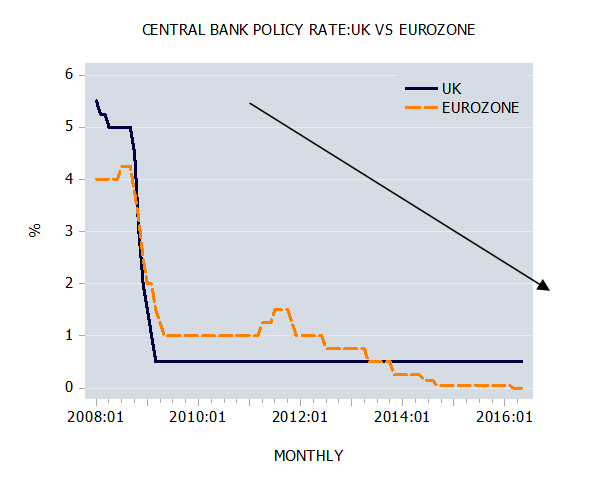
Both the US Federal Reserve and the European Central Bank are now offering limitless quantities of new money – the ECB to support the banks, and the Fed for reasons (despite explanations) that are not entirely clear. The Fed in its press release announced that it expected interest rates to “warrant exceptionally low levels for the Federal Funds Rate at least through late 2014.” The fact that the central banks governing the two most important currencies in the world are issuing money to all-comers at very little interest cost for up three years has not been lost on gold and silver, whose prices shot up in response to the Fed’s announcement.
The Fed has effectively extended its zero interest rate policy (ZIRP) for another 18 months. The reason stated is “low rates of resource utilisation and a subdued outlook for inflation in the medium run”. More important perhaps and unsaid is the presidential election due later this year and the need to finance a deficit that seems impossible to cut.
The Fed is running huge risks with its extended ZIRP, principally with monetary inflation morphing into price inflation. To help achieve its low inflation target the Fed uses the Personal Consumption Expenditures Price Index (PCEPI), which assumes that consumers switch spending from higher priced goods to those that are stable or falling. The result is that this index rises at about one-third less than the Consumer Price Index, which itself rises at less than half the CPI calculated on the more honest methodology used before 1980. The upshot is that the Fed uses inflation targets that are so heavily adjusted that they are effectively meaningless.
To the Keynesians at the Fed, subdued inflation is linked with a sluggish economy, and here the Fed is very selective in its approach. It admits that employment is picking up, and household spending “continues to advance”; but instead chooses to worry over slowing fixed investment and a depressed housing sector. Surely, whatever your views, there are enough signs of economic stabilisation to justify sitting on the fence, instead of committing to ZIRP for an extra 18 months.
I take the view that Gross Domestic Product is likely to surprise on the upside, as I wrote in an article for GoldMoney on 10 January. In that article I gave concrete reasons why, and suggested that money will begin to flow from capital markets into the economy. This is important, because GDP is only a money quantity and can rise without any underlying economic progression – the difference being reflected in the prices of goods and services. So GDP can actually rise with no underlying improvement in economic activity, it merely reflecting higher prices.
Changes in the prices of goods and services are actually impossible to measure and so cannot be quantified. Under-reporting price increases by using an index approximation such as the GDP deflator, which represents price inflation similarly to the PCEPI, artificially inflates real GDP. It will be interesting to hear what excuse the Fed comes up with then for the continuing for even longer with ZIRP. The reality is that the Fed and other central bankers are cornered and have only one tool left: issue as much paper money as it takes to prevent systemic financial calamity. This realisation is only just dawning on individuals with savings to protect, which is why precious metals were right to rise so sharply.
This article was previously published at GoldMoney.com.
By Alasdair Macleod, on 16 December 11
For some time I have taken the view that rescuing eurozone governments from their financial crises was too big a job for the European Central Bank, which should stick to keeping the banking system going. The only hope was that individual governments would be forced to face up to the reality of cutting government spending hard and quickly. They have failed to even begin to address this fundamental problem. As a consequence, it is now impossible for them to roll over their maturing debt, let alone raise new money. Instead there is now a scramble into cash as banks and hedge funds prepare themselves for sovereign defaults.
Posturing over geared stability funds, financial transaction taxes, installing unelected governments, putative treaty changes and finally enhanced fiscal supervision proposals have finally convinced markets that the only outcome is widespread government defaults. There is now no alternative and the fallout will have to be managed.
The inept handling of this crisis has weakened the eurozone’s banks to the point that they are unable to subscribe for more debt. Furthermore, the ECB cannot afford to see the liquidity it provides to European banks disappear into new government bonds that will default anyway. Therefore, it is now in the ECB’s interest to see sovereign defaults occur as soon as possible, unless the International Monetary Fund can come to the rescue, which is looking less likely by the day.
There is growing evidence that there is insufficient support for an IMF bailout from its member governments. The IMF’s charter is as an intergovernmental lender of last resort, not a supporter of government profligacy. Following the failure of the G20 meeting in mid-October there has been no substantive attempt to rescue the eurozone. The telephones might be buzzing, but there is no urgent meeting, suggesting that events must take their course.
So the quicker these defaults happen, the sooner the ECB can work with the national central banks to bail out the major Eurozone commercial banks. Once we accept this line of reasoning, we must think about the likely candidates. In no particular order they are France, Italy and Greece: France and Italy because they have to roll enormous amounts of debt in the coming months and Greece for obvious reasons. Less pressing perhaps but also likely default candidates are Belgium, Spain, Portugal and Ireland: Belgium might fall with France and the others have the potential to struggle through but might chose to wipe the slate clean. And when the first goes, the rest will surely follow rapidly.
The sequence of events is now under way. This will be followed by the defaults themselves, and the likely trigger will be escalating French government bond yields.
In summary, we have reached the point where the ECB’s vested interest requires eurozone governments to default because further delay will make the rescue of the currency and banking system more difficult. Expect co-ordination between the Bank for International Settlements, The Fed, Bank of England and Bank of Japan to smooth markets through the turmoil and to back up the ECB.
This article was previously published at GoldMoney.com.
By Alasdair Macleod, on 14 December 11
Last Friday, David Cameron came back from Brussels having rejected proposals to draft a new European Union treaty, having failed to get promises of adequate safeguards to protect Britain’s financial sector. But given that the UK has no veto over Brussels’ power to regulate anyway, the prima facie reasons presented to Parliament were therefore not crystal clear. However, Cameron must have been aware that ratifying a new treaty without safeguards was a non-starter, and the fact that the dominant mainland powers were not even prepared to consider them is a reflection of their lack of rational thinking rather than his. After all, they should have been briefed that any treaty changes now require a referendum under UK law, and given the EU’s self-aggrandising tendencies, any treaty changes would be a tough sell to Parliament – let alone the electorate.
What was proposed in Brussels was a typically dirigiste response to unwelcome economic reality. Perhaps the script intended was as follows: we go through the motions of imposing fiscal controls and responsibility, and that should be enough to get the European Central Bank – working with the International Monetary Fund if necessary – to release the money to continue to finance our political ambitions. This is not the direction of travel for the UK.
In political terms we are probably witnessing the end of an empire, and when such an event occurs it can be swift. Forward-thinkers need to look beyond the EU as an institution, and in this respect an alternative and as yet unrecognised future for Germany is evolving. She faces stagnant markets in Europe, declining markets in the US, but booming markets for her products in China, South East Asia and other emerging economies. Even if the eurozone does not break up, her economic motivations will lie increasingly elsewhere and the weaker EU members will remain an unwelcome burden.
Her biggest problem is France, a point not yet recognised by commentators and as yet untested in the markets. In the short-term, Sarkozy faces an election next May, which explains why he must stick like glue to Angela Merkel rather than cut government spending. But France also has to refinance the same amount of debt as the Italians before May: about €180bn, and half in the next two months. This is an impossible task without external help, because the major French banks which have always been coerced into buying French government bonds in the past are themselves in a critical condition. A short-term fix is urgently needed of which there is no sign as yet.
We have to trust that there will be a solution, but talk of treaty-change does not represent urgent action. Anyway, the French socialists, who look like winning May’s election, have said they will not ratify any new treaty – creating more doubt and uncertainty for markets. It does not take much imagination to see French bond yields rising to over 7%.
This is the mess that Cameron has disassociated himself from. It will not be long before this becomes more widely appreciated.
This article was previously published at GoldMoney.com.
By Detlev Schlichter, on 13 December 11
Apologies to my readers that no new contributions have appeared on the Schlichter Files for two weeks, and in particular that I did not get around to responding to some of the questions and comments on my blog. I hope to rectify this shortly. I was committed to a few speaking engagements in connection with my book Paper Money Collapse – The Folly of Elastic Money and the Coming Monetary Breakdown. Also, the brokerage firm CLSA was so kind to arrange a whole string of meetings with their clients in London and in Milan on the topic of the book, and this has taken up most of my time last week.
Last week was supposed to be a major week for Europe. We had the ECB meeting on Thursday and then another EU summit to ‘solve’ the eurozone debt crisis on Thursday and Friday. Of course, nothing has changed, nothing has been solved, and quite frankly, I do not see any reasons whatsoever for changing my analysis of what is going on and how all of this is likely to end – badly, that is. If anything, the events of last week confirm that authorities are adamant to continue travelling further on the road to complete currency destruction – not only in the eurozone but equally in the U.S. and the UK, although the latter two are managing to escape closer scrutiny by markets for the time being. As usual, I felt that most of the commentary in the media was missing the main points.
The problems around the world are essentially the same. After decades of ongoing and generous expansion of the fiat money supply, of artificially low interest rates and cheap credit, banks are hopelessly overextended, asset markets are distorted, and sovereign states are bust. I sometimes get pushback on the last point. Are they really bust? – Yes, most of them are. They have acquired debt loads and spending habits – now very deep-rooted and practically impossible to eradicate – that require constant new borrowing at fairly low interest rates – cheap credit forever. Obviously, that is not going to happen. The end of the forty-year credit boom has arrived. The private sector is no longer playing ball.
What needs to happen? The overextended credit edifice needs to be cut back to a size that is commensurate with the underlying pool of real voluntary savings and with underlying real income streams. Money printing and the constant attempt to manipulate lending rates down have to stop. The market has to finally be allowed to set interest rates that reflect the true cost of available savings, and to liquidate what is not sustainable. Deleveraging, default, and debt deflation are necessary to bring the economic structure back into balance. Is this painful? – You bet. It is also unavoidable. There is no other solution. Yet, the solution is deemed politically unacceptable and it is thus being fought tooth and nail. Not only in the US and the UK, also in Europe.
The entities that are most under stress in this scenario are the banks and the debt-addicted states. You know my forecast: the central banks will be asked to underwrite the states and the banks directly with the help of the printing press on an ever-larger scale, and this will ultimately lead to higher inflation and finally to paper money collapse: the end of our present fiat money system, the latest experiment in the sad history of unlimited and fully elastic state money systems.
While this is broadly a global story, many people question whether it really applies to Europe. Isn’t the ECB more conservative, more Bundesbank-like, and thus less prone to debt monetization than the other central banks? Is there not some real effort being made in Europe to sort out the fiscal problems? – No. Most of it is simply theatre that has no or little implication for the final outcome. Let me explain.
The EasyB.
Like the other major central banks around the world, the ECB played its role in setting the world up for the credit bust by providing the cheap credit for the preceding credit boom. The ECB’s balance sheet – or rather the consolidated statement of the Eurosystem as it is correctly termed – started out at less than €690 billion in 1999. On the eve of the present credit crunch, in the summer of 2007, the balance sheet had reached a size of €1.2 trillion. In fact, over this period the ECB’s balance sheet had grown faster than that of the Fed. Like all other central banks, the ECB has, since the crisis began, become the lender-of-last resort to ever more banks and also to state institutions. At the end of 2011, the ECB’s balance sheet will be more than €2.4 trillion – its largest size ever, and also more than 20% larger than at the start of the year!
And as Mr. Draghi, the ECB’s top central banker, told us on Thursday, the growth of the central bank’s balance sheet will continue. More than four years after the crisis started and more than three years after Lehman collapsed, none of the problems in the European banking community are fixed. This is evidently the case as the European banking sector is still in desperate need of ongoing and, this is important, growing central bank support. In fact, the ECB announced more ‘liquidity’ measures to prop up the banking system this week. It also stated that it would lend money against an even wider range of collateral than previously. These measures are similar to the ones announced a week earlier by the major central banks around the world, which were also designed to lessen funding pressures among the banks. We can only conclude that the state of the banking sector must be extremely precarious.
Can all these banks ultimately be ‘eased’ back into lasting health and operational independence by the central banks? Of course, not. A reduction in banking capacity via a shrinking of balance sheets and potentially via defaults is ultimately unavoidable. Again, the banking sector overdosed on years of cheap credit. The boom will not be extended forever. Rehab is inevitable. So are the present measures of the central banks aimed at slowing this process, at postponing it, at sabotaging it or even completely avoiding it? I fear that the key decision-makers don’t even know the answer themselves. They simply want to buy some time, I guess.
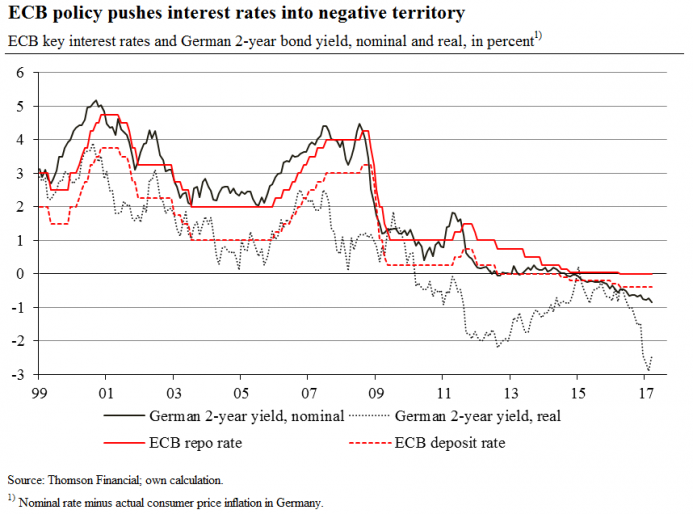
The ECB had by Thursday night also fully reversed its timid and tentative rate hikes from spring and summer and was thus back to record-low policy rates. Developments last week thus confirmed my outlook: None of these central banks have an exit strategy. If you believe that these so-called unconventional and extreme measures are temporary, and that policy will be normalized at some stage, you are mistaken, in my view. The biggest direct beneficiaries of cheap money from the central banks are now the ‘private’ banks and the sovereigns, and as the shrinkage and/or failure of these entities is deemed politically unacceptable, and as the states in particular cannot cut back their expenditures and thus their deficits meaningfully, the central banks will continue to print money.
It is somewhat astonishing that in financial market debate and in large parts of the media coverage of ECB policy, the idea is conveyed that the ECB was being particularly stringent. This is due to the fact that many now demand that the ECB provides not only ‘unlimited’ direct support to the banks but that it should also manipulate directly the prices of certain financial assets, in particular the prices of governments bonds of weaker eurozone states, to an unlimited degree, because many banks hold huge quantities of them and they struggle with the lower and, I would suggest, more appropriate market prices for these securities. ‘Unlimited’ bond buying, however, is something that the ECB struggles with, at least officially, and that hits some raw nerves in Germany. Draghi’s negative assessment of large-scale bond buying in the press conference made all the headlines last week, and this is what helped to give the impression of conservatism and policy tightness.
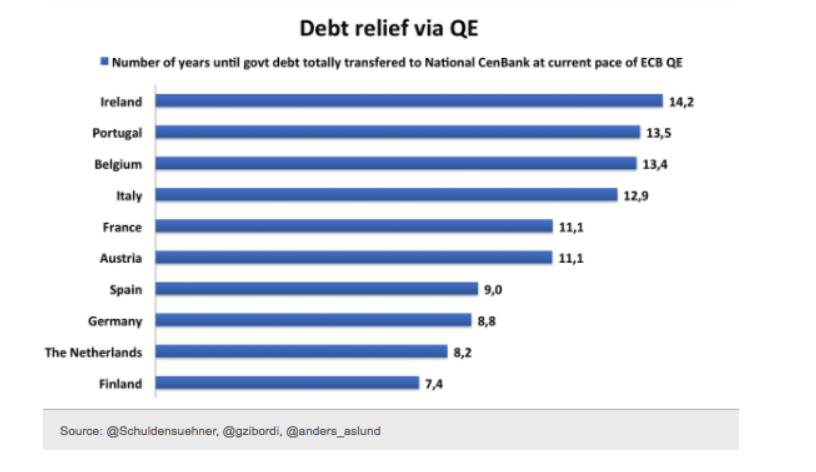
The whole affair is complete theatre, of course. The ECB has indeed been engaged in sizable price-fixing operations in the government bond market for quite some time and is still conducting these operations today. Every week, the ECB buys bonds of weaker eurozone states in an attempt to lift their prices above normal market-clearing levels. Such indirect funding of state spending via the printing press is against ECB-rules, as Mr. Draghi confirmed again in his press conference. However, it is being done continuously by the ECB and defended with the ridiculous excuse that these operations are needed to allow a proper transmission of ECB policy. This is a blatant lie, of course, but apparently all this money-printing, market manipulation and rule-breaking still doesn’t go far enough for many in the financial industry who now demand even more money printing and more market manipulation. Please remember that the ECB presently limits its bond buying to €20 billion per week. If it only continues at this pace, which I expect it to do until it will give up its faint resistance and accelerate bond buying, the present procedures will add up to more than another €1trillion by next Christmas, and thus mean that the ECB’s balance sheet has expanded by another 42% in a single year! But, according to financial market economists, that is not enough!
None of this is a solution but all that market participants (and politicians) want is apparently some peace and quiet, a little pause in this unfolding disaster. Of course, it is only a question of time and the ECB will accommodate the wishes for even more aggressive money-printing. Again, I consider most of the debate theater.
Inflation will rise
What will all this money-printing mean for the purchasing power of money? – The answer is clear in my view: it will mean rising inflation, then accelerating inflation when confidence in paper money erodes and when central banks will find it impossible to restore such confidence through tighter policy.
It is truly remarkable that four years into a major credit correction, none of the major economies has registered any deflation. Of course, those who have an irrational fear of deflation and declare it an evil to be avoided at all cost will consider this a success. The truth is, a deflationary correction would be the natural response at the end of an extended inflationary boom based on artificially cheap money. Deflation would be part of a necessary, if in many ways painful adjustment process. This process is aborted via aggressive money printing from the central banks. We can clearly see that nothing has been solved and that the channels through which money debasement occurs have simply changed but that it is still ongoing.
Inflation in the eurozone may not be very high at present but it is above target and it will, in my view, continue to rise. The idea that all this money printing is not only harmless but also positive because it avoids deflation is nonsense. In the case of Britain, we are told every month that the Bank of England needs to keep rates low and its balance sheet expanding to avoid deflation and economic contraction when inflation has continuously been above target and in fact rising. Something similar is now unfolding in Europe. Easy money is supposed to help the banks and the states but enough of it is leaking into the wider economy to continually debase the monetary unit, while failing to initiate another artificial boom in the wider economy. I consider what we are seeing in Britain a good blueprint of what will unfold elsewhere in coming quarters: rising inflation (now above 5 percent in the UK), ongoing central bank balance sheet expansion (whether labelled officially ‘quantitative easing’ or something else), an overall weak economy with rising unemployment, failure to reign in budget deficits.
Fiscal consolidation and fiscal integration
It can only be a sign of desperation that grown and otherwise intelligent people believe that the solution to Europe’s debt problem is fiscal integration or policy coordination. This is at a minimum naïve. Debt levels and budget deficits are not where they are today because of a lack of coordination or integration among the member states. They are where they are because NONE of the states can live within their means.
Fact is that all members of the club have been shown to be habitual over-spenders and fiscal-rule breakers for years. The risk that in a fiat-money union some members may run excessive deficits and then expect to get bailed out by the other states or via the printing press, thus being rescued by a process that involves taking from the tax-payers in other countries (via fiscal transfers) or by taking from their own savers and savers in other countries (via higher inflation), was understood and clearly seen from the start of EMU. That is why certain rules were implemented: budget deficits shouldn’t exceed 3 percent, overall debt levels not 60 percent, there was a no-bail-out provision, and the ECB was banned from bailing out states with the printing press. ALL of these rules have now been broken. Germany insisted on the Maastricht criteria which restricted overall state debt to 60 percent of GDP. Germany herself is now at 83 percent – and happily signing up to new commitments in bail-out-funds that should not be possible under EU rules to begin with.
All fiscal rules have by now been broken. Bail-outs have been implemented and the ECB is funding member states to the tune of €20 billion per week!
But now, these politicians tell us, now we can finally trust them. Because all these cheaters and fraudsters will now check on one another very thoroughly as part of ‘fiscal integration’ under a new set of self-imposed restrictions and with a new treaty, and this will turn a club of rogues and rascals into a group of prudent and trustworthy guardians of the public purse.
This whole idea only deserves ridicule. It is completely laughable. Of course, it will not work. Sadly, it is also presented to the public with that specifically distasteful ingredient of bureaucratic micro-management. Obviously, the member states only trust one another to obey the rules if all decision-making is minutely coordinated and policy-setting on everything from corporate tax laws to bank regulation carefully centralized under a new European super-state. We will get more state-interference, more centralization, more meddling in markets, more and higher taxes and more capital misallocation. What we will not get is less government spending. All power to the bureaucracy!
The endgame does not change because of any of this. The only question is this: Will this impress the markets and restore some stability for a while? I doubt it.
In the meantime, the debasement of paper money continues.
This article was previously published at Paper Money Collapse.
By Detlev Schlichter, on 15 November 11
“The unlimited resources” of the European Central Bank (ECB) is quickly becoming the new magic mantra in political commentary and financial market analysis, now that the bigger euro-dominos are beginning to wobble and everybody realizes that nobody has the firepower to bailout Italy, or to ‘recapitalize’ (i.e. bailout again) all the banks that lent to the country. So the chorus that demands that the printing press finally be put to good use is getting louder by the day.
Robert Peston, the BBC economics expert, last week claimed that the solution now lies with the ECB, and he spoke confidently of the ECB’s ‘unlimited resources’. Yesterday Vince Cable demanded ‘unlimited powers’ for the central bank. He also shamelessly regurgitated the well-worn politician’s excuse for Europe’s problems, namely that these countries are under ‘speculative attack’. The advocates of large-scale ECB intervention now include many pundits and commentators plus a sizable group of financial market economists and strategists whom decency obliges me to leave nameless. “It is important to keep the ECB engaged,” as one economist put it, “as only the ECB has unlimited resources”.
Such proclamations immediately invoke Albert Einstein’s famous dictum: “Only two things are infinite, the universe and human stupidity, and I am not sure about the universe”.
Everything is going according to script.
None of what is going on surprises me. It is perfectly in line with what I predicted in my book. However, I am ready to admit that I am a bit baffled by the quick willingness by so many people to embrace what is ultimately a sure road to complete economic destruction. In Paper Money Collapse – The Folly of Elastic Money and the Coming Monetary Breakdown I explain why systems of elastic money are always suboptimal, unstable and ultimately unsustainable. A monetary system like ours must, over time, accumulate dislocations and imbalances that will finally become so big that their liquidation through market forces is deemed politically unacceptable. Then, out of desperation, an unwinnable war against economic reality will be fought by means of the printing press. Ever more money will be created ever faster in a futile attempt to outrun the market’s urge to liquidate.
In chapter ten of my book, I describe the two final stages of a paper money system as Monetization of Debt and Inflationary Meltdown. We are now firmly in the Monetization of Debt phase. This process will accelerate in coming months and quarters. Not only in the Eurozone but also in the United States and in the UK. All of these central banks will continue to expand their balance sheets aggressively and use their ability to print money without limit to support banks, governments, and a wide range of asset classes.
Bernanke (Fed) and Draghi (ECB) pointed out in their respective press conferences recently that monetary policy is not a panacea for all economic ills. It doesn’t matter. Policy has no other tools left to postpone the inevitable or to make the status quo appear sustainable again. By the way, it is entirely immaterial what Bernanke or Draghi think and say. Their press conferences keep our dear Street and City economists busy. But these gentlemen are quickly becoming mere extras in a bigger political game, in which desperation rules, and in which they will simply perform their roles of fiat money producers.
When do we enter the final stage of inflationary meltdown? Difficult to say. It all depends on when the public loses faith in a form of paper money that is being printed in ever more bizarre quantities only to keep states and banks alive and to project some resemblance of normalcy to the masses.
I do not disagree with the mainstream economists on whether paper money central banks can create essentially unlimited amounts of money. Of course, they can. That is precisely why gold and silver as monetary assets were replaced with entirely flexible state money under central bank control in the first place. And I do not disagree that we will soon see more debt monetization by the ECB and other central banks around the world.
What is sheer lunacy, however, is to advocate such a policy as a solution, or part of a solution, to our problems. This is where I draw the line. It is simply beyond me how people who call themselves economic experts and who must have at least a basic understanding of monetary theory and some knowledge of economic history can seriously advocate debt monetization as a sensible policy tool.
Dr Strangelove – Or how I learned to love the printing press.
I suspect that many of them, at least the financial market economists, are talking their own book. Not in the sense that they personally invest in Greek or Italian sovereign debt. I know of no private individual who is this careless with his or her own hard-earned savings. Investing in these bond markets is now predominantly an institutional affair. Banks, insurance companies and pension funds own these securities (which means your own savings or retirement funds are probably at risk through the channels of professional money management). I don’t even want to imply that these institutions tell their economists to advocate debt monetization via the printing press so that they get bailed out – although I wouldn’t put it past them either. They don’t have to. I rather suspect that now that the fiat money model is approaching its endgame many economists, just like other people who built their careers in the financial markets of the past thirty years of cheap credit and ever-growing balance sheets, feel the ground move under their feet as established business models, career plans and the cherished benefits of sitting so close to the ceaseless fountain of easy money are all coming unglued. Our financial market economists now cling to anything that promises to buy them time and some stability, even if logic tells them that what they are advocating is exactly the opposite of what should be done. They are not unlike the gambler who knows he should quit but, out of sheer desperation, is rolling the dice one more time.
Of course, there are always those who are imbued in Keynesian economics and other sorts of interventionist myth to such a degree that they honestly think that there is no problem that cannot be fixed with government stimulus. If the medication hasn’t worked, just keep increasing the dose. Paul Krugman (Nobel laureate) and Christina Romer come to mind. But I don’t quite believe that all economists are in this camp.
But whatever their reasons and motivations, it is quite clear that all these economists are now mouthpieces for the establishment. They are all defenders of the status quo, or of what has passed for the status quo for the past thirty years. Government bonds should again be considered ‘risk-free’ assets, and banks should again be considered ‘too big to fail’ and ‘too important to fail’, so that risk premiums come back in and the symbiotic and clubby relationship between states and banks that a fiat money system fosters and that has been so mutually beneficial to the political class and the banks, can finally be restored. It is a sad spectacle to see people who call themselves economists and often even free-market economists come up with ever more extreme recommendations of how we can fund Big Government.
To the broader public and the economy as a whole, the collapse of this system would be painful first but ultimately hugely advantageous. It would allow a renaissance of real capitalism rather than the continuation of this system of monetary interventionism that has allowed the state to assume control over such vast resources and the financial sector to enjoy uninterrupted fiat-money-fuelled growth for decades.
What good do these economists expect to come out of ECB debt monetization? Do they really believe that once the ECB has committed itself to buying hundreds of billions worth of Italian government bonds in order to manipulate the yield on these bonds – against market forces – down to what the political class deems sustainable, let’s say 5 percent, that then Italian politicians will reform public finances in the country, that they will quickly bring down deficits and the debt load to sustainable levels, at which point Italy can borrow from the market again, the ECB can safely sell its bonds and reduce its balance sheet, and everybody lives happily ever after? Does anybody seriously suggest that this scenario is likely, probable or even possible?
Fact is that none of these governments can be trusted to bring their finances under control as long as they have access to cheap credit, i.e. to funds at ‘sustainable’ interest rates. Germany forced through the Stability and Growth Pact at the start of EMU (does anybody remember Theo Waigel?) that should have limited debt-to–GDP ratios to 60 percent, only to violate it herself. Germany’s ratio is now officially at 83 percent. The government is already on the hook for another €211 billion under its EFSF commitments, which are now all but guaranteed to come due as the bailout fund is supposed to cover first losses on bonds in order to maximize its ‘firepower’, meaning Germany is already set for more than 90 percent of debt to GDP. And that is supposed to be Europe’s “stability anchor.”
All rules and guidelines that were designed to guarantee the fiscal and monetary stability of EMU and were implemented at its start have by now been broken – without exception. Do you think that this will change once the politicians have obtained the unlimited support of the printing press?
“Quantitative easing” in Japan, the United States, and the United Kingdom goes hand in hand with growing debt, not debt reduction. Providing a lender-of-last-resort and easy money and cheap credit to governments does not lead to deleveraging but to the opposite.
Only default and cutting off a government from additional borrowing will reform the government. That is why I say: Embrace default!
The Future
When the ECB has implemented its backstop for Italian government bonds, it will end up buying vast amounts of these securities at above market prices. Draining equal amounts of liquidity from somewhere else in the system in order to minimize the inflationary impact will be illusionary. Inflation will creep higher. Concerns about sovereign solvency are, of course, not restricted to Italy. These concerns plus rising inflation will put upward pressure on the yields of other bond markets, in particular Spanish and French bonds. The ECB will have to expand its support program in order to stabilize these bond markets as well. Why should unlimited ECB support be limited to Italy? What is good in the case of Italy must be equally good for Spain and France!
The notion that the ECB could ever change course now and tighten policy in order to fight rising inflation pressure will appear increasingly fantastical. Market participants and the wider public that uses the euro will simply not believe it. Inflation expectations will rise rapidly. Money will become a hot potato. When money demand falls, inflation will shoot up quickly, which would require the central bank to establish markedly positive real interest rates in order to restore confidence in paper money. But this would mean allowing several governments that are now reliant on cheap central bank funding to go bankrupt. This will not be allowed to happen which will undermine confidence in paper money further. We will have reached the Inflationary Meltdown phase.
All complete paper money systems in history were established to fund the state. Our system is no exception, as becomes increasingly clear. All paper money systems in history failed. Ours will be no exception either. Our system is the most ambitious. We had a global system of unrestricted fiat money production for forty years. The endgame is fast approaching.
I increasingly feel like an observer who predicts that a war is likely and even inevitable, and who is fearful of the consequences as both sides have a massive nuclear arsenal at their disposal. And everyday in the papers and in the research pamphlets of ‘experts’ what I encounter is not concern, calls for moderation and thoughtful inaction but the shouts of war-mongering chicken hawks: “Press the button! Press the button!”
Let’s quote Albert Einstein once more. “Insanity: doing the same thing over and over again and expecting different results”. On that definition, the advocates of unlimited ECB support can safely be called insane.
In the meantime, the debasement of paper money continues.
This article was previously published at Paper Money Collapse.
By Alasdair Macleod, on 12 November 11
In the last two weeks the headlines have switched from Greece to Italy. Financial and economic commentators who dismissed Greece as a small cog in the Euroland machine are now seriously alarmed and see no solution to Europe’s sovereign debt crisis other than the short-term expedient of getting the European Central Bank to print lots of money. They castigate Germany’s sound money approach, ignoring the fact that it has been central to Germany’s economic success, preferring to commend the loose-money economics of the unsuccessful “PIIGS” (Portugal, Ireland, Italy, Greece and Spain). And when listening to them, just remember that none of them foresaw this crisis, when it was obvious to Austrian economists in the early days of the banking crisis.
Keynesian and monetarists believed that the problems surfacing in the PIIGS would be resolved by economic growth, which would follow so long as governments maintained their deficit spending. As events are now proving, this analysis was flawed, which is why Keynesians are now confused. They should open their minds and absorb Austrian economic theory to gain a proper understanding of human actions and how people are affected by money and credit.
The first thing they will learn is that the economic benefits of credit expansion are a myth. All it does, by a process of capital redistribution – from savers to those who are first in line to receive the new money – is distort the economy and restrict its long-term potential. By lowering interest rates and diverting private sector resources from genuine production to government spending, the economy becomes less efficient and malinvestments occur. The mistake has been to only consider the visible benefits, such as short-term job creation, while ignoring the destructive effects of deficit financing.
The distortions created by easy money and deficit spending will naturally try to reverse themselves as surely as night follows day. The recession that follows the temporary boom is the way an economy cures itself from unsound money and government intervention. This is hard for interventionist governments to accept because it strikes at the heart of their existence. And while printing money and credit is always popular with an electorate that does not understand what is happening to their money, reversing the process is readily noticed and immensely unpopular.
This brings us back to Euroland’s problems. The creation of the euro twelve years ago allowed banks to expand credit massively in the mistaken belief that sovereign risk had been eliminated. The result was that spendthrift governments availed themselves of cheap credit. Eurozone governments, particularly the PIIGS but also France and Belgium, have squandered huge sums to prevent the unwinding of malinvestments and other economic distortions, preferring to perpetuate existing malinvestments. The only solution is for them to let the unwinding happen, which is what the financial markets (for which read reality) are now forcing them to do.
What we are seeing, the markets unwinding economic distortions from the past, is a necessary process and therefore beneficial, a point which goes completely unrecognised. If only governments had the sense to understand this, it is not too late to plan wisely for regenerated economies and a sounder Europe. Unfortunately, the gut reaction of the political class and its advisors is to continue as before at all costs, deferring this necessary adjustment and increasing its eventual severity.
There is no joy for the informed spectator in seeing continuing economic destruction. However harsh it may be in the short-term, the EU elite needs to start paying attention to Austrian School remedies to Europe’s financial woes – and fast.
This article was previously published at GoldMoney.com
By Alasdair Macleod, on 6 November 11
The basic market problem is there is too much sovereign borrowing for the money available, which would normally drive interest rates sharply higher. Some countries have got round this by printing money while pretending they are issuing bonds. A few countries are unable to do this, because they lack their own printable currencies. And that is the root of the problem faced by the weaker eurozone members.
This problem for some of them has become so acute that they cannot now fund their deficits. What is less obvious is that these highly-indebted states also have to roll over existing debt as it matures. Traditionally this debt has been absorbed on a replacement-basis in the markets, but that only works as long as the markets are fundamentally confident, which they are no longer: the inability of the political classes to resolve their difficulties has seen to that. Therefore, as bonds mature, investors and banks are unlikely to re-invest, preferring cash. Even if the weaker states are able to fund redemptions, from an expanded European Financial Stability Facility (EFSF) for example, this will be used to reduce euro-denominated bank credit and improve capital ratios.
This need not be a bad outcome, because the economic effect is to simply transfer the funding of sovereign debt to the EFSF. The question is who is going to fund the EFSF, which with its gearing is a risky proposition? There are only two possibilities: the ECB (which should not be assumed at this stage) and those with trade surpluses to recycle, particularly China. And since she is the only major source of this potential funding in the running, she is in a position of enormous negotiating power.
Looking at the proposition from China’s viewpoint is instructive. She is being asked to bail out profligate nations, who have run out of credit and whose citizens enjoy a far higher standard of living than their own. It amounts to a position of power ahead of her economic development. Furthermore, China’s economists were brought up with the Marxist dictum, that capitalism ultimately destroys itself, so they are being invited to merely delay something that is inevitable. Will they fund the EFSF? Beyond perhaps a token amount, it seems unlikely. But will they stand back and let Europe sink? That would be a missed opportunity to wield her enormous power, and we need to give this thought some historical context.
The one thing the Chinese have learned is that they cannot guarantee their own security through military means alone, they also require economic strength. This was the reason old-style communism failed. It has taken them only thirty years to acquire that strength. To consolidate it, they now seek to eliminate their dependency on the US dollar. Therefore, the price Euroland will have to pay for funding is that either the Chinese are given some control over the euro, perhaps by having permanent representation at the ECB, and/or there must be a material advancement for the yuan in trade settlements. And it is unlikely loans will go through the EFSF, because China will want to set her own terms.
This describes the strength of her position. It remains to be seen how China uses this longed-for escape route from dollar domination, and how she plays a winning hand. Initially, she may wisely play for time, letting the Euroland situation deteriorate further, to get the terms she requires.
This article was previously published at GoldMoney.com.
By Nick Ottens, on 1 November 11
Eurozone leaders ordered their banks to raise additional capital last week to prepare for a partial Greek default. The continent’s banking industry didn’t yet receive a direct financial injection but will be allowed to appeal to national governments and the European bailout fund for assistance.
A recapitalization of Europe’s financial industry was championed by the International Monetary Fund and the United States as well as countries whose banks are excessively exposed to Greek debt, notably France. It is why President Nicolas Sarkozy liked to enable banks to tap into the European Financial Stability Facility that was set up last year to help countries, not companies, in financial distress so his fiscal challenges wouldn’t be aggravated. German Chancellor Angela Merkel insisted that banks raise capital from their own governments before raiding the bailout fund.
It’s a better plan, but one that will provide only temporary relief to Europe’s sovereign debt crises before making it worse.
Europe’s leaders agree that Greek debt levels have reached unsustainable heights. Its public debt is now worth 50 percent more than its entire economy and is projected to growth further in the coming years as Athens struggles to rein in spending substantially. Greek debt will be “restructured,” which means that roughly half won’t be paid back. European banks that have loaned to Greece could be in trouble. Even if they aren’t, other banks and investors might worry that they are, causing the market to tank. “Recapitalization” is designed to prevent that from happening.
In the short term, it could, but several weeks later markets would likely start wondering whether pumping billions of euros into a financial system that’s bloated with debt is really an intelligent strategy.
Western banks have been hesitant to loan money, to each other and to businesses, since the 2008 financial panic when the investment bank Lehman Brothers collapsed. American and European central banks lowered interest rates in response, allowing banks to borrow cheaply in the absence of private sector confidence.
The European Central Bank has been more prudent than its American counterpart, the Federal Reserve, and didn’t buy sovereign bonds, from Italy and Spain, until this summer. The Fed, by contrast, has been financing American deficit spending by printing trillions of dollars for more than two years. Both have supported banks in the expectation that they would continue to extend business loans and mortgages.
They haven’t really—not enough to stir an economic recovery, anyway, because they realize that the market is still full of dislocations and excesses.
If there weren’t central banks or if they hadn’t intervened, those dislocations and excesses, build up in an era of “cheap money” when financial institutions knew that they were “too big to fail,” would have been cleared out in 2008 when Lehman collapsed and threatened to sink half of Wall Street with it. Prices that did not reflect real demand, especially in housing, where government policy had encouraged people without sufficient income to apply for mortgages, would have deflated—considerably.
Default and deflation however, along with potentially huge losses in personal savings, are politically unacceptable. So instead of failing, the institutions that created the crisis are now on life support while the housing market in many Western countries, and construction with it, is stuck. Homeowners aren’t willing to lower their expectations while buyers aren’t able to purchase at the prices they charge.
Recapitalizing banks after they bought worthless Greek bonds when they should have known better isn’t just wrong; it’s not going to work. If writeoffs are also expected for Portugal and maybe Italy and Spain, investors will realize that no matter how big the EFSF is made to be, the solvent countries in the north of Europe can’t afford to compensate them for their losses indefinitely. If the ECB also turns on the printing presses (which it doesn’t want to), that will be the clarion call for investors to get out. Interest rates on peripheral bonds will skyrocket.
The political willingness to reform structurally rather than cut several billions of euros in annual spending is virtually nil in Greece and Italy. These states are already bankrupt and waiting for Germany to pull the plug. It is king in the land of the blind (or broke actually) but doesn’t have the cash on hand to bail out half of Europe. Some countries just won’t change until they’ve hit bottom. The sooner the better, for the longer banks have to wait for the inevitable, the longer they’ll avoid investing in enterprises and loaning to other banks — they don’t know which will survive the reckoning and which won’t. Recapitalization would thus make the problem worse by providing a false sense of security that cannot last.
This article is based on one previously published at Atlantic Sentinel
By Alasdair Macleod, on 31 October 11
Angela Merkel told the German Bundestag last Wednesday that in the absence of a deal on the eurozone debt crisis, “Nobody should take for granted another fifty years of peace and prosperity in Europe: if the euro fails, Europe fails”.
This perhaps encapsulates Germany’s fears, born out of experience, and it would be wrong to dismiss her statement, as many commentators have, as mere rhetoric. The whole concept of the European Coal and Steel Community, the original forerunner of the European Union, was to tie Germany and her neighbours together in a trade and political union to prevent future wars between them.
The EU has delivered peace and prosperity for Germany. It is reasonable to conclude, as Merkel does, that the destruction of the euro will reverse the political process. Post-war European politics has been largely based on these two premises. But there is a deeper point to Merkel’s statement, which has been forgotten in our modern world of fiat currencies: in history the greatest threats to peace and social stability have usually been associated with currency debasement. And here, Germany’s unhappy experience has become rooted in its people’s psyche.
Germany’s spending in the build-up and early years of the First World War was financed purely by monetary inflation, and even by 1917, 85% of the cost was paid for by new paper money. This came about as a result of the economic advice at the time, principally from Georg Knapp, who believed that money is a government product and should be free of other constraints. For the Kaiser, it was like having a modern Keynesian economist advising a government today that it has a right to finance itself through monetary inflation. It was therefore hardly surprising that an ambitious Kaiser, having been shown how to finance the expansion of Germany by attacking its neighbours, actually did so.
The social consequences of printing money are entirely supported by economic theory of the Austrian School of economists and the lessons of history. It boils down to a simple fact: any electorate can be patriotically roused for war, so long as it doesn’t have to pay for it. And that is the lie behind monetary inflation. If you print money to finance a war instead of raising taxes, for a time, no one notices the cost.
Germany has been through this lesson twice in the last century, so her people instinctively understand the chaos that results. It is the rest of Europe, with the exception perhaps of Austria, which has forgotten it. So let us state it loud and clear: sound money is the best guarantee of peace, while fiat money is a precondition for chaos.
So Angela Merkel is right, but the pressure from other euroland and G20 states will be difficult to resist. They have placed their trust in an expanded bailout fund to be supported partly by the EU’s Asian trading partners, which if it gets off the ground will do so at the expense of the dollar. The trouble will come if the European Central Bank is also expected to fund it, which so far is assumed by many but not discussed. Any major injection of ECB money into the fund will be extremely controversial in Germany, and therefore should not be taken as read.
By Detlev Schlichter, on 28 October 11
As you know, my expectations were low to begin with. I did not expect the EU summit on the debt crisis to provide a solution. There is no solution. The situation is beyond repair and the crisis will continue to unravel.
What struck me most when reading the first responses to the EU summit was this: most of what you get from the mainstream media pundits or from the financial economists on Wall Street or in the City of London not only misses the relevant points, it usually gets things completely the wrong way round. What these analysts suggest is good policy and needs to be done is almost always bad policy and should be avoided under any circumstances.
Let’s go through the salient points:
1. Write-down of Greek debt to 50%
“Private sector involvement,” aptly abbreviated PIS, is one of those dreadful, perverted phrases that conceal more than they explain. The private sector here means of course the banks that were stupid enough to give billions of euros to Greek politicians.
We all know what happens under capitalism to lenders who give money to borrowers who end up being unable to pay: they lose their money. That is how it should be. That’ll teach them and hopefully make them more prudent lenders in the future. Alas, this is Europe, so there is no capitalism, and you can negotiate your losses with the political class and agree on the ‘appropriate’ haircut. In July, a 20 percent write-off was agreed, now this was upped to 50. Either number is entirely arbitrary.
The positively Orwellian phrase “private sector involvement” makes it sound as if these poor banks were just innocent bystanders – and respectable members of the private sector for that matter – who got dragged into this unfortunate business at no fault of their own.
For how much should the ‘private’ sector be ‘involved’? Well, I would say for exactly as much as it chose to involve itself in the first place by voluntarily lending money to the Greek government. I mean, have the risk managers and credit analysts at the likes of Credit Agricole and Societe Generale ever been to Athens and inspected the bottomless pit in which their loans were dumped? Or have they from the start assumed that the German taxpayer or the ECB would cover their losses?
Of course, a haircut of 50 percent, as now agreed in Brussels, is better than the ridiculous 20 percent, or so, ‘agreed’ in July. But looking at Greece’s dire financial situation the haircut should be at least 60 percent, or maybe 90, or 100. As I said here and here, there is no reason for the Greek citizens of this and future generations to suffer endlessly because of the corruption of their past governments and the stupidity of their bankers. Embrace default! Just stop paying, go bankrupt, shrink your government, role up your sleeves and start from scratch. After a complete and proper default the state will not get loans easily again, which coincidentally is an additional bonus of a complete government default, it keeps your future politicians honest. That would be the free-market solution. But again we are in Europe.
An even bigger haircut, one decided not by political horse-trading but by the market and Greece’s true ability to pay, would be more helpful for the Greeks and would conveniently discipline the bankers. Why is it not considered? Well, the politicians don’t like it because it would shut much of the government bond market down and make it difficult or impossible for them to keep running deficits of their own, and also because the banks have skilfully booby-trapped the entire financial system with explosive CDS (credit default swaps) that get triggered if the “private sector involvement” gets too big. The bankers resemble increasingly financial terrorists: If you don’t bail us out we blow the whole place up!
Bottom-line: A haircut of 50 percent is better than 20 but it is still too little for Greece, and the whole idea that the ‘private’ sector negotiates losses with the politicians doesn’t bode well for the future.
2. Fiscal coordination.
Nothing specific was agreed at the summit but this is where we are going, and the mainstream economists are cheering for it.
For years now we have heard this in endless macroeconomic research pamphlets and newspaper editorials: There can be no monetary union without a fiscal union. This is, of course, utter nonsense. Complete rubbish. And it doesn’t get any more right by repeating it at nauseam.
The money of capitalism, of the free market and global trade, has always been gold (or silver, but I will refer to gold here). A gold standard is the oldest and best currency union imaginable, and I would argue, the only one workable. Under a gold standard various countries and their governments use the same currency, gold. There is no central bank and no printing press. Governments have to make do with the income they generate from taxing their local population. In such a system, the state has to live, just like any other entity in society, within its means. Apparently, this is a truly fantastical notion for today’s politicians and mainstream economists. Under a gold standard, the state may also borrow from the market but it is clear to the lenders that they assume full risk of default. There is no lender of last resort. This is a powerful constraint on government largesse.
The Greek crisis was a good test to see how closely the European fiat money union could resemble the workings of a proper gold standard. In theory at least, and as intended by the original designs for EMU, there should have been no bailout and the whole mess should have been a local affair between the Greek government and its lenders, just as it would be under a gold standard.
All this nonsense about the falling apart of the euro was, of course, needless scaremongering, albeit politically motivated. When a government defaults under a gold standard, there is no reason why any other government should give up gold as a currency. Had the no-bailout provision been adhered to, there would equally have been no reason why a Greek default should have affected the acceptance and the usability of the euro in any of the other countries, nor for the Greeks themselves. A currency union does not require a fiscal union. Quod erat demonstrandum.
But EMU is no gold standard, and it already failed its first test of whether it could even be a currency union of some discipline. The gold standard was abandoned globally precisely so that governments would not have to live within their means. The euro is political paper money, fiat money, and issued to allow persistent fiscal irresponsibility, as is any other paper currency. Central banks have always been created to fund the state and the banks. The ECB is no different.
This is the global picture in 2011: After 40 years of complete paper money, public debt around the world has reached such momentous dimensions that the major central banks are now increasingly funding the state directly. This is what is happening in the U.S., the UK and increasingly the eurozone, and it is either accepted with suspicious equanimity or enthusiastically supported by bank economists and the inflationistas in the mainstream media. The trend is the same pretty much everywhere. It is only that within the eurozone it is less clear which government has first call on the printing press. In other paper money economies this can be done more straightforwardly.
To assume that some form of institutional framework for fiscal coordination will discipline the European governments and reduce the desire for ongoing central bank debt monetization is at least naïve, if not outright stupid. All governments in Europe are fiscally irresponsible, even the German one. In the run-up to EMU Germany imposed the Maastricht criteria on her European partners. Anyone remember the 60 percent debt to GDP limit? Laughable. Today Germany is at 83 percent and rising, which may look relatively prudent if compared to Belgium or Greece, but if Germany has to pay up on its already agreed upon commitments under the European Financial Stability Fund, she will go above 90 percent in one giant leap, roughly where Ireland was when her creditors said ‘no mas’! Germany may have the lowest unemployment rate in twenty years and, last year, had the highest GDP growth in twenty years, but she is still running deficits, accumulating debt every year, just like anybody else in Europe.
On a long enough time line, everywhere is Greece!
Bottom-line: We will see a plethora of treaty changes, top-level EU summits and other pointless boondoggles. All to no avail. To assume that governments will not collectively resort to the printing press and that they will instead discipline one another when all of them are long-standing, habitual and incorrigible fiscal offenders, is beyond ridiculous! If you believe it, call me, I may have something I want to sell you!
3. ‘Unlimited firepower’ courtesy of the central bank
I guess you might argue that it could have been worse. Merkel could have given in to demands by Sarkozy to use the ECB straight away to leverage the €440 billion bailout fund. Seems like she didn’t, and Sarkozy will have to go, hat in hand, to the Chinese and see if they have some change to spare. However, this is not a long-term solution and once Italy and Spain are in trouble, the bailout fund will be depleted.
One of the most shocking aspects of this crisis is how acceptable it has become for the mainstream economists and the pundits in the media to point towards the ‘unlimited resources’ of the ECB. True, a fiat money central bank can print unlimited amounts of paper and electronic money to bailout everybody, the government, the banks, the pension funds, etc. It is just that such a policy used to be advocated only by suicidal cranks, as it is a sure recipe for complete currency annihilation. Today, established and supposedly highly regarded economists point out the importance of ‘keeping the ECB engaged’ because only the ECB has the ‘unlimited’ resources to underwrite the boundless fiscal profligacy of modern democratic governments and their vote-buying political elites, and to underwrite the gargantuan debt pile.
As the hysterical calls by the inflationistas for a bold ECB policy get ever shriller, Mario Draghi, the new money-printer-in-chief for Europe, has already signalled his support for the ECB’s debt monetization policy, that is, ongoing buying of depressed and ultimately worthless government bonds with the help of the euro-printing press.
Anyone who has any savings stored in the euro-area should be extremely concerned about what is going on here, and in particular about the tone of the debate. When the mainstream speaks of ‘unlimited’ resources of the ECB, they do in fact mean unlimited. The creation of new euro-currency units will be without ANY LIMIT. And the remaining inflation will also be without limit.
Bottom-line: On the face of it, the German position has won: deeper haircuts and no use of the ECB for leveraging the EFSF for now. But where is the money for the larger EFSF going to come from? Italy and Spain will remain under pressure. Nobody has the money to save them or to recapitalize the banks again when the big deficit countries lose access to the market and fail. The ECB is not off the hook. Resorting to the printing press has become a global policy theme for the past three years, and sadly such thinking is now part of the mainstream. The balance sheet of the ECB will not shrink, it will grow. There is no exit strategy. Pressure for further and accelerated monetization of debt, of budget deficits and bank balance sheets will continue and intensify. The endgame will be inflation.
|
|