By Dr Frank Shostak
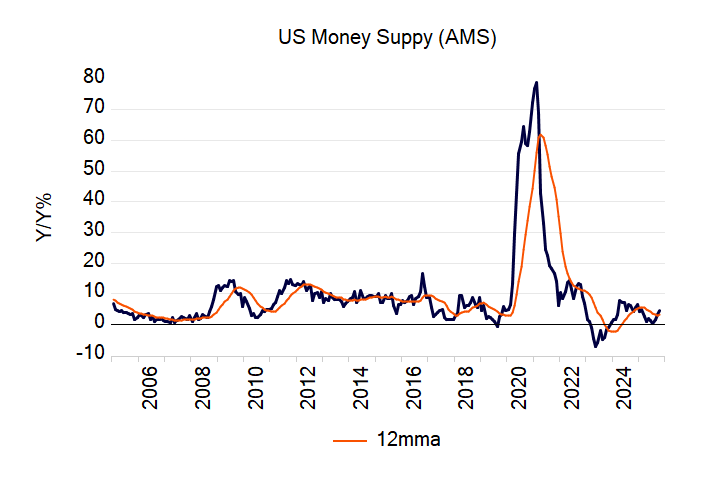
There is a high likelihood that due to the past large decline in the yearly growth rate of the money supply, the US economy is heading towards an economic bust. Note that the yearly growth rate of money supply fell from 79% in February 2021 to minus 7% by May 2023.
The sharp decline in the yearly momentum of money supply is starting to hurt various activities that emerged on the back of the huge increase in the money supply yearly growth rate between August 2019 and February 2021 – from minus 1% to 79%. It is likely that the effect of this massive increase is still dominating the present state of economic activity. (see chart).
As time goes by however, the effect of the huge decline in money supply growth is increasingly likely to assert itself on economic activity.
As a result, various bubble activities are likely to crumble. The reason for this is that the diversion of savings to them from wealth generators will weaken due to the decline in money supply growth. Consequently, various bubble activities will be deprived of the diverted savings they have relied upon in order to grow and survive. (We define a bubble as activity that emerged as a result of an expansionary monetary policy of the central bank.)
Projects that have emerged because of the expansionary policy of the central bank and the resulting money creation by the commercial banks might be impressive in nature and scale – such as the artificial intelligence (AI) capex boom – but these projects might not be affordable. What determines the affordability of these ventures is the state of the subsistence fund.
The essence of the subsistence fund
Most goods that individuals require to support their lives and well-being are not readily available from nature. These goods have to be produced by transforming various things in nature into goods that individuals can use. This transformation undergoes various stages.
In an economy which operates in the framework of the division of labor, some individuals are employed in the extraction of various raw materials such as coal and iron. Some other individuals are employed in the alteration of raw materials into various tools and machinery. Whereas some other individuals are employed in the transformation, by means of the tools and machinery, of various goods into consumer goods.
Note that individuals employed in the various stages of production must have access to consumer goods in order to support their lives and well-being. This access to consumer goods is possible because of savings, which are the amount of consumer goods produced in excess of the consumption of these goods.
Note that the saved consumer goods support individuals in all the stages of production, from the producers of consumer goods to the producers of raw materials and the producers of tools and machinery. The stock of saved consumer goods is the “subsistence fund”.
Observe that if the production of consumer goods were to increase, all other things being equal, this would permit an increase in savings and hence an increase in the subsistence fund. This in turn would permit the expansion of productive infrastructure.
An expanded subsistence fund enables individuals to introduce new stages of production which, prior to the expansion of the fund, could not be undertaken. This in turn permits the production of a greater quantity and a greater variety of consumer goods.
In addition, once there has been an adequate increase in the pool of consumer goods, individuals would then be in a position to aim at further enhancing their wellbeing by seeking things such as entertainment and services related products – such as medical services etc. (Note that the subsistence fund supports the lives and wellbeing of various individuals that are providing entertainment and various services).
The size of the subsistence fund sets the limit on the projects that can be implemented. Note again that in order to maintain their lives and wellbeing human beings require access to consumer goods.
On this, Richard von Strigl wrote:
Let us assume that in some country production must be completely rebuilt. The only factors of production available to the population besides labourers are those factors of production provided by nature. Now, if production is to be carried out by a roundabout method, let us assume of one year’s duration, then it is self-evident that production can only begin if, in addition to these originary factors of production, a subsistence fund is available to the population which will secure their nourishment and any other needs for a period of one year……..The greater this fund, the longer is the roundabout factor of production that can be undertaken, and the greater the output will be. It is clear that under these conditions the “correct” length of the roundabout method of production is determined by the size of the subsistence fund or the period of time for which this fund suffices.
According to Bohm-Bawerk:
The entire wealth of the economical community serves as a subsistence fund, or advances fund, and, from this, society draws its subsistence during the period of production customary in the community.
The size of the subsistence fund constrains the affordability of various projects such as AI. Note that the enhanced infrastructure is what sets in motion an increase in economic growth, all other things being equal. The improvement in the infrastructure in turn takes place as a result of the increase in the subsistence fund. Hence, anything that weakens the subsistence fund undermines the prospects for economic growth.
Consequently, regardless of how impressive various projects are, what determines whether these projects are viable is the state of the subsistence fund.
Introducing money
Money’s main function is to fulfil the role of the medium of exchange. Money does not sustain or fund economic activity but without the medium of exchange – .e. money – neither the division of labor nor the market economy could have emerged. (The existence of money enables individuals to specialize).
Individuals pay with goods and services they produce – they do not pay with money. Money only helps to facilitate payments. Money enables the goods of one specialist to be exchanged for the goods of another specialist. On this Mises wrote,
Commodities, says Say, are ultimately paid for not by money, but by other commodities. Money is merely the commonly used medium of exchange; it plays only an intermediary role. What the seller wants ultimately to receive in exchange for the commodities sold is other commodities.
By means of money, an individual can channel savings, i.e. unconsumed consumer goods, to other individuals, which in turn permits the widening of the process of wealth generation. Thus, a producer of a consumer good exchanges his saved consumer good for money. He can in turn exchange the received money for other goods and services. Note that by exchanging his savings for money he has supplied the other producer with his saved goods.
As things currently stand, it is likely that the yearly growth rate of the subsistence fund is under pressure. The key reason for this is the ever-growing government outlays and the relentless central
bank tampering with financial markets (see charts below). In April 2026 government outlays increased by almost 400% versus January 2000.
We suggest that the erosion of the subsistence fund through decades of money printing and distortion of market signals means that, individuals in the economy are currently not wealthy enough to pursue the current level of investment in activities such as AI.
Now, if the central bank were to aggressively lower the interest rates and lift the money supply growth rate this would make things much worse. Expansionary monetary policy undermines the subsistence fund further by weakening the wealth generation process.
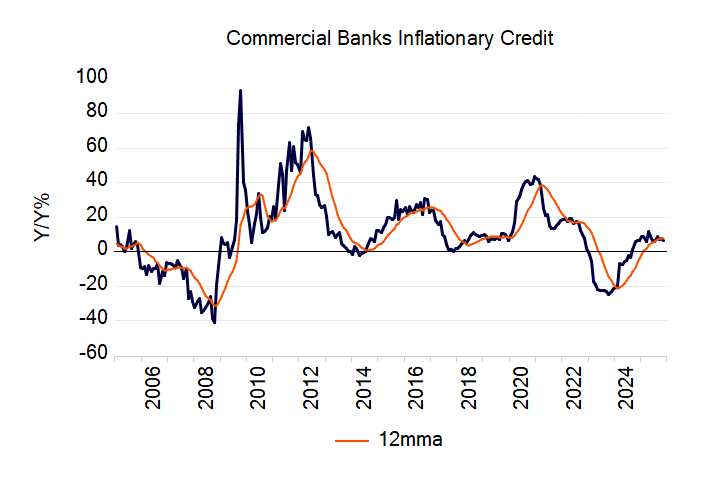
Furthermore, we expect the yearly growth rate of banks’ inflationary credit – i.e. lending not backed by savings or the lending out of “thin air” – to weaken in the months ahead.
As a result, the growth rate in the money supply is likely to follow suit. This is expected to put more pressure on bubble activities as they are starved of diverted savings.
To alleviate the likely economic crisis what is required is a reduction in the central bank’s tampering with financial markets and a large curtailment of government outlays. This would likely arrest the pressure on the subsistence fund.
Conclusion
As a result of the decline in the monetary growth during the February 2021 to May 2023, it is quite likely that the US economy is heading towards an economic bust. Various projects that have emerged on the back of the previously expansionary policy of the central bank during August 2019 and February 2021 might be of an impressive nature but, given the likely decline in the momentum of the subsistence fund, these projects might not be affordable. So, regardless of how impressive these projects are, they are bubble activities and therefore are likely to burst.