When institutions strain, behaviour adjusts.
By Elias Sanchez
Despite rising public debt, intensifying fiscal extraction, recurrent economic shocks, and heightened trade and policy uncertainty, the global economy has exhibited a striking degree of resilience. This resilience, however, goes beyond mere survival. It reflects a shift from robustness to what can be described as ‘antifragility’, where systems not only withstand shocks but gain from them. This dynamic adaptation is evidenced not just in headline GDP figures consistently surpassing pessimistic forecasts, but more profoundly in the way markets adapt and evolve in response to these challenges, becoming stronger rather than merely enduring.
Economic coordination has persisted through decentralised adjustment, entrepreneurial reallocation, and institutional workarounds that mitigate the frictions imposed by policy volatility and fiscal strain. This persistence has puzzled commentators and policymakers alike, who increasingly question how economic activity continues to expand under conditions that, in theory, should erode growth incentives, disrupt coordination, and weaken institutional stability.
Conventional explanations emphasise the AI boom, highlighting significant expectations associated with advancements in machine learning and automation. Proponents of this narrative, such as those from the International Monetary Fund, argue that these technologies are anticipated to drive productivity and profitability to unprecedented levels. According to reports in Reuters and the Financial Times, the enthusiasm is tempered by the risk of market correction should these gains not materialise as expected. Supporters of the AI boom claim that technological innovation, backed by robust macroeconomic management and effective institutional capacity, will provide the economic stability and political legitimacy necessary to navigate these transitions.
But these explanations miss the hidden world of quiet adaptation, where everyday people find subtle ways to sidestep, reshape, and outmanoeuvre the systems that try to squeeze them. Imagine a small community market where vendors silently adjust prices in response to fluctuating costs of goods, or neighbours bartering homegrown produce and handmade crafts, bypassing cash transactions entirely. These micro-adjustments deepen the concept of quiet adaptation, anchoring it in everyday routines before scaling the impact globally.
One explanation lies in what the political scientist James Scott once called “everyday resistance”, which provides a powerful framework for understanding this resilience. By extending Scott’s insights beyond their original agrarian contexts, this article conceptualises human action, tax resistance, informality, and parallel markets as stabilising processes operating within the global political economy—processes that sustain economic life precisely where formal institutions appear overstretched or failing.
Resilience Without Legibility: How Everyday Economic Resistance Sustains the “Teflon Economy”
The core idea is straightforward: it is the daily acts of quiet resistance that have softened the blow of bad policies. Crisis after crisis, the system bends but does not break, kept afloat by the steady undercurrent of everyday defiance.
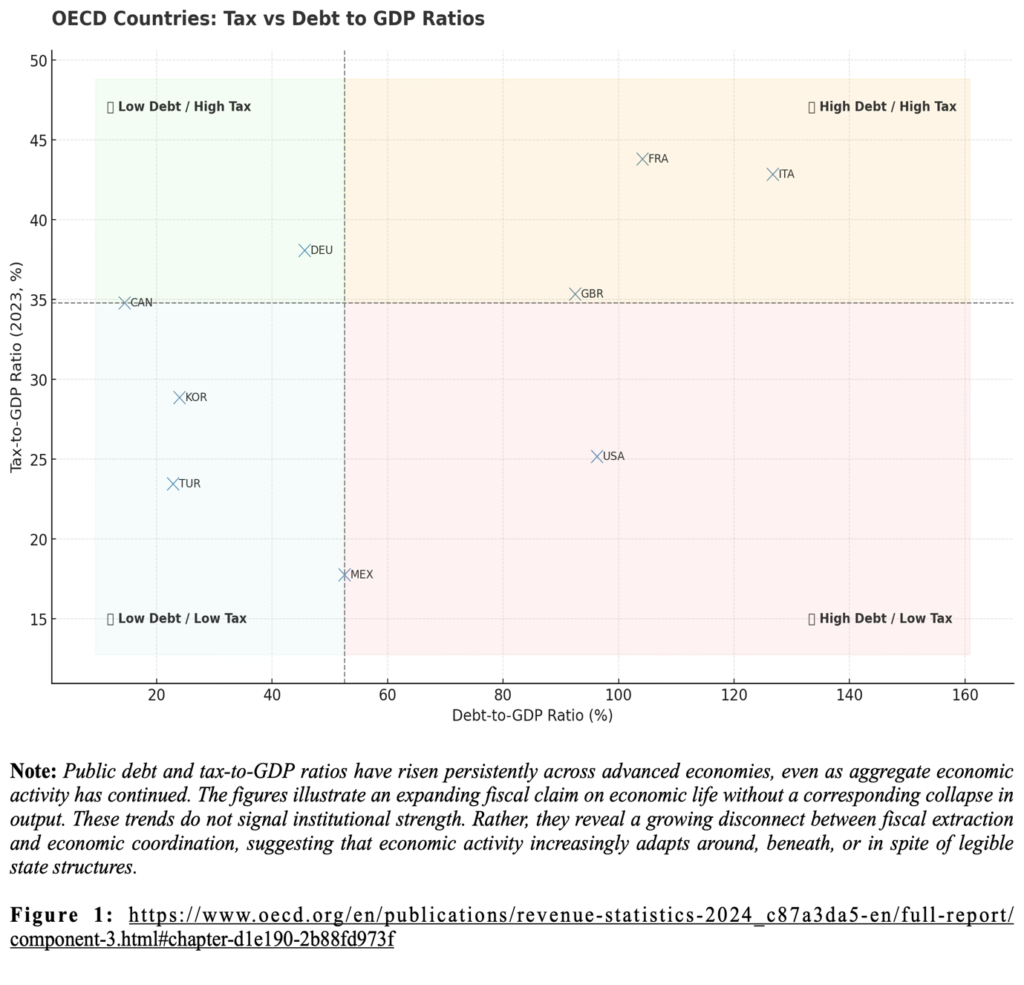
This means that, despite rising public debt and tax-to-GDP ratios, as illustrated in Figure 1, the economy continues to function. This resilience is not merely a temporary stickiness or a matter of good fortune; rather, it suggests a deeper structural property inherent in the economic system that actively repels shocks. The political class’s attempts to make economic action legible in aggregate terms inadvertently highlight this structural resilience. These consequences contribute to the problem that The Economist has mentioned regarding the “Teflon economy”. From this perspective, day-to-day resistance is precisely what keeps the “Teflon economy” running: an economy where adverse conditions do not seem to have lasting negative effects, allowing it to keep growing despite shocks that, theoretically, should slow it down.
The Economist states that “the resilience of the world economy may flummox market liberals”. However, this confuses all market liberals equally. Javier Aranzandi, an economist, in his work the Philosophical Foundations of Economic Reality identifies two types: ‘Equilibrium Economists’ and ‘Social Market Advocates’. Equilibrium Economists believe in markets devoid of societal context, focusing on static equilibrium models that ignore the complexities of real-world economic processes. In contrast, Social Market Advocates see markets as inherently linked to societal dynamics, emphasising the informal and often overlooked segments of the economy that truly drive it. These advocates recognise markets as social processes rather than abstract models and understand that growth can occur beyond what GDP numbers suggest or where state policies impose heavy burdens on entrepreneurs.
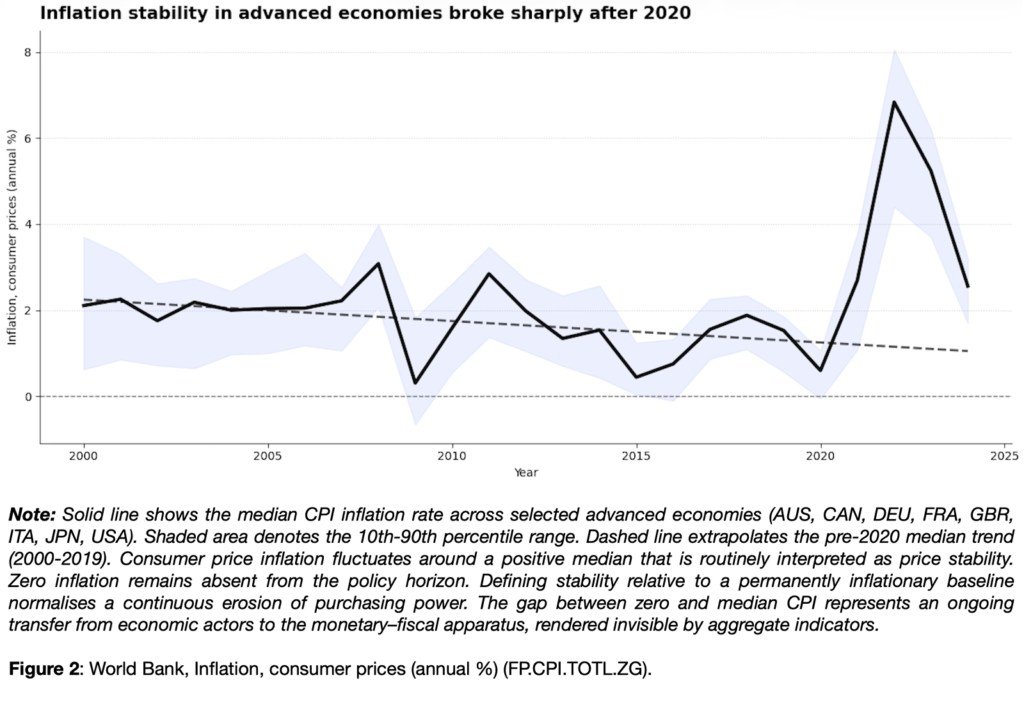
Figure 2: World Bank, Inflation, consumer prices (annual %) (FP.CPI.TOTL.ZG).
Note: Solid line shows the median CPI inflation rate across selected advanced economies (AUS, CAN, DEU, FRA, GBR, ITA, JPN, USA). Shaded area denotes the 10th-90th percentile range. Dashed line extrapolates the pre-2020 median trend (2000-2019). Consumer price inflation fluctuates around a positive median that is routinely interpreted as price stability. Zero inflation remains absent from the policy horizon. Defining stability relative to a permanently inflationary baseline normalises a continuous erosion of purchasing power. The gap between zero and median CPI represents an ongoing transfer from economic actors to the monetary–fiscal apparatus, rendered invisible by aggregate indicators.
Mainstream indicators characterise the period preceding 2020 as one of “inflation stability,” as illustrated in Figure 2. Such a framing, however, obscures a crucial distinction: the gap between zero inflation and median CPI inflation represents a persistent transfer of purchasing power, interpretable as fiscal extraction through monetary means. For those unable or unwilling to hedge against this process, inflation functions as a form of involuntary expropriation. Consider a household that visits the grocery store to find that the same budget no longer covers the usual basket of goods; staples like bread, milk, and vegetables have increased in price without a rise in their income. This everyday reality vividly illustrates the impact of inflation as it erodes purchasing power and forces families to make difficult choices. As a monetary phenomenon, inflation expresses this dynamic with particular clarity. Policymakers, structurally dependent on monetary expansion, remain unable to disengage from the mechanisms of credit creation and monetary financing, generating institutional overload. As these pressures accumulate, economic freedom erodes, with constraints on entrepreneurial and business activity following in turn.
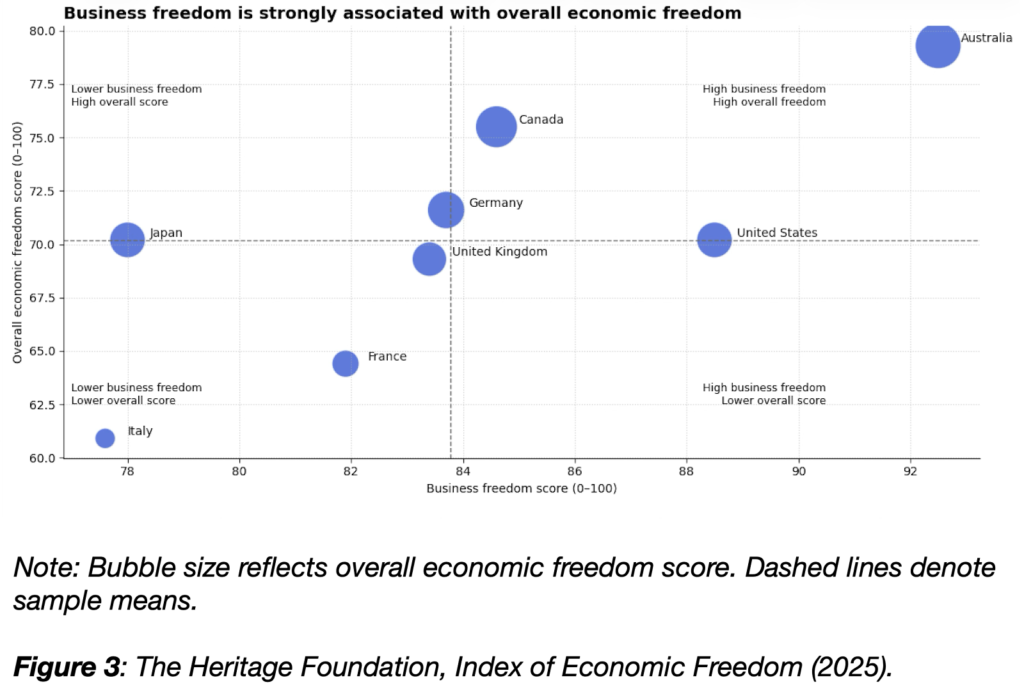
Figure 3: The Heritage Foundation, Index of Economic Freedom (2025).
Note: Bubble size reflects overall economic freedom score. Dashed lines denote sample means.
Still, the economy endures. Underneath the surface, a quiet entrepreneurial resistance keeps things running through constant innovation and adaptation—right where you would least expect resilience to thrive. This begs the question: how does the global economy keep going when its official pillars look so shaky? Most theories fall short. They focus on big-picture policies, powerful institutions, and political legitimacy, but consistently ignore the shadowy, everyday actions that keep the wheels turning. By spotlighting elites and official channels, mainstream analysis misses the unsung adaptability of ordinary people who keep the economy alive in ways that rarely make the headlines.
In southern Europe, it is the cash-only deals, characteristic of economies where regulation creates significant barriers for formal business operations, prompting individuals to navigate these financial hurdles informally. In Latin America, the bustling street markets represent a cultural mainstay where entrepreneurship thrives amid varying levels of economic stability. In wealthier nations, the silent surge of freelancers and gig workers reflects a response to high entrepreneurial scope and advancing technologies that support remote and flexible forms of employment. These distinctions highlight how different socio-economic contexts shape the ways people adapt to and sustain their economic environments.
The Quiet Defiance That Sustains Capitalism
One explanation lies in what James Scott once called, everyday resistance”, originally formulated in his studies of subordinated political groups, particularly peasants in Asia. Scott conceptualised everyday resistance as a rational, low-risk strategy through which subordinate groups contest domination when open confrontation would be suicidal. In contrast to direct rebellion against an increasingly expansive state—one that has grown over time with few effective constraints—everyday resistance operates quietly, informally, and incrementally.
Scott described these practices as a “genuine form of class struggle”, despite their lack of formal organisation. Unlike political parties, pressure groups, or syndicates, these forms of resistance do not rely on structured representation or explicit ideological mobilisation. Those who engage in them typically lack formal political voice; their interests are marginalised, their representation negligible, and their position within the political economy unstable. Yet this ostensibly invisible group—composed of common-sense individuals who appear as statistical outliers within formal systems—produces cumulative and enduring effects that contribute to economic stability.
Everyday resistance, in Scott’s framework, is characterised by being low-risk, informal, non-confrontational, and survival-oriented. It provides a lens through which economic coordination can be analysed beyond the confines of formal politics and institutionalised participation. The nature of these practices lies in “low-visibility acts” aimed at reducing state or Leviathan exploitation, constituting a largely ignored form of resistance in political science, one that departs from classical notions of overt class struggle. Such resistance depends on shared social coordination and targets material appropriation, often grounded in the defence of private property understood as a source of dignity and autonomy, whether in tangible or intangible forms. Over time, these practices reshape power relations without requiring organisation, ideology, or open revolt.
Even in their apparent disorganisation, those who engage in everyday resistance are unified by a shared purpose: to obstruct elite appropriation under conditions of unequal power. This occurs through informal coordination, community complicity, and moral legitimacy, rather than through formal confrontation or institutionalised organisation. A form of resistance forgotten in political science.
The Economy’s Silent Exit Option
Scott’s framework can be extended from agrarian politics to the global political economy, and from peasant resistance to contemporary forms of economic resistance such as tax resistance, informality, parallel markets, and the evasion of the written record. In this context, tax resistance constitutes a form of everyday resistance that succeeds not through protest or formal organisation, but through quiet, coordinated non-compliance. A concrete example of this exploitation is the administrative bottleneck of tax audit capacity. With limited resources and personnel, tax authorities cannot scrutinise every transaction or taxpayer thoroughly, leaving gaps that everyday resistance can navigate. This is grounded in shared norms of fairness and effort, exploits these enforcement limits, and leaves formal authority symbolically intact.
In Western economies, this resistance is reflected in the routine extraction of income through monthly payroll deductions—often weakly accepted by workers facing limited alternatives, as the perceived returns on public services diminish. In non-Western contexts, it manifests more visibly in bazaars and parallel economies, where informality operates as a form of resistance to institutional arrangements that Western societies have largely accepted by default. This encompasses a mass refusal to participate fully in systems of organisation perceived as having failed, yet sustained through public debt. Within this framework, everyday resistance consists of evading, or attempting to evade, the written record. In a historical example, Scott observed that under state socialism, agrarian resistance frequently took the form of quiet non-cooperation: withdrawing effort, concealing output, and undermining extraction unless the state responded with overwhelming coercion. In many contemporary contexts, where local knowledge circulates between rulers and ruled but rule-making remains monopolised by elites, resistance does not exist outside power, but within the narrow spaces created by competing schemes of governance.
Formal authority in the global economy—when institutionally sanctioned and legally codified—is exercised through offices and procedures, whether in Downing Street, the White House, the Palacio de Gobierno in La Paz, the Palacio de Miraflores in Caracas, or the Casa Rosada in Buenos Aires. Its effectiveness depends less on coercion than on subjects’ willingness to cooperate. Where such cooperation erodes, the structure of formal authority weakens.
How Resistance Stabilises the System
Everyday acts of resistance quietly anchor and sustain the global economy, especially when fiscal pressures mount, institutions falter, and political voices fade. These acts are not grand revolutions but subtle manoeuvres within the boundaries of power. As the AI bubble swells with controversy, the irony of ‘order through disobedience’ both upholds and challenges the system. This paradox reveals how ordinary defiance can both disrupt and reinforce the very structures it resists.
It is not smarter policies that keep the world economy afloat, but the quiet choices people make every day. When taxes rise, money wobbles, and rules tighten, people do not take to the streets. Instead, they adapt—redirecting their energy, tucking away income, moving into the shadows, and quietly stepping back from systems that no longer serve them.
Every day, resistance quietly changes the world, all while giving a nod to the very systems it subverts. Open rebellion only surfaces when this quiet disguise can no longer hold. Beneath the global economy’s surface, a silent majority keeps things running and evolving, no matter how chaotic or misguided official actions become. What looks like informality or rule-bending is not a fringe activity, but the hidden engine that keeps economic order alive.