Economics

Recovery surprises leave markets floating on air – Times Online

The distinguished writer and economist for the Sunday Times, David Smith, on the 30th of August in this article wrote the following;

Why have stock markets risen so strongly? It has been a two-stage process. The initial spurt from the dark days of early March came with a realisation that the world was not entering a second great depression (third if you count the end of the 19th century) and that not all banks would have to be nationalised. Markets were priced for disaster and decided this had been averted.

The second leg has been driven by good figures. “Economic data generally continue to be better than expected, which suggests that we are emerging from the longest and deepest recession” says Bob Doll, chief equity investment officer at Black Rock.

So it would appear that to this economist the FTSE moves only because of expectations about the future. This may well be part of the case, but as I have argued here, it is the state of liquidity that determines the great movements in the stock market indices. The Bank of England has expanded its balance sheet by some 158% since September of last year. This massive amount of liquidity coupled with the £175 billion of Quantitive Easing, has to go somewhere in the economy. If people’s demand to hold money remains the same, those recipients of all this excess liquidity can only but spend it!

To recap, I wrote:

  • “Money is the medium of exchange. It is the most marketable of all commodities that facilitates the exchange of one person’s goods and services for the other person’s goods and services.
  • Since the economy has slowed, it must follow that there is less production of goods and services to exchange for money. This has the effect of suppressing the prices of those goods and services.
  • Conversely when the economy is booming and more production is facilitating more demand for money to exchange for more of those goods and services, you would expect to see prices rising.
  • If we have a given demand for goods and services, even if it is a suppressed demand, such as it is in the economy of today (in Recession / Depression) and there is a sudden increase in the supply of money, such as has happened with the stunning 158% rise in the Bank of England’s Balance Sheet, certain peoples monetary liquidity has dramatically risen. To start the process of eliminating this surplus liquidity, it would seem that money has moved into near liquid markets such as the various stock exchanges of the industrialized world when the practice of massive money pumping has taken place.”

I also wrote,

If more money exists today than yesterday then all other things being equal, we can deduce that there is a surplus of money in relation to money demanded. What happens to this surplus? The only way to get shot of a surplus of money is to spend it. This spending increase prices of the goods and services that it is being spent on. One of the most liquid places for you to spend this surplus is to put it in near liquid assets such as highly traded shares. As excess liquidity builds up all over the world, over and above money demanded, we see various stock exchanges rising. In a separate article, our colleague Sean Corrigan points out that the huge increase in M1 in China has set the Shanghai Composite reaching for the top of Mount Everest!

We should always remember that we describe as an asset bubble a large increase in the price of those assets. A price is the amount of pounds Sterling we pay for our assets. This is the same as saying an asset bubble is a large increase in the payment of pounds Sterling for these assets. So the larger the monetary footprint in the economy, the more Sterling paid for things. Certainly this was the case for the Housing Boom and if the FTSE continues in its rise, I strongly suspect that this is the case here.

David Smith then continues to say,

We should not read too much into share prices. One thing we have learnt during this crisis is that markets are skittish, and hugely influenced by confidence and mood. There are solid economic reasons why the stock market has risen, however. Cazenove, taking the bull by the horns, says there is still plenty of value in British shares and limited downside risks.

The key influences on markets will be surprises. On the plus side, markets have priced in a recovery, both in Britain and globally. On the minus side, that recovery is expected to be weaker than usual, because of the banking system’s long period of convalescence, tight credit and a throbbing fiscal hangover that will require years of tax increases and public spending cuts.

Where the stock market goes depends on where the news comes in relation to these expectations.

To a certain extent I do not disagree with this. I would qualify this by saying that the above sentiments are what causes the FTSE to extend from trend, but not the cause of the trend. So what is the cause of the large movements in the stock exchange?

My contention is that it is the rate of monetary pumping into the economy that creates excess liquidity. If you can actually define money and count it, you can see the effect of excess money pumping very clearly. My co authoured working paper cited here shows the correct way to count money and what the problems are with the traditional M0 / M4 measures. I am very glad we have created a lot of interest on the Social Science Research Network. We then introduce MA or Money Actual, sometimes called the AMS, Austrian Money Supply, it shows a very convincing correlation to GDP and retails sales.

Changes in MA +24 months and GDP

Changes in MA +24 months and GDP

Changes in MA and retail sales

Changes in MA and retail sales

Here we add the correlation with FTSE:

Changes in MA and the FTSE

Changes in MA and the FTSE

As you can see, the broad movements in the money supply effect the FTSE. As people have more liquidity in relation to their money demand, it moves into liquid markets. Liquid markets such as FTSE and as Corrigan shows, the Shanghai Composite, rise. This applies to virtually any of the stock markets of the world. The government is the monopoly issuer of money or currency and privately created bank credit can only exist on the scale it does by the granting of special legal privilege to bankers to not keep their creditors whole at all points in time. As these vital functions are controlled in full by the State, it should come as no surprise that the main influence on FTSE is the prevailing surplus liquidity of the day, first and foremost, then investor sentiment.

Further Reading

Economics

Baxendale and Evans make the SSRN top ten

On 26 August 2009, Baxendale and Evans’ paper Assessing UK Money Supply Measures in Light of the Credit Crunch made the top ten papers of the past sixty days on the Social Science Research Network. From the abstract:

Following the credit crunch renewed attention has been given to the relationship between the money supply and the operational efficacy of the Bank of England. We present a theoretical definition of the money supply developed by Frank Shostak, called “Austrian money supply” (MA) and present calculations for the UK economy. We find preliminary evidence that MA provides a constructive interpretation of broader macroeconomic activity and warrants further attention from academics and policymakers.

Changes in the actual money supply and retail sales

Changes in the actual money supply and retail sales

The paper can be downloaded here and our article presenting the background and key findings may be found here.

Congratulations Toby and Anthony!

Economics

Tangible Ideas – Goodbye to All That

Tangible Ideas

Tangible Ideas

By kind permission of Sean Corrigan, we reproduce his report Tangible Ideas – Goodbye to All That, in which he explains the end of an economic era.

Consider German revenues:

German Revenues

German Revenues

The sheer violence of this reversal of fortune – something akin to the sudden, mortal swoop of a melted‐wax Icarus after long hours of patiently spiralling heavenward on the thermals rising off the Cretan coast ‐ has perplexed everyone from Her Britannic Majesty and her hapless First Minister to the fallen idols of investment practice, like Bill Miller and Bruce Bent – yet while its pattern may be a complex tangle of circumstances, there are, in truth, only a few basic threads in the weave, all of them very familiar to those with an Austrian perspective on the case: fiat money, gross government interference with markets, and the avid, rent‐grubbing irresponsibility it fosters in everyone involved from the most prominent financial flesheater to the most pathetic, Forgotten Man structured‐product stuffee.

And malinvestment arising from the system of money:

Malinvestment Defined

Malinvestment Defined

The reason [the nature of modern money] has been so pernicious is that it has circumvented the very business of reserve management and so has turned what should be the semi‐automatic self‐equilibration of the classical specie‐flow mechanism into a positive feedback of ever wider current account gaps, ever more profound misallocation of capital, ever more inflation ‐ albeit one masked in terms of finished good prices, as we have already seen, by the supply side impact of shifting production to where labour is cheap and the local politburo is happy to connive with its buddies in the state‐owned enterprises to provide near‐costless finance, inexpensive land, export tax incentives, and even subsidised utilities to a producer who is therefore relatively indifferent to the price he has to pay for his commodity inputs (remember those relative price trends we discussed earlier).

In a fair system, based on a proper, hard currency, the country running a deficit settles up by losing the bullion on which its circulation is based: domestic credit then contracts, prices fall, activity shifts to import substitution, and competitiveness is hence restored – an adjustment quickened by the fact that equal and opposite changes are taking place in the surplus country. ‘The monetary sin of the West’, however (to employ another Rueffism), is that while the surplus country today uses its excess foreign exchange receipts to expand the stock of high-powered money at home and so triggers its own production‐lengthening cycle, it simultaneously loans those same receipts straight back to their creators, preserving their credit pyramid in turn and thus encouraging them to continue their gross overconsumption.

Adding to the dangers, the deficit nation central bank sees the low‐price imports and artificially stabilized exchange‐rate as helping achieve its monophthalmic goal of suppressing ‘inflation’ which – being typically mainstream in its analysis – it imagines to consist only of rises in its favourite (usually pared) consumer price index. It is thus perilously predisposed to running far too loose at the same time as its foreign counterpart is relaxing, all despite the obvious warning sign which the trade deficit itself constitutes, namely, that demand has already outstripped the potential for domestic output to meet it.

Inevitably, in the over‐financed, speculative milieu in which we live, the excess credit thus called into existence soon spills over into asset markets (whose inordinate rise does not at all figure in the wholly naïve policy settings being followed) and so begins that unstable spiral of financial convection which sees notional net worth increasing and effortlessly generating the fresh collateral which will form the basis for yet more asset price‐boosting loans in the next iteration. Tempted by the capacity to engineer illusory and prematurely capitalised ‘profits’ in such a conducive current, the ever more hubristic bankers – by now not so much on Cristal Roederer as on crystal meth (metaphorically speaking, of course) – soon allow their hired‐in, mathematical idiot savants to ferret out highly explosive ways to cheat shareholders and regulators of due disclosure and so arrange to heap a Pelion of non‐linearity upon an Ossa of over‐leverage and undercapitalization.

And on the role of credit in the crisis:

Perhaps the quickest and cleanest way to show this was indeed the case is to look at the behaviour of the BIS series for member‐country banking balance sheets over the relevant periods. Indeed, if we consider that inflation – i.e. excess money creation – is, these days, primarily an increase in (demand) liabilities at banks, it is instructive to look at the explosion in their size (here, strictly speaking, we have performed our calculations on the other side of the balance sheet for convenience, but the difference is not significant).

BIS Bank Asset Inflation

BIS Bank Asset Inflation

In the 3 ½ years to the March 2008 quarterly peak of $40 trillion, total banking claims grew virulently at a ~22% compound annual rate, achieving the fastest nominal doubling in a three‐decade data series. Though it took a while for consumer prices to respond, if you wanted inflation (properly defined), you certainly had it in spades going into the Crash!

And, concluding:

The market may have to suffer a nasty bout of disillusion before it reconciles itself to the fact that the halcyon days are long gone and that the clock is everywhere ticking toward a reckoning with the government debt market.

Economics

FT.com / Comment / Opinion – The risk of a double-dip recession is rising

Writing in the Financial Times, Nouriel Roubini, professor of economics at the Stern School of Business, asks questions which chime with The Cobden Centre:

T he global economy is starting to bottom out from the worst recession and financial crisis since the Great Depression. In the fourth quarter of 2008 and first quarter of 2009 the rate at which most advanced economies were contracting was similar to the gross domestic product free-fall in the early stage of the Depression. Then, late last year, policymakers who had been behind the curve finally started to use most of the weapons in their arsenal.

That effort worked and the free-fall of economic activity eased. There are three open questions now on the outlook. When will the global recession be over? What will be the shape of the economic recovery? Are there risks of a relapse?

via FT.com / Comment / Opinion – The risk of a double-dip recession is rising.

As we have explained, injecting new money cannot create sustainable prosperity, but only an artificial boom. Our escape lies not in printing more money, but in a paradigm shift in economic thinking.

Economics

Strip the Bank of England of its power | Jamie Whyte – Times Online

Writing in The Times on 2 July 2009, Jamie Whyte called for the Bank of England to be stripped of its power to set interest rates.

Via Strip the Bank of England of its power | Jamie Whyte – Times Online :

Mervyn King, Governor of the Bank of England, complained recently that he lacked the powers required to fulfil his new statutory role of ensuring stability in the banking system. A more powerful Bank of England would do a better job.

He is wrong. The economy would benefit from a weaker Bank of England, stripped of its principal power: namely, the power to set interest rates. This is not intended as a criticism of Mr King or of the other members of his Monetary Policy Committee. No one should be allowed to set interest rates.

Read more.

Economics

Bailing out the Banks – Glaring Evidence of Moral Hazard

Gordon Kerr, a banker with expertise in derivatives and foreign exchange, explores the evidence of moral hazard in the bank bail outs.

By rescuing the banks with taxpayers funds the Government won the approval of many who were horrified at the prospect of repeats of the TV footage of depositors queuing to try and take their money out of the first failure, Northern Rock.

Whilst the protection of depositors is to be welcomed, that protection could have been achieved by the adoption into the UK banking business model of the ‘honest money’ policies familiar to frequent visitors to this site.

What commentators dwelt less on at the time of the UK bailouts were the distortive effects on the market of continuing taxpayer support. The market’s cries for the emergence of new brands, perhaps even the revival of the genuinely mutual template, remain stifled. Why would depositors choose such new brands when the old mismanaged failures enjoy a government guarantee, albeit in some cases implicit rather than explicit?

If the frightening consequences of the new era of zombie banking were not plain enough, the report in today’s Daily Telegraph by Philip Aldrick removes any iota of doubt:

Northern Rock should not be allowed to complete a planned restructuring without paying financial penalties, Britain’s building societies have told European competition regulators, on the grounds that the nationalised mortgage lender will otherwise have an unfair advantage.

Northern Rock is planning to split into a “good bank”, BankCo, which will continue to lend, and a “bad bank”, AssetCo, which will house and run down the bad loans. The BSA, which represents Britain’s mutual lenders including Nationwide, said the break-up will allow BankCo “to lend freely, without having to absorb losses from non-performing loans, unlike all of its competitors”.

Northern Rock has one of the worst lending records of all UK banks. Some 39pc of its £62bn of mortgages are in negative equity, and it made a £724m loss in the first half on the back of £602m of bad debts. Without hiving off the loss-making mortgages, Northern Rock would only be able to lend profitably by charging uncompetitively high rates.

The lender has stressed, however that the restructuring is in taxpayer’s best interests as it will allow the bank to operate without further capital injections.

– via Mutuals fear Rock plan will distort market – Telegraph.

In Scandinavia, in the early 1990s, mass bank failures were resolved by the ringfencing and liquidation of ‘bad’ assets in ‘bad banks’ to enable the brands to continue with the performing loans or ‘good’ assets.

The difference between Scandinavia then and the UK now is twofold: firstly the scale of the failures was small – the banks were restored by the excision of a relatively modest amount of nonperforming property loans; secondly the miscreant senior managers were pursued in the courts for personal restitution. It is worth noting that in today’s money the average annual compensation of very senior bankers in Northern Europe at that time would have been around the £100,000 mark. Whatever restitution funds were actually extracted were clearly therefore meaningless when measured against the taxpayer cost of the bailouts.

However the pursuit of those deemed responsible dealt with the worst possible consequence of the bailout, moral hazard. This pursuit removed any temptation that the next generation of bankers might otherwise have sensed to overleverage their banks in reliance on the state on the basis that they personally would have nothing to lose.

The Northern Rock ‘good bank’ will continue with the state guarantee. Rather than emphasise the importance of ending this or paying for it, Northern Rock believe that the continuance of the guarantee is in the taxpayer’s best interests since it “will allow the bank to continue to operate without further capital injections.” The failure of the spokesman to make any reference to the source of such future “capital injections” (you and me), or to imply any doubt that such ‘further capital’ would be available if required, is staggering. The most worrying aspect of the quotation is the apparent absence of irony.

All UK big banks are now explicitly, not just implicitly, state guaranteed. That is why sterling has fallen, entrepreneurialism hindered, and bank shares have risen. Certain Parliamentarians have invoked the term “casino banking” to summarise the banking malpractice that has created the failure (nobody really believes the ‘global crisis’ explanation beloved of the PM).

The UK holy trinity of treasury, regulator and central bank have not only failed to deal with the moral hazard point, their actions have sadly exacerbated it. Senior bankers are enjoying the highest levels of compensation with even less personal risk than before.

Unfortunately for the trinity however, market forces remain at work. The authorities’ failure to even recognise, let alone address, the moral hazard issue regrettably enhances the probability of a new wave of ‘casino banking’ failures.

An afterthought — moral hazard defined

Moral hazard refers to the idea that certain types of insurance systems might cause individuals to act in a more dangerous way than normal, causing a difference between the private marginal cost and the marginal social cost of the same action.

– S Ross, ‘The Economic Theory of Agency: the Principal’s Problem’, American Economic Review, vol. LXIII (1973), 134-39

Press

Don’t just howl with rage. | Jonathan Freedland | The Guardian

The Guardian indicates the level of bonuses being paid by bailed-out banks and encourages the growth of credit unions.

Here’s a figure to chew on, though you may find yourself choking. It comes from the US, but there are similar numbers in the UK, too. Remember those banks that were so close to collapse, so desperate and needy they held out the begging bowl and pleaded with the taxpayers for help? Well, it turns out that nine of those banks – who between them trousered $175bn of the American public’s money in bailout funds – have fallen back into their old habits: last year they paid their top staff $32.6bn in bonuses.

via Don’t just howl with rage. Try an idea that does away with banks altogether | Jonathan Freedland | Comment is free | The Guardian .

Economics

The economic paradigm and its shift

The Economist

The Economist

There are three prevailing theoretical frameworks in economics: Vienna (Austrian), Cambridge (Keynes) and Chicago (Monetarist). Via the Mises Institute and Kuhn, we indicate an explanation for the entrenchment of the present system of thinking and point to a possible future development in economics.

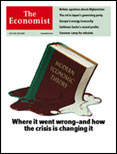
The Economist has had as a cover story What went wrong with economics and the Financial Times has asked What is the point of economists? We argue that in addition to the orthodox Monetarist and Keynesian economic frameworks, the Austrian School deserves attention. Moreover, with Murray Rothbard and the Mises Institute, we believe the science of economics is overdue a true paradigm shift: a change in basic assumptions.

Via Ludwig von Mises and the Paradigm for Our Age – Murray N. Rothbard – Mises Institute:

The fundamental paradigm, once established, is no longer tested or questioned, and all further research soon becomes minor applications of the paradigm, minor clearing up of loopholes or anomalies that still remain in the basic vision. For years, decades, or longer, scientific research becomes narrow, specialized, and always within the basic paradigmatic framework.

But then, gradually, more and more anomalies pile up; puzzles can no longer be solved by the paradigm. But the scientists do not give up the paradigm; quite the contrary, increasingly desperate attempts are made to modify the particulars of the basic theory so as to fit the unpleasant facts and to preserve the framework provided by the paradigm.

Only when anomalies pile up to such an extent that the paradigm itself is brought into question do we have a “crisis situation” in science. And even here, the paradigm is never simply discarded until it can be replaced by a new, competing paradigm which appears to close the loopholes and liquidate the anomalies.

When this occurs, there arrives a “scientific revolution,” a chaotic period during which one paradigm is replaced by another, which never occurs smoothly as the Whig theory would suggest. And even here, the older scientists, mired in their intellectual vested interests, will often cling to the obsolete paradigm, with the new theory only being adopted by the younger and more flexible scientists. Thus, of the codiscoverers of oxygen in the late 18th century, Priestley and Lavoisier, Joseph Priestley never — till the day he died — conceded that he had in fact discovered oxygen; to the end he insisted that what he had discovered was merely “dephlogisticated air,” thus remaining within the framework of the phlogiston theory.

And so, armed with Kuhn’s own paradigm of the history of scientific theories, which is now in the process of replacing the Whig framework, we see a very different picture of the process of science. Instead of a slow and gradual upward march into the light, testing and revising at each step of the way, we see a series of “revolutionary” leaps, as paradigms displace each other only after much time, travail, and resistance.

Furthermore, without adopting Kuhn’s own philosophical relativism, it becomes clear that, since intellectual vested interests play a more dominant role than continual open-minded testing, it may well happen that a successor paradigm is less correct than a predecessor. And if that is true, then we must always be open to the possibility that, indeed, we often know less about a given science now than we did decades or even centuries ago.

Because paradigms become discarded and are never looked at again, the world may have forgotten scientific truth that was once known, as well as added to its stock of knowledge. Reading older scientists now opens up the distinct possibility that we may learn something that we haven’t known — or have collectively forgotten — about the discipline. Professor de Grazia states that “much more is discovered and forgotten than is known,” and much that has been forgotten may be more correct than theories that are now accepted as true.

The answer — which obviously cannot be documented in the compass of this article — is simply and startlingly this: that Ludwig von Mises offers to us nothing less than the complete and developed correct paradigm of a science that has gone tragically astray over the last half century. Mises’s work presents us with the correct and radically divergent alternative to the flaws, errors, and fallacies which a growing number of students are sensing in present-day economic orthodoxy.

Briefly, Mises’s economic system — as set forth particularly in his Human Action — grounds economics squarely upon the axiom of action: on an analysis of the primordial truth that individual men exist and act, that is, make purposive choices among alternatives. Upon this simple and evident axiom of action, Ludwig von Mises deduces the entire systematic edifice of economic theory, an edifice that is as true as the basic axiom and the fundamental laws of logic.

The entire theory is the working out of methodological individualism in economics, the nature and consequences of the choices and exchanges of individuals. Mises’s uncompromising devotion to the free market, and his opposition to every form of statism, stems from his analysis of the nature and consequences of individuals acting freely on the one hand, as against governmental coercive interference or planning on the other.

For, basing himself on the action axiom, Mises is able to show the happy consequences of freedom and the free market in social efficiency, prosperity, and development, as against the disastrous consequences of government intervention in poverty, war, social chaos, and retrogression. This political consequence alone, of course, makes the methodology as well as the conclusions of Misesian economics anathema to modern social science.

In short, Mises shows that the market economy is a finely constructed, interrelated web; and coercive intervention at various points of the structure will create unforeseen troubles elsewhere. The logic of intervention, then, is cumulative; and so a mixed economy is unstable — always tending either toward full-scale socialism or back to a free-market economy. The American farm-price support program, as well as the New York City rent-control program, are almost textbook cases of the consequences and pitfalls of intervention.

The instability of the interventionist welfare-state system is now making fully clear the fundamental choice that confronts us between socialism on the one hand and capitalism on the other. Perhaps the most important single contribution of von Mises to the economics of intervention is also the one most grievously neglected in the present day: his analysis of money and business cycles. We are living in an age when even those economists supposedly most devoted to the free market are willing and eager to see the state monopolize and direct the issuance of money. Yet Mises has shown that

  1. there is never any social or economic benefit to be conferred by an increase in the supply of money;
  2. the government’s intervention into the monetary system is invariably inflationary;
  3. therefore, government should be separated from the monetary system, just as the free market requires that government not intervene in any other sphere of the economy.

Specifically, expansion of bank money causes an artificial lowering of the rate of interest, and an artificial and uneconomic overinvestment in capital goods: machinery, plant, industrial raw materials, and construction projects. As long as the inflationary expansion of money and bank credit continues, the unsoundness of this process is masked, and the economy can ride on the well-known euphoria of the boom; but when the bank credit expansion finally stops, and stop it must if we are to avoid a runaway inflation, then the day of reckoning will have arrived.

There is no more fitting conclusion to a tribute to Ludwig von Mises than the moving last sentences of his greatest achievement, Human Action:

The body of economic knowledge is an essential element in the structure of human civilization; it is the foundation upon which modern industrialism and all the moral, intellectual, technological, and therapeutical achievements of the last centuries have been built. It rests with men whether they will make the proper use of the rich treasure with which this knowledge provides them or whether they will leave it unused. But if they fail to take the best advantage of it and disregard its teachings and warnings, they will not annul economics; they will stamp out society and the human race.

Thanks in no small measure to the life and work of Ludwig von Mises, we can realistically hope and expect that mankind will choose the path of life, liberty, and progress and will at last turn decisively away from death and despotism.

Following Kuhn, Rothbard and Mises, we may be on the verge of a paradigm shift in economics as the inconsistencies, inappropriate simplifications and downright errors of current economic thinking reveal themselves.

Social progress depends upon it.

Further Reading

Economics

Where next for the economy?

Via Entering the Greatest Depression in History by Andrew Gavin Marshall, indications of the possible path of the global economy:

Entering the Greatest Depression in History by Andrew Gavin Marshall

While there is much talk of a recovery on the horizon, commentators are forgetting some crucial aspects of the financial crisis. The crisis is not simply composed of one bubble, the housing real estate bubble, which has already burst. The crisis has many bubbles, all of which dwarf the housing bubble burst of 2008. Indicators show that the next possible burst is the commercial real estate bubble. However, the main event on the horizon is the “bailout bubble” and the general world debt bubble, which will plunge the world into a Great Depression the likes of which have never before been seen.

Economics

Why is the FTSE going up?

FTSE 10 at YahooThe FTSE 100 Share Index has been riding high since it fell to a low of 3,512 on March 2, and continues to flirt with the 4,700 barrier. With the economic data being still so poor and underlying company results being very weak, why would this be so?

In the UK, we have seen, in the space of a year, the Bank of England Balance Sheet climb by 158%. This is in large part due to the £175 billion QE (Quantitive Easing – crudely speaking, printing money (Zimbabwe style) out of thin air) program. This is where in short, one arm of the government (the Bank of England) buys existing outstanding securities such as Treasury Bonds, that the other side of the Government, has issued to various creditors of the government with freshly minted cash, created out of thin air. This new money needs to ultimately be banked somewhere in the banking system. At the bottom of the banking system upon which all reserves of the banks sit, we have the Bank of England itself. Hence its balance sheet rises.

What happens to this new money?

If more money exists today than yesterday then all other things being equal, we can deduce that there is a surplus of money in relation to money demanded. What happens to this surplus? The only way to get shot of a surplus of money is to spend it. This spending increase prices of the goods and services that it is being spent on. One of the most liquid places for you to spend this surplus is to put it in near liquid assets such as highly traded shares. As excess liquidity builds up all over the world, over and above money demanded, we see various stock exchanges rising. In a separate article, our colleague Sean Corrigan points out that the huge increase in M1 in China has set the Shanghai Composite reaching for the top of Mount Everest!

What is Money Demanded?

  • Money is the medium of exchange. It is the most marketable of all commodities that facilitates the exchange of one person’s goods and services for the other person’s goods and services.
  • Since the economy has slowed, it must follow that there is less production of goods and services to exchange for money. This has the effect of suppressing the prices of those goods and services.
  • Conversely when the economy is booming and more production is facilitating more demand for money to exchange for more of those goods and services, you would expect to see prices rising.
  • If we have a given demand for goods and services, even if it is a suppressed demand, such as it is in the economy of today (in Recession / Depression) and there is a sudden increase in the supply of money, such as has happened with the stunning 158% rise in the Bank of England’s Balance Sheet, certain people’s monetary liquidity has dramatically risen. To start the process of eliminating this surplus liquidity, it would seem that money has moved into near liquid markets such as the various stock exchanges of the industrialized world when the practice of massive money pumping has taken place.

Does a stock exchange index reflect the value of the companies that make it up?

The monetary value of something is what the next person is prepared to pay for it. The stocks in the FTSE are no different. There as been a 30% increase in the value of the FTSE100 over the last 5 months, is this because underlying corporate earning have substantially, no, astronomically recovered? No, it is more to do with the fact that there is excess liquidity in the system created by the Government to provide the illusion of wealth. This is a dangerous policy to continue for the reasons mentioned here.

I would also suggest to any investor that they should watch the size of the Bank of England’s Balance Sheet as a key determinate in liquidity in the most liquid of markets such as the stock exchange. When the Bank starts to reverse its asset purchase program, this liquidity effect will start to unravel and put downward pressure on the Stocks. The only thing that will stop this unraveling is genuinely more production taking place, more efficiently with the given factors of production, by entrepreneurs in real business doing real things. This will create real demand for the service of money and real exchange for real goods and services that people want. We need to hope that the productivity gains that this recession is foisting on the private sector outpace the decline in liquidity that must happen when the Bank starts to reverse its process of QE.

See also